Cafe Witness

Wednesday, May 13, 2009

We Need a New Water Cooler

Now that Twitter has removed a feature they claim only 2% of their users were using (and which nearly everyone I follow has been complaining about, which I guess means we ARE that 2%), something has become clear:

We need a new water cooler.

Twitter is often described as a "virtual water cooler," serving as a gathering place for people who work remotely. It's where we who don't have officemates (or who don't care to speak with the same 10 people all week long) go to bounce ideas off people half a world away, in real time, with minimal obligation or investment of attention.

But when the service terminates one of its own best reasons for existing -- the ability to stumble across other users via "fragmented conversations" (a functionality, it should be stressed, that THE USERS THEMSELVES invented) -- it becomes clear that Twitter is less concerned with serving the needs of its core users than it is with appealing to the masses. (After all, the masses bring the money; the 2% do not.)

And when the service then schedules planned downtime at noon PST on a Wednesday, those of us who rely on it for our daily conversation stream realize it's time to create a backup plan.

You wouldn't keep every document you own on one hard drive, thus stranding yourself if it crashes. So why are the bulk of our conversations contained within one service?

Seduce me, Facebook. Dazzle me, Plurk. Rise from the dead, Jaiku, and provide for us a valid alternative to the service that no one wanted until everyone had to have it.

Image by dennis.

Labels: , , , , , , , , ,

Monday, May 04, 2009

Your Customer Is Not Your Problem

Black humor - customer service

Two very different experiences this past week have taught me a lot about the value of positive customer service -- and the need to create a workplace environment that encourages and sustains it.

When Good Road Signs Go Bad

A week ago, I noticed that the five-way stoplight at the Forward and Murray Avenues intersection of Pittsburgh's Squirrel Hill neighborhood was broken. One of the light's cycles -- the side that faces traffic coming off the I-376 exit -- was lasting at least 2-3 times longer than it normally does. This is odd because that's usually NOT a high-traffic approach; it also extends the wait time for those on Murray Avenue, which results in 8-block traffic jams during rush hour.

So I contacted PennDOT, informed them of the problem (via email form), and someone wrote me back within a day to explain that traffic lights are the concern of the municipality, rather than the state. They also said they'd forward my email to the Pittsburgh traffic office -- which, I'll admit, is where I thought this story would end.

Today, I received the following email from Amanda Broadwater, P.E., Municipal Traffic Engineer for the City of Pittsburgh's Department of Public Works - Bureau of Transportation and Engineering:

Dear Mr. Kownacki,

Within the State of Pennsylvania, traffic signals are the jurisdiction of the City. Therefore, the Pennsylvania Department of Transportation forwarded your comment to us regarding the intersection of Forward and Murray in the Squirrel Hill neighborhood.

The City of Pittsburgh has identified [that] loop detectors are malfunctioning at the intersection. This type of problem happens often during wet weather. When this occurs, the maximum time allotted to the approach with the bad loop is displayed during each cycle, rather than the green time being traffic responsive. Obviously this creates greater delays on the other approaches of the intersection.

The electricians will be back on site today to try and remedy the problem. However, it may be necessary to completely replace the loop detectors. If this is the case, a timing change will be needed to ease congestion during preparation of the work. If a timing change is needed, it should be in place by mid week.


I wanted to highlight Amanda's response for two reasons:

* What speedy turnaround time from a pair of agencies that probably receives dozens (if not hundreds) of similar reports every day.

* What a thorough and understandable explanation! I would have expected a form letter saying "thanks, we'll get to it." Instead, Amanda went to the trouble of explaining the issue to me in layman's terms and then suggested a date by which the work should be completed.

On the Other Hand...

Last week, I stopped at a Wendy's just off the Hazleton, PA, exit on I-80. I've been to this Wendy's half a dozen times over the past year, because that exit is a regular pit stop on my business trips between Pittsburgh and Connecticut.

This time, I was one of the only customers in the place, and the staff of 5 or 6 seemed frustrated. Maybe it was because I was disrupting their side work, or because of something their manager may have said moments earlier. Maybe they were just having a bad day.

But when the kid gave me my order and I said "Thanks," and he just grunted at me with the body language that let me know I was his problem, not his customer, it clarified two things for me:

* There's a reason front-end workers in fast food and retail only get paid a minimum wage, and

* I need to stop eating at the Wendy's in Hazleton.

Conversely, although I disagree with their politics, I enjoy the experience of ordering food at Chick-fil-a. Why? Because their employees (at least in Pittsburgh's Waterfront location) are perpetually in good moods. Not the kind of fake smile most employee handbooks insist their cashiers sport, but the kind of jovial attitude that lets me know they enjoy working there -- and that they're happy I'm spending my money with them.

Like PennDOT and Pittsburgh's Department of Public Works, I'm not Chick-fil-a's problem. I'm their customer - and they'd like me to stay that way.

Photo by lawgeek.

Labels: , , , , , , , , , , ,

Wednesday, April 22, 2009

The Thankless Job of Being Ahead of the Curve

Oregon Trail Pano

This week, the world was all abuzz about the mainstreaming of Twitter thanks to Ashton Kutcher & CNN, Oprah Winfrey, USA Today and countless other "names" who've taken up the habit of Twittering.

Of course, by "world," I mean the relatively self-obsessed cadre of regular Twitter users -- myself among them -- who thought social media was a pretty cool club until the stars showed up. Like the aesthetic suckerpunch that comes from seeing the captain of the football team wearing your favorite indie band's t-shirt, the mainstreaming of any subculture is a tragedy for those who were there first. In one seemingly innocuous act, whatever exclusivity there was that bound you all together is now eroded. It's like your girlfriend taking a sudden interest in Star Trek -- or your mom using Facebook.

You know who wants your mom to be on Facebook? The people who create the service and the people who profit from the service.

You know who doesn't want your mom to be on Facebook? The people who use the service -- or, at least, the ones who used it enough to make it useful to your mom in the first place.

Being Useful Is the Fastest Way to Die

In order for any business or service "succeed" -- social media included -- it has to go mainstream. This means it has to be considered useful (or at least interesting) by the masses. But since "the masses" tend to be less interesting than the individuals who comprise them, when something does generate a wide appeal, it tends to do so at the expense of the individuals who partly defined themselves through it. And as the originators of a subculture leave, they take something with them: the originality, eccentricity or unconventional wisdom that made that subculture worth noticing to begin with.

So now, as blogging, podcasting and social networking become commonplace, the power centers behind these tools shifts away from the geeks who'd started them and becomes concentrated within the same media conglomerates for which these tools were originally conceived as an antidote. (This is not unlike veteran political skewer Al Franken eventually being absorbed into Congress.)

How Many Coonskin Caps Is One Fail Whale Worth?

What we've been seeing this week is the lamentation of hardcore Twitter users who've realized that their much-maligned (and yet, paradoxically, much-loved) service may be on the brink of becoming mainstream -- and, simultaneously, irrelevant.

If all these Twitter pioneers sound bitter, it's because they realize society is now waiting for them to pull up their stakes and migrate away from Twitter, on toward some other as-yet undiscovered social media country... that can be colonized and mined for profit, by others, in another 2 or 3 years.

Meanwhile, any book written decades from now about the success of Twitter will almost surely mention Ashton Kutcher's name, but it probably won't mention yours -- even though you were there first.

Image (taken along the Oregon Trail) by Fokket.

Labels: , , , , , , , , , ,

Thursday, March 26, 2009

You're Not Worth My Time

It's widely believed that our attention spans are rapidly eroding. MTV, the Internet, multitasking or globalization may be to blame, but regardless of the source, everyone seems to think that nobody pays attention to anything anymore.

But why should we?

Online, people skim webpages for relevant information. When they find something they're passionate about, they'll devour endless amounts of related material across multiple media platforms. Otherwise, they zip through the bare basics -- enough to wrap their heads around what everything may mean -- and then they move on to something new.

The key word there is "passionate." Not everyone is passionate about everything. Some topics are more alluring than others, and some purveyors of information do a better job of hooking an audience than others.

The real problem? It's getting harder to make a living by being mediocre.

Gatekeepers Gone Wild

Long ago, the public was content to have their media handed down to them by OTHER PEOPLE who decided what information was worth their time. Today, the means of distribution (and production) have been disrupted to the extent that anyone can engage with any type of media at any time and in any format (give or take), which means the gatekeepers are dead.

And they're pissed.

The gatekeepers believe that some media and information is more important (or of a higher quality) than others, and they want to "save you" from wasting your time on the inferior and impractical. But modern audiences have realized that the critics, agents and hitmakers don't speak for everyone, primarily because they don't UNDERSTAND everyone -- and so we no longer trust anyone who attempts to tell us what we SHOULD be embracing.

Beyond that, there's the issue of sheer quantity. A new piece of media isn't competing against dozens of distractions anymore; it's competing with the sum total of all human knowledge and experience, most of which is available at the click of a button.

Given all of this, how can anyone expect that 21st Century digital boys and girls would voluntarily spend ANY time reading / watching / listening to something they personally consider to be uninteresting?

This Blog Post Is Already Too Long

Yes, I understand the elite's self-aggrandizing concern that allowing the public to educate and entertain itself is akin to letting them overdose on junk food, junk media and junk lifestyles. But that's a cynical defense: just because something is necessary, important or vital, that's no excuse for it to be achingly boring.

So next time you're tempted to lament that "no one pays attention" to you, buck up: people are obviously paying attention to *something* out there, and there's no reason that something can't be you.

Get interesting.

(And don't tell me fables like "reading is dead;" it isn't.)

Image by moriza.

Labels: , , , , , , ,

Wednesday, March 25, 2009

Hating Twitter Is Like Hating a Hammer

There's been a lot of social media hate thrown around lately, mainly by people who hear about services like Twitter in the mainstream press and then, once they poke around a bit, reject it immediately and with much gusto.

The bitter invective comes from all sides, including Jon Stewart, Gawker, the Pittsburgh Post-Gazette and this amusing cartoon.

And they all miss the point.

I Would Rather Eat Live Children in a Barrel Than Use a Power Drill

Twitter, like all social media, is a tool. It can be used to entertain, to share, to self-promote, to inform or to educate. Unfortunately, casual observers rarely see the breadth of its use because the bulk of its users aim low, and use the service in inane ("OMG drinking tea cuz I'm sooooo tired lol") ways. Thus, they conclude that these are the only ways the service can be used, and they choose to decry the service (and ALL of its users) as the worst humans on the planet while simultaneously distancing themselves from anything associated with it.

Explaining to these people that Twitter has also been used to exonerate innocents from jail, unite outsiders during a tragedy and raise life-saving donations doesn't always help. If anything, it only seems to exasperate them further -- as though they wonder, "If you CAN do all that stuff with Twitter, why DOESN'T everyone?"

But asking that question is like asking why every building isn't as gorgeous as the Taj Mahal. Trust me: it isn't the hammer's fault.

Image by Being Yogendra.

Labels: , , , , , , ,

Tuesday, March 24, 2009

If YOU'RE Not the Boss of Me... Who Is?

Day 260: Don't Censor Me

Last week, blogger Joyce Dierschke asked a not-quite hypothetical question: Do you censor yourself online? Her example, of whether or not she should have re-posted a link to a (biased) political video that she personally found amusing, encapsulates a question we all ask ourselves on a regular basis:

When I'm online, am I allowed to be me?

The answers to the question are (if you ask me) far too complicated, because they can only be revealed by first determining who you are AND what you believe.

Some Things to Consider About Who "You" Are:

Are you a person or an employee?

Are you a brand or an individual?

Are you more concerned about being authentic or about getting paying work?

If a potential client decided they didn't want to work with you because of something you said or did online -- essentially, because of who you are (and the judgment they believe you display) -- would you regret the action in question?

Are you using the internet for communication or self-promotion?

Is your belief system permanent, or does it evolve over time?

Would the person you are today be embarrassed or ashamed of anything you did 10, 5 or even 2 years ago?

Are you steadily advancing toward a specific goal, or are you exploring for the sake of experience?

Do you expect greater integrity from others than you do from yourself?

Does transparency trump ethics?

Forget Big Brother -- EVERYONE'S Watching

Every decision we make online is a personal decision, undertaken privately (or so it seems) yet available publicly to anyone who knows how to look for it. Classic concepts of privacy, identity and "the self" are in flux now due to the web's multiple layers of "personal branding" and anonymity. And while Jonah may have believed that God could see him even when he was inside the whale, Jonah also never had to deal with recruiters scouring his friends' Facebook accounts for all his potentially incriminating kegstand photos.

So before you start censoring (or uncensoring) yourself online, perhaps you should first figure out who YOU are... and who you answer to.

Image by amanky.

Labels: , , , , , , , , , , , , ,

Wednesday, March 18, 2009

I'm a Fag

Not really, but that's beside the point, because that title was decided for me last week. [NOTE: Update at the end of this post.]

I was walking the two blocks from my apartment to the grocery store when two of the neighborhood kids -- girls between the ages of 8 and 12, I'd guess -- noticed that I was:

* wearing a light red (to them, pink) hoodie,
* carrying a recyclable grocery bag (to them, a purse) over my shoulder, and
* bouncing when I walk (which is a happy family trait)

Thus, in their eyes, I was a fag. And they let me know it.

On my way home, the older girl called out to me, and when I looked over, she -- in all the slow-motion magnitude that cinematographers use to signify a watershed moment in one's life -- flipped me off.

I decided to shrug it off, since kids are kids. But I filed it away, knowing that it would boomerang back around again, since kids are also pack animals. And it did.

Yesterday, I was walking Rufus and a gaggle of neighborhood kids -- all of them white and lower-middle-class -- were playing one someone's lawn. When I walked past, they let me know my new name ("Fag Peter") and hurled insults at me and my dog for a full two blocks, loud enough that I (and, certainly, anyone else in the neighborhood) could hear quite clearly. Again, I chose to ingore it, but it does pose a number of interesting problems:

* I now brace myself every time I leave my house, expecting to be venomously insulted by children.

* Since these kids likely know where I live (and what I drive), property damage or vandalism is not out of the question.

* Presuming that everyone else on the block heard these insults and has thus far decided to say nothing about it, I presume they don't mind the neighborhood kids slurring anyone else who walks through.

I'm Wondering How Best to Handle This

If we were all kids (or adults), I could react in an appropriate way (fistfights, reasoned discourse or litigation). If I was a kid and they were adults, I could tell my parents and get the police involved.

But as an adult being harassed by children, my options seem starkly limited. As mentioned above, their parents and neighbors don't seem to think that insulting someone is a reprimandable offense. And even if I did approach their parents, I suspect one of the following things would happen:

* It would let the kids know they were getting to me, thus fueling their desire to further harass me

* It might get the kids in trouble, thus legitimizing their anger toward me, or

* The parents might not see anything wrong with it, and accuse me of either provoking the kids or otherwise causing a needless problem.

As I See It, I Have Four Options:

* Walk Rufus on other streets, and avoid my own neighboring block at all costs (thus living as a prisoner in my own neighborhood)

* Walk everywhere with Ann (which might at least momentarily confuse the kids long enough to Google the term "fag hag")

* Confront their parents, or

* Confront the kids

Also, I should point one bit of clarification:

* Although I'm not gay, it's not the "fag" insult that bothers me. They could just as easily (and nonsensically) be calling me a cripple or a nigger. What frustrates me is that these kids are evidently growing up in a neighborhood where judging someone based on outward appearances, and then slurring them in the streets, isn't deterred.

Granted, I'm sure each of these kids will learn a lesson someday, when they display their prejudices against someone their own age -- or, as adults, against someone who doesn't mind beating the shit out of them -- but for now, I feel unnecessarily cast as the moral protagonist in some afterschool special, in which I know have to reach deep inside and find some pearl of wisdom that will make this all worthwhile for everyone involved, when really I just want to buy groceries and walk my dog in the neighborhood where I'm paying to live.

Thoughts?

3:21 PM UPDATE: While walking Rufus this afternoon, I passed by the homes where some of the kids live, and two of their parents were at work (on laptops) on their porch. I introduced myself and explained the situation to them, and we had a fruitful (I think) discussion about it.

They were upset, apologetic and, I think, embarrassed that any of this happened. One of the moms admitted that she'd heard the kids yelling something yesterday, but since their voices all blend together when they're in a pack, she couldn't make out what they were saying. They each said they'd talk with their kids, both individually and as a group, because they said their kids know that kind of behavior is wrong and they want to make sure it doesn't happen again.

Here's hoping this works out, and that we can all move forward as a neighborhood, rather than seeing an escalation in petty insults.

Labels: , , , , , , , , , , ,

Friday, March 06, 2009

Responsibility Is for Suckers

I have a dog, but I don't have a backyard. Thus, I walk my dog several times a day. So do dozens of my neighbors -- but evidently not all of them carry poop bags, because the neighborhood is becoming increasingly poop-filled.

This makes me wonder about the mentality of people who think it's okay to let their dogs poop on someone else's lawn, or in the middle of the sidewalk, and just leave it there. Clearly, these are not people who buy into the concept of cleaning up after themselves, or being "good citizens," or respecting anyone else's property.

These are the people who've figured out one of life's little secrets: personal responsibility is for suckers.

Why We Reward Mediocrity, Miscreants and Motherf*ckers

Despite what all 78 variations of Law & Order would have us believe, it's actually quite hard to get caught doing something wrong, and it's even harder to get punished for it. The reasons for this include:

* Evildoers tend to be smart, highly-motivated or both
* There's not enough time to right every wrong
* Justice suffers from scalability, and
* Most people just don't care

At the end of the day, after we're done bickering about which heinous offenses are worth our time and effort to punish and remedy, the fact remains that most wrongs will never be righted because, quite simply, there are too many of them to act upon. How can we care about child soldiers in Uganda, corruption in our government AND poop on our sidewalks?

So the mediocre, the miscreants and the motherfuckers tend to get away with murder. Not because we condone it, but because we simply lack the Batman-like vigilance it would require to take each and every one of them down AND STILL HAVE TIME to enjoy the positives in life (if we could even appreciate them after a marathon of righteous ass-kicking).

Plus, practically speaking, what's anyone going to *do* about it? Nothing. If someone else's dog (or child) shits in your yard, you have to deal with it. Unless you know who it was, but even then, what are you going to do? Demand that they clean it up? How? With what? And where's your leverage in that argument?

Evildoers know that justice may be on your side, but our universal avoidance of conflict is on theirs.

If You Can't Beat 'Em...

Last week, someone broke glass all along the sidewalk. The glass is green -- maybe a car window? -- and, initially, was confined to an area between two houses. The problem: one of those houses is for sale, and the other is occupied by people who don't care. So that glass has been sitting there for about 10 days, unattended, scattering itself across the full width of the sidewalk over time. It's reached the point where I have to pick Rufus up when I walk him down that block, because the odds of him stepping in glass are too great for me to risk it.

I know what you're thinking: if the glass bothers me so much, why don't I clean it up?

Because if I stopped to clean up someone else's mess on the street, where do I draw the line? Do I start cleaning up messes in other people's yards, too? Do I carry a broom, shovel, dustpan and gun with me everywhere I go, "just in case"? (Okay, maybe that's overkill; I don't really *need* the shovel...)

All of which means I'm just part of the problem. The person who broke the glass didn't clean it up, the people who live beside the broken glass won't clean it up, and now neither will I.

And why should I? Responsibility is for suckers.

Photo by What What.

Labels: , , , , ,

Wednesday, March 04, 2009

Stop Telling Me I'm Amazing. I Know.

When was the last time someone came up to you and launched into a glowing report on how smart / talented / wonderful you are, and you preemptively cut them off with two words:

"I know."

I'm pretty sure your answer is "never," because doing so is considered rude, ungrateful, egotistical or any other personality trait we apply to celebrities who've lost touch with "who they are" and "where they come from." (Evidently, remembering "where you come from" implies that you should never admit that you aren't there anymore.)

Instead, conventional wisdom mandates that such exchanges must always proceed as follows:

Fan: "You're amazing!"

Hero: "Shucks. No I'm not..."

Fan: "Yes you SO are! And here's why!" [produces voluminous list of rationales]

Hero: "Well, if you say so..." [smiles sheepishly and stares at his own $4,000 shoes]

Such interactions imply that having enough confidence in your own work that you don't need to pretend to be validated by the words of others is somehow a character flaw.

But why?

Because the fan must also feel validated by the hero.

The Inverse Value Proposition of Being a Fan

In the eyes of the fan, the hero already appears to have everything. The hero is getting paid to do something that the fan considers to be a dream job, and by definition, having a dream job means that the possessor of said job would naturally be forever thankful. (After all, if the fan were in his hero's shoes, he'd be thankful.)

Conversely, if the hero no longer appears to be thankful for external validation, that means the hero has "changed," and it now becomes the job of the "fan" to instead tell the hero that he sucks. This is because the fan must feel as though his outreach to the hero is justified by imparting information on him that the hero would never otherwise know (or at least admit to).

All of which means that the rules of modern interaction were obviously written by fans who made the mistake of approaching too many heroes who were confident enough in their own abilities to not realize they needed "others" to validate them. (This makes sense, because their heroes were too busy doing heroic things to bother deciding how they should feel about them; that job fell to the fans, who had a lot of free time on their hands.)

I'd Like to Forget All the Little People

The bizarre lesson being taught here is that being confident enough in our own abilities to not constantly require external validation is somehow wrong. It's not. Not that you'd know that from the hyper-self-fascinated world of social media, where every view / follower / comment is analyzed to ensure maximum validation for the recipient, but it's true:

It's okay to be confident in yourself.

You don't have to be a douche about it, but you're certainly welcome to admit to yourself -- and, yes, to others -- that you are good at what you do, that you do stand out from the crowd and that you really did expect to succeed all along.

And if you're so good that you can be a douche about it and still remain at the top of your game, let's be honest: there's only so much time in the day, and sometimes douchebaggery is the finer part of brevity. So accept the obligatory applause, walk away, and get back to being a hero.

Because if you're good enough at being a hero, the fans will write your legend for you... whether you want them to or not.

Image by Our Hero.

Labels: , , , , , ,

Tuesday, March 03, 2009

How Long Is Your Internet Celebrity Shelf Life?


Remember last year's video for Weezer's "Pork and Beans"? It was filled with all the YouTube stars of the moment.

How many of them are still recognizable today?

Internet fame is fleeting. People become disproportionately famous for (usually) doing something novel or unusual, once. And then they attempt to turn that one-time novelty into a brand. And then they try to get paid for it.

Some Schticks Last Longer than Others

Gary Vee has been successful both promotionally and financially with his Wine Library TV webcast, a gig that's grown beyond the confines of the internet and gotten him invited on The Conan O'Brien Show. Gary's content is primarily information-based, which means it's built to last over time instead of flaming out when he can't think of a better punchline.

In order for Gary to start losing traction, he'd need to be outperformed by a competitor who offers:

* more compelling information
* higher-quality content
* better ease of access, or
* a more widely-embraceable personality

And even if that were to happen, Gary still has one more ace in the hole: he was first. Some fans won't ever migrate away from the pioneer, even if the competition is stronger, because legacy occasionally trumps legitimacy.

How to Avoid Rickrolling Yourself

If you're planning on becoming "internet famous," make sure you're extraordinarily:

* informative (particularly within a scalable niche)
* entertaining (at least to a dedicated audience)
* engaging (because nothing replaces authenticity)
* original (and unlikely to be duplicated)
* available (everywhere), or
* first

Unless you're one of those things, odds are, you'll never become the kind of celebrity whose exploits titillate the rabid throngs. Instead, you might be relegated to the island of one-hit web wonders, where the real estate is cheap and the skyscrapers stretch forever upward...

Labels: , , , , , , , , ,

Wednesday, February 25, 2009

All Politicians Are Marketers

Politics.

All politicians lie. Some lie more than others, but none of them tell the truth all the time.

Neither do marketers.

The difference is, the rhetoric of politicians is designed to motivate the people who already agree with them, while the rhetoric of marketers is designed to create awareness of a product in the minds of people who may not be consciously aware that the product even exists.

Thus, the content of the words is largely useless, but the way those words are delivered says a lot about what the speaker thinks of us, and what we think of ourselves. So if we can momentarily agree to ignore the content of political speeches (and marketing campaigns) themselves, what we're left with is our emotional response to the rhetoric.

Are we inspired and energized by the words we hear, or do they talk down to us and insult our sensibilities? Do we want to be uplifted, or would we prefer to be reassured that someone else knows best?

Politicians and marketers are each betting that their words can make you do something you wouldn't do otherwise -- cast a vote, buy a product, take an action. You almost never need to do what they're asking you to do, but their words make you think that you should. The trick is to figure out whether you want to do what they're asking of you, or whether you feel you ought to.

The most successful marketers are the ones who can sell us back to ourselves.

Image by r. e. wolf.

Labels: , , , , , , ,

Tuesday, February 24, 2009

The Brogan Effect 2: Electric Boogaloo

Bad Chris Brogan - Gnomedex 2008

Last week, I mentioned that a retweet from Chris Brogan had resulted in 21 times my normal daily blog traffic. When I mentioned this, a commenter asked what effect my blog post about "The Brogan Effect" would have on my traffic that day.

As it turns out, a lot.

Once again, according to Lijit, my daily traffic (which normally hovers around 30 visits, or so Lijit tells me) jumped to 563 visits on the day I posted "The Brogan Effect." That's about 18x my normal traffic, or just a hair off from the previous instance. (And, yes, Chris Brogan retweeted *that* day's post too, so the same effect still applies.)

As I mentioned before, Chris isn't the only person who drives traffic to my blog, nor does that traffic always stick around after his initial "must-read" suggestion has been heeded. (In fact, last week, my traffic steadily declined each day after the initial Brogan bump.) But it's becoming clear to me that one way to generate a large amount of daily traffic is to either:

* write a post that the influencers (like Brogan, whose word is trusted among his readers) enjoy and recommend, or

* write about the influencers themselves, because their sheer association with a blog post is somehow magnetic.

This leads me to two larger observations about the future of blogs and media:

* In this new millennium, as Gary Vee implores, anyone can become a content creator, but that's still not enough to topple the existing media congolmerates. However, being a trusted thought leader of thousands *could* be enough, because that kind of clout leverages both the distribution AND marketing power of those corporations into smaller, individualized channels that prompt direct action. (Lucky for you, I've assembled 10 ways to become a thought leader.)

* If writing about the influencers is the best way to aggregate an audience -- at least for a day at a time -- does this mean we'll all be reading (and writing) a lot fewer posts about original concepts and a lot more posts about what other people are already doing? I know none of my posts that involve critical analysis of a subject generate anywhere near the amount of feedback as the sound bite-friendly, personality-driven ones do -- probably because the web isn't designed for analysis, but snapshots of distraction.

All of which means I should probably find a way to work the word "Brogan" into everything I write from now on, just to make sure my bills get paid on time... and so should you.

Image by Randy Stewart.

Labels: , , , , , , , , ,

Monday, February 23, 2009

We Need More Trolls

project 365 #17: troll dolls

Here's a paradox: most web services don't reach their full financial potential until they've attracted users who don't even appreciate the service in the first place.

Consider Facebook: sure, it was all the rage among the social media set a few years ago. But it couldn't be taken seriously by the mainstream until the people it was never intended for decided that they needed to use it. So, paradoxically, the service that was initially designed as an exclusive connection service for college students can only be considered to have "arrived" now that your grandmother can use it to stalk you.

This method of "acceptance" (and, therefore, acceptable financial risk for investors) is not limited to the web. If you've studied film history, you know there was a time before Star Wars, The Godfather and Jaws, in which a film was considered "a success" if it made more than $30 million and / or garnered a few awards. Now King Kong can become one of the biggest-grossing movies of the year and still be considered a financial flop. Expectations for mainstream success state that a film is only "a hit" if people who have no reason seeing it in the first place are somehow motivated to do so -- and budgets are based upon *those* projections, not the more realistic concept of actually attracting your intended audience.

This translates directly to YouTube, where numbers are all that matters. And no video that's garnered more than 60,000 views has done so without attracting both "the choir" (who simply parrot the video's merits in the comments) and "the trolls" (who believe everything is worthless). Only then can someone say their YouTube video was "a success."

One of the many ironies inherent in this arrangement is that a service, tool or medium can only succeed if the rule-breakers, innovators and trend-setters adopt it early enough to make it interesting -- and then that interest must be borne out by attracting the bulk of society, who couldn't care less about the original reason the service, tool or medium was invented in the first place. Only then, once the original intent has been polluted, the initial audience driven away and whatever magic made the experience remarkable in the first place has finally been expunged, can the world at large finally admit that the entire venture has been a worthwhile success.

By that rationale, anyone with a new business idea should find the shortest distance between themselves and the mass attraction of trolls. Because, ugly and destructive as they may be, trolls are also a harbinger of something else: an IPO.

Image by flisspix.

Labels: , , , , , , , , ,

Thursday, February 19, 2009

The Comments Ate My Baby

Some blog posts elicit more comments than others, and when the occasional "hot button" post (or anything on Scobleizer) attracts massive amounts of comments, it gets me thinking...

How many comments is TOO many?

As a Blog Writer...

... I would say "there's no such thing as too many comments," because the more people take the time to respond to something I've made, the more I know I've connected with my audience. (Minus all those people who post comments that add zero value to the conversation and simply act as a free ad for their own URL).

I also enjoy hearing people's differing opinions, or seeing them make additional suggestions that are relevant to the topic at hand. One author can't nail a topic from every angle, so it's great when interested commenters can add depth and breadth to the conversation.

As a Blog Reader...

... I rarely read beyond the first 10 comments on a given post, because so much of it is either empty congratulations or a stock battalion of "yes, but" arguments.

That said, when a topic DOES spur a healthy (or heated) debate, I'll read much further down the comment stream, usually until the sentiments begin rapidly duplicating themselves.

And, as a Commenter...

... I'm more likely to leave a comment on a post if I'm either among the first responders to that post (and, thus, more likely to have my comment read by others) *OR* if I have something to add that I believe is both valid and as-yet unsaid by anyone who's commented before me.

In my opinion, there's no sense in adding yet another voice to a string of comments unless that voice extends the conversation beyond its existing borders. Which is ironic, because as a blog author, I don't mind redundancy in the comment stream; when I'm in that role, every comment carries with it the added value of validation.

So, how do YOU handle (or leave) comments?

Image by lammy.

Labels: , , , , , , , ,

Friday, February 13, 2009

They'll Never Know Who You Are Unless You Break Into Their Homes

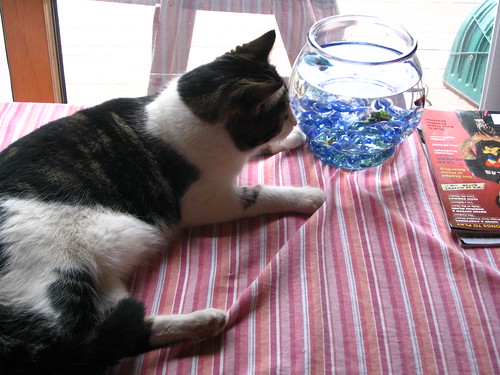
sonny and the fishbowl

After the conversational stir caused by yesterday's blog post, I'm happy to report that there was a healthy intermixing of complete strangers at last night's Pittsburgh Twestival. (Congratulations to Holly Maust and Mandy McFadden for organizing a great event, and special thanks to Derrick Brashear for manhandling the A/V duties like a man possessed [by his own techxpertise].)

And yet, at least one person mentioned that he hadn't even heard of the Twestival until yesterday morning. (In fact, he'd just heard of the worldwide event at 5 AM, and he said to himself, "There's no way Pittsburgh would be involved in this." And then he scrolled down the list of participating cities and was amazed to discover he was wrong.)

To me, the bigger question isn't "why would one automatically presume that Pittsburgh wouldn't be involved in such a thing," but, "why wouldn't someone have heard about a fairly major event until the morning of?"

I'm pretty sure the answer has to do with closed loops.

I Can't Hear You Because I Won't Stop Talking

Because Holly and Mandy travel in a slightly different social media crowd than I (and the rest of the PodCamp Pittsburgh organizers) do, each group doesn't always hear about the events that the other group is involved with. That's because all the chatter about these events tends to be confined to our existing Twitter / blog / podcast / social network loops -- which means we'll talk about them endlessly to ourselves, but the information will be lost to anyone who isn't already tracking those channels.

The long-standing knock on social media is that we're a giant fishbowl of geeks who talk endlessly about ourselves to each other. Based upon the disconnected subdivisions I'm discovering among the Pittsburgh social media crowd, I think it's likely that every city has its own disparate groups who are caught in their own feedback loops, which means we're actually all a bunch of even SMALLER fishbowls stacked inside the same dunk tank.

So how do we break out?

By breaking in.

You be Me for Awhile, and I'll Be You

Sure, we're all swimming in our own fishbowls, but SO IS EVERYONE ELSE. And for every person who knows what Twitter is, there are a thousand (at least) who don't, which means THOSE people are getting their information from other sources. And guess what: they don't think they're missing anything, because if something's important enough, they presume it's already found a way onto their radar.

So get on their radar.

To do this, you'll have to step outside your comfort zone and step into theirs. Everyone has a different information-gathering routine, and you need to figure out what everyone else is doing when they're NOT engaging you (because, right now, they aren't -- so spending more time getting the word out through your existing channels is just polishing the same fishbowl).

You may have to traffic your message in unfamiliar territory. You may have to explain things that you currently take for granted. You may even have to engage different TYPES of media, because not everyone is on Twitter, or Facebook, or even the internet. But they're all somewhere, and they're all reading something, or watching something, or listening to something else. And that something probably isn't you.

But it could be.

(Image by samatt.)

Labels: , , , , , , , , ,

Thursday, February 12, 2009

I Don't Want to Meet You

IMG_0257.JPG

I had a great time at yesterday's Open Coffee Club, where investors, entrepreneurs and wild cards (like myself) came together at AlphaLab for some quality face time. The catch? Although I met 3 or 4 new and interesting people, I spent most of the event talking to folks I already know.

Why do we do this?

Why do so many of us attend "face to face" events and then spend the bulk of the event talking to the same people we knew yesterday? Isn't the entire point of a social event to meet people you wouldn't otherwise have the opportunity to talk with?

And yet, when faced with the prospect of cold-contacting a complete stranger -- even at an event where everyone allegedly has multiple overlapping interests and is ostensibly there PRECISELY to make new contacts -- most of us who don't already have an elevator pitch burning up our tongues opt for the woobie of familiarity.

I think the reason why is 3-fold:

* The known payoff from talking with a friend is preferable to the unknown outcome of talking with a complete stranger. Especially at an event where you're not sure what everyone's area of expertise is, and you're afraid you won't be able to extricate yourself from a conversation with someone who offers no direct value (in your opinion).

* We have no idea what our true value is. So instead of trying to explain why we think we're valid to a complete stranger (who, we presume, is automatically judging us and comparing our net conversational worth against that of everyone else in the room), we'd rather talk with people whom we already know appreciate us in some capacity.

* We have no game plan. Sure, the concept of being surrounded by "interesting people" is alluring, but once we're in the situation, we immediately presume that everyone else who's there has a much more specific agenda. If WE don't, we wouldn't want to waste anyone's time (or our own), so we aim for the low-hanging fruit of familiarity instead.

All of this usually results in small clumps of conversations among people who obviously already know each other OR, in a variant, people of a similar age / gender / dress code, who gravitate together because they imagine that they must have something in common. And if you've come to such an event alone and aren't wearing a popularized "uniform," you're probably floating along the fringes, eating the free food and conspicuously pretending to check your text messages, so no one knows you're privately terrified of making contact.

If so, here are 5 tips for breaking up the monotony at your next "live" event:

* Pre-set one goal. Maybe you want to meet one prospective collaborator. Or bounce a vague idea off 5 people. Or collect 20 business cards. As long as you have a concrete goal, you can focus on accomplishing that first, and then any chatting among your friends won't feel so guilty.

* Talk to the loner. Immediately beeline for the nearest person who appears to be floating adrift and engage them directly. As you've probably noticed, small groups tend to be where the loners will eventually wash up anyway, so you might as well cut out the middleman and form your own small group right from the get-go.

* Bring people together. Chris Brogan is the master at this, usually because he's swamped with conversations and needs an elegant escape clause. Following his method, start by engaging someone you DON'T know. Find out their story, in a nutshell. Then rope in your nearest friend by asking the new person, "Have you met my friend [NAME] yet?" and physically deposit them in a conversation. This allows you to then step away without leaving the new person alone, which is probably how you found them.

* Make a scene. This is where talking with your friends actually comes in handy. Once a pack of you are talking about something, get contentious / absurd / offensive / funny, and raise your voices. Move around. Draw attention to yourselves. Because nothing attracts a crowd like a crowd -- especially one where a wallflower can expect to linger and observe without being drawn into the fray because the fray seems self-contained. But here's the catch: once you've attracted some spectators, then draw them directly into the spectacle. Ask them a question, use them as an accomplice in a recreation -- whatever it takes to incidentally break the ice and help them feel like they're now a part of the fray. (Because they are.)

* Refuse to leave until you're out of business cards. This means you're forcing yourself to meet new people until there are none left. It also means you probably want to arrive with fewer than 500 cards in your pocket, or you'll be making friends with the caterers and janitors, too. (Which, depending on your pre-set goals, may not be such a bad idea after all...)

NOTE: Dropping the cards in a stack near the coffee cups doesn't qualify as dispensing them. Man up, people.

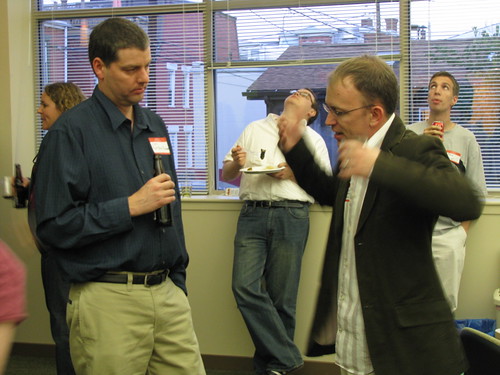
This image of Woycheck trying unsuccessfully to frighten Jim Russell into fleeing was taken at a previous AlphaLab event by Michael Fulk.

Labels: , , , , , , , , , ,

Friday, November 21, 2008

PittGirl and the Trouble With Being Anonymous

As most Pittsburgh bloggers have already noted, veteran 'burgh blogger PittGirl has closed up shop (although she's still Twittering). Easily the most popular blogger in the area, she was also a mystery of sorts, due to her strident anonymity. And, in the end, it appears that a potential compromise of her anonymity is what led to her decision to commit blogging seppuku.

As much as PittGirl's anonymity was the "hook" of her self-created brand, it was her writing style that kept her core fans coming back for more. (After all, a mystery is interesting, but a comedy is eternal.) So it's ironic that her anonymity -- aka the packaging that surrounded her REAL product, her writing -- would be what ends up robbing her fans of the opportunity to enjoy more of what they've come to enjoy.

It's a bit like Reese Cups going off the market because someone told them they had to change their wrappers to green instead of orange; I sincerely doubt the Reese Cup fans would stop eating their favorite candy due to a packaging change any more than PittGirl's readers would have unbookmarked her if they knew her name.

But PittGirl's decision to walk away is less about the foibles of packaging than it is about the cultural problem that led to the packaging conundrum in the first place: the need to be anonymous.

Who... ARE You?

In her case, PittGirl genuinely believed that blogging under her real name might get her fired (or, to speak the parlance, Dooced.) Whether that concern was real or perceived, it was a risk she wasn't willing to take. But why did it have to be a risk in the first place?

Why is society so uptight about what its citizens say?

Why should what YOU, the employee, say or do in public directly affect anyone's perception of your company?

Because everyone is afraid. Of what? Of everyone else? Despite the fact that we no longer have to fight one another for food and shelter, we still live in a constant subconscious fear of what everyone else THINKS of us -- and we all believe that ANY OTHER PERSON could squash our lives just by blinking.

That has to stop.

Who Do You Think You Are, Anyway?

Are we still operating in the perceptual Dark Ages, where we believe that everyone else is as perfect as they claim to be? Does showing a glimpse of humanity, a personal flaw or a whiff of disagreement with the party line automatically brand a person as "dangerous," worthy of being shunned or shown the door?

Why do we give companies the benefit of the doubt, but not the people who WORK in those companies? (And your instincts might lead you to believe that we actually do just the opposite, but if we did, why would people be afraid to post photographs of themselves at a party on their Facebook account for fear that an HR troll would find a reason to fire them as a result?)

Something tells me that PittGirl would have been ENCOURAGED to blog on behalf of her company if all she had to say was glowing and positive. So why does society only want to reward the people who DON'T encourage us to improve upon the status quo? What good is a coal mine without a canary?

And, in the extreme, what is it that any one person could possibly say or do that's SO MUCH WORSE than what any of the rest of us could say or do?

Look around. I guarantee you that everyone sitting near you right now is hiding a secret that they think would make you shun them for life, IF YOU ONLY KNEW.

Guess what, people: if we shunned everyone who had a secret, we'd all be eating alone forever.

So let's each grow some backbone and admit to a very unpleasant truth: that not everyone will like us ALL the time -- including (for various reasons) our employees, friends and families. Get over it. The ones who tell you how wrong you are from time to time are the ones you can trust when they actually tell you you're right.

And as for the anonymous folks out there, whether you're noble or trolls, here's a thought: whatever you have to say is far more resonant when you believe it enough to say it with a straight face -- preferably your own.

Labels: , , , , , , ,

Wednesday, November 12, 2008

10 Ways to Become a Thought Leader

When I was a kid, I wanted to grow up and become an artist, a chef or (in one bout of misplaced humanism) a farmer. Today, kids grow up wanting to be social media rockstars and thought leaders. (And by "kids," I mean "thirty-five year-old desk jockeys," but I digress...)

Why the newfound passion for "thought leadership"? Because in uncertain economies, one thing still counts: influence. You may not have two dimes to rub together, but if you can convince the guy next to you that You Have Ideas, he'll probably buy you a cup of coffee just to hear you out. And that's how people without real jobs can stay alive when the depression comes.

So, without further ado, here are 10 Ways YOU Can Become a Thought Leader:

1. Get It Out There. History is littered with the corpses of people who put off sharing their big ideas because they "weren't ready yet." Do you have an idea? Share it. If it sucks, people will tell you. If it's good, people will steal it. And if it's great, people will tell you it sucks and THEN steal it. (Watch for this; it means you're on to something...)

2. Be Controversial. No one quotes the moderate, and even when they do, no one remembers what he said. If you want to be remembered, be extreme. If you want to be influential, be extreme AND easy to read. No one likes long-winded crackpots.

3. Make It All About You. Human beings have a natural tendency to cast the spotlight off themselves and onto other people, especially when they ask things like "How are you?" and "What do you think?" Be resilient. That spotlight was made for you, and the longer it's cast across your luminescent talents, the longer an opportunity the world will have to bask in the shadow of your genius. Thus, never miss an opportunity to turn any conversation into a time-worn anecdote about A Lesson You Learned (Preferably In Three Acts).

4. Start a Religion. Hey, it worked for L. Ron Hubbard and Jesus.

5. Influence the Influencers. Remember Basquiat? He was forever surrounded by low-level starmakers, but it wasn't until he literally threw himself at Andy Warhol that he got "discovered." Who's the Andy Warhol of your field? Get on that person's radar, and then don't leave -- at least not until you're bigger then he is. (Then run, because he'll probably want something.)

6. Repeat Things. This is a fast-paced world. People often completely ignore the best advice, even when it's right in front of them, because they're distracted. Or skimming. Or both. Don't let them miss out on your gems of wisdom.

7. Be Vague. If you give people a 10-step plan to upright the economy, you're a policy wank. If you tell people that "Savers Are Losers", you're a thought leader. Go with that.

8. Repeat Things. This is a fast-paced world. People often completely ignore the best advice, even when it's right in front of them, because they're distracted. Or skimming. Or both. Don't let them miss out on your gems of wisdom.

9. Be Prolific. It's not enough to have one good idea. Have dozens. Because if you're capable of being a genius once, people will expect you to be a genius in all cases. DO NOT DISAPPOINT THEM.

10. Preach Common Sense. Because life isn't all that hard, when you stop and think about it. In fact, it can be summed up pretty easily: say, think and do the things that make your life, and the lives of those around you, as fulfilling and rewarding as possible. But these days, no one actually has the time to stop and think; they need YOU to do that for them.

And they'll pay you for it.

(Photo by farlyj)

Labels: , , , , , , , ,

Wednesday, October 08, 2008

An Audience Without A Reason to Care Is Just a Bunch of People That You Have to Clean Up After

Carson Summit - Audience


Every three months, downtown Pittsburgh's art galleries unite for a free Friday Night gallery crawl. All the spaces are open to the public, the arts organizations mount new works and performances, and there's free food and drink for everyone who attends.

As you might imagine, people usually show up in droves for these events. And then, afterward, almost none of them come back. (At least, not until the next free event.)

Why?

Because just getting an audience in the door once isn't enough to make them want to come back on their own. You have to make the effort to get their attention, yes, but you also have to dazzle them while they're in your space AND give them a means to stay involved even after they've left.

And all of that requires a lot more effort than just handing them a mailing list.

The Fallacy of Eyeballs

At concerts, all bands love to leave mailing list sign-up sheets around the merch table. Mailing lists are useful, but getting people to admit that they want to hear more about you is only one step toward RETAINING that audience; it has nothing to do with GROWING an audience in the first place.

If all a band did was play four shows a year and then hound their mailing list to buy a CD every week, they'd have the support of very few people. So why would an arts organization -- or YOUR company -- be any different?

Give People Handles

The takeaway is the key. A band sells (or gives away) copies of its CD. Their fans play that CD for other people, and their interest in the band spreads. People start talking about that band and developing an emotional or intellectual alliance with the band's style, content and point of view.

Being a fan of the band becomes an active part of each fan's daily culture, and it becomes a natural act to share their passion for that band with others.

The organizations involved in Pittsburgh's quarterly Gallery Crawls can hand out postcards, fliers and mailing lists all they want, but they're not handing out anything people can actually take away and share. Nobody gives their friend a flier, but they will give them a CD.

So what can artists or organizations provide that would be a "CD equivalent"?

What could someone take away from your business / site that would enable them to tell another person about you, and illustrate WHY they think you're so interesting and worth getting excited about?

You Don't Know a Thing About Me

The other major stumbling block most of the Gallery Crawl organizers face is that, for many attendees, this will be the first (and only) time they'll ever walk through a gallery's or theater's doors. If they don't understand what that space is about, what kind of work it normally produces, and why its work actually matters (not to the world at large but to them, the individual visitor), they won't have a reason to come back because they won't even know why they should.

How many websites do you visit where you can't immediately figure out WHY it exists? Did the site designers provide you with sufficient answers on the About page? (Did the site designers provide an About page at all?) If not, was the site still sufficiently interesting that you cared enough to explore it on your own, or did you press the "back" button and try to find something else more obviously rewarding?

Artists face this challenge every day, and yet so few of them bother to make themselves interesting AND easily explainable. The same conundrum applies to social media. If I visit your site or download your podcast and I can't immediately understand who you are and why you're doing what you do, do you really expect me to spend my own valuable time figuring out why you matter?

If you or your organization / site / company is able to generate occasional bursts of traffic, but you never seem to actually RETAIN it, ask yourself what it is that you're NOT doing to dazzle / engage / explain yourself to them before they leave. Then, make every effort to solve that problem. Because if you don't, all you end up with are some half-eaten cheese plates and a few scribbled names on a mailing list, and neither of those are going to pay your bills.

Photo by Pete Lambert

Labels: , , , , , , , , , , ,

Thursday, October 02, 2008

Tweeting Up Is(n't) Hard to Do

The first (to my knowledge) Tweet-Up in Pittsburgh happened last night at the Firehouse Lounge. Organized my Holly Maust, Mandy McFadden and Nicole Miller -- three women I'd admittedly never met -- it was great to get out and meet some new faces in the social media space.

One thing I find amusing about all of this is that none of us involved with PodCamp Pittsburgh 3 had ever met anyone else at the tweetup -- which means, if Pittsburgh's social media scene is this splintered / varied (and we've already had two PodCamps to get everyone together), imagine what your city's scene is like.

What else does this mean? That our social media scene is growing, and that's a very good thing.

Also: if you're looking for a great dessert, try the Firehouse Lounge. The bartenders tell me that their chef is actually a pastry chef, and the dessert I tried -- a triple chocolate mousse -- was amazing. (I also heard rumor of "bananas foster wontons" being experimented with as a future possibility, and that's just intriguing enough to be worth a return trip all by itself...)

I hope to see our new Tweet-Up friends at PCPGH3 in two weeks. Meanwhile... when's the next Tweet-Up?)

Photo by Teejay Hanton

Labels: , , , , , , , ,