Cafe Witness

Wednesday, May 13, 2009

We Need a New Water Cooler

Now that Twitter has removed a feature they claim only 2% of their users were using (and which nearly everyone I follow has been complaining about, which I guess means we ARE that 2%), something has become clear:


We need a new water cooler.

Twitter is often described as a "virtual water cooler," serving as a gathering place for people who work remotely. It's where we who don't have officemates (or who don't care to speak with the same 10 people all week long) go to bounce ideas off people half a world away, in real time, with minimal obligation or investment of attention.

But when the service terminates one of its own best reasons for existing -- the ability to stumble across other users via "fragmented conversations" (a functionality, it should be stressed, that THE USERS THEMSELVES invented) -- it becomes clear that Twitter is less concerned with serving the needs of its core users than it is with appealing to the masses. (After all, the masses bring the money; the 2% do not.)

And when the service then schedules planned downtime at noon PST on a Wednesday, those of us who rely on it for our daily conversation stream realize it's time to create a backup plan.

You wouldn't keep every document you own on one hard drive, thus stranding yourself if it crashes. So why are the bulk of our conversations contained within one service?

Seduce me, Facebook. Dazzle me, Plurk. Rise from the dead, Jaiku, and provide for us a valid alternative to the service that no one wanted until everyone had to have it.

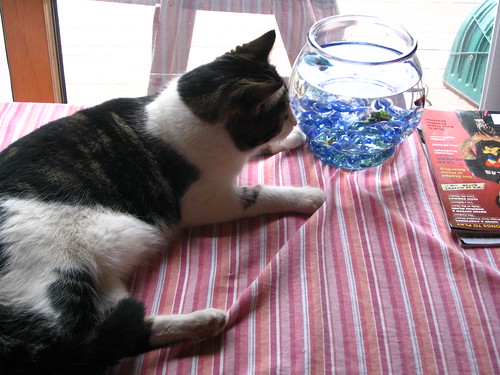
Image by dennis.

Labels: , , , , , , , , ,

Wednesday, April 22, 2009

The Thankless Job of Being Ahead of the Curve

Oregon Trail Pano

This week, the world was all abuzz about the mainstreaming of Twitter thanks to Ashton Kutcher & CNN, Oprah Winfrey, USA Today and countless other "names" who've taken up the habit of Twittering.

Of course, by "world," I mean the relatively self-obsessed cadre of regular Twitter users -- myself among them -- who thought social media was a pretty cool club until the stars showed up. Like the aesthetic suckerpunch that comes from seeing the captain of the football team wearing your favorite indie band's t-shirt, the mainstreaming of any subculture is a tragedy for those who were there first. In one seemingly innocuous act, whatever exclusivity there was that bound you all together is now eroded. It's like your girlfriend taking a sudden interest in Star Trek -- or your mom using Facebook.

You know who wants your mom to be on Facebook? The people who create the service and the people who profit from the service.

You know who doesn't want your mom to be on Facebook? The people who use the service -- or, at least, the ones who used it enough to make it useful to your mom in the first place.

Being Useful Is the Fastest Way to Die

In order for any business or service "succeed" -- social media included -- it has to go mainstream. This means it has to be considered useful (or at least interesting) by the masses. But since "the masses" tend to be less interesting than the individuals who comprise them, when something does generate a wide appeal, it tends to do so at the expense of the individuals who partly defined themselves through it. And as the originators of a subculture leave, they take something with them: the originality, eccentricity or unconventional wisdom that made that subculture worth noticing to begin with.

So now, as blogging, podcasting and social networking become commonplace, the power centers behind these tools shifts away from the geeks who'd started them and becomes concentrated within the same media conglomerates for which these tools were originally conceived as an antidote. (This is not unlike veteran political skewer Al Franken eventually being absorbed into Congress.)

How Many Coonskin Caps Is One Fail Whale Worth?

What we've been seeing this week is the lamentation of hardcore Twitter users who've realized that their much-maligned (and yet, paradoxically, much-loved) service may be on the brink of becoming mainstream -- and, simultaneously, irrelevant.

If all these Twitter pioneers sound bitter, it's because they realize society is now waiting for them to pull up their stakes and migrate away from Twitter, on toward some other as-yet undiscovered social media country... that can be colonized and mined for profit, by others, in another 2 or 3 years.

Meanwhile, any book written decades from now about the success of Twitter will almost surely mention Ashton Kutcher's name, but it probably won't mention yours -- even though you were there first.

Image (taken along the Oregon Trail) by Fokket.

Labels: , , , , , , , , , ,

Tuesday, April 21, 2009

Where I'm Speaking Next: The Business Smart Tools Conference

On Tuesday, May 5, I'll be conducting a pair of workshops at the Business Smart Tools Conference in Stamford, CT. The subjects I'll be covering are the two I spend the most time with online: video and Twitter, both in terms of business use.

The BST Conference is aimed squarely at companies who are just starting to explore social media. Admittedly, as someone who's been creating social media for years, I often take it for granted that everyone already knows what I know. Then I meet someone new -- or I organize a PodCamp Pittsburgh -- and I remember that technophobia and learning curves tend to keep some people away from the web. This event is intended as a way to break down some of those barriers and get new businesses interested and up to speed on the potential of social media.

Other speakers include Tom Guarriello, John C Havens, Cindi Bigelow, Albert Maruggi and Scott Monty, who's been working wonders on the social media front at Ford.

Want to attend the BST Conference? Register with the discount code "twitter" (no quotes) and save 20%!

Want to hire me to speak at your event? Contact me on Twitter, or leave your email address in the comments below.

Labels: , , , , , , , ,

Wednesday, March 25, 2009

Hating Twitter Is Like Hating a Hammer

There's been a lot of social media hate thrown around lately, mainly by people who hear about services like Twitter in the mainstream press and then, once they poke around a bit, reject it immediately and with much gusto.

The bitter invective comes from all sides, including Jon Stewart, Gawker, the Pittsburgh Post-Gazette and this amusing cartoon.

And they all miss the point.

I Would Rather Eat Live Children in a Barrel Than Use a Power Drill

Twitter, like all social media, is a tool. It can be used to entertain, to share, to self-promote, to inform or to educate. Unfortunately, casual observers rarely see the breadth of its use because the bulk of its users aim low, and use the service in inane ("OMG drinking tea cuz I'm sooooo tired lol") ways. Thus, they conclude that these are the only ways the service can be used, and they choose to decry the service (and ALL of its users) as the worst humans on the planet while simultaneously distancing themselves from anything associated with it.

Explaining to these people that Twitter has also been used to exonerate innocents from jail, unite outsiders during a tragedy and raise life-saving donations doesn't always help. If anything, it only seems to exasperate them further -- as though they wonder, "If you CAN do all that stuff with Twitter, why DOESN'T everyone?"

But asking that question is like asking why every building isn't as gorgeous as the Taj Mahal. Trust me: it isn't the hammer's fault.

Image by Being Yogendra.

Labels: , , , , , , ,

Tuesday, February 24, 2009

The Brogan Effect 2: Electric Boogaloo

Bad Chris Brogan - Gnomedex 2008

Last week, I mentioned that a retweet from Chris Brogan had resulted in 21 times my normal daily blog traffic. When I mentioned this, a commenter asked what effect my blog post about "The Brogan Effect" would have on my traffic that day.

As it turns out, a lot.

Once again, according to Lijit, my daily traffic (which normally hovers around 30 visits, or so Lijit tells me) jumped to 563 visits on the day I posted "The Brogan Effect." That's about 18x my normal traffic, or just a hair off from the previous instance. (And, yes, Chris Brogan retweeted *that* day's post too, so the same effect still applies.)

As I mentioned before, Chris isn't the only person who drives traffic to my blog, nor does that traffic always stick around after his initial "must-read" suggestion has been heeded. (In fact, last week, my traffic steadily declined each day after the initial Brogan bump.) But it's becoming clear to me that one way to generate a large amount of daily traffic is to either:

* write a post that the influencers (like Brogan, whose word is trusted among his readers) enjoy and recommend, or

* write about the influencers themselves, because their sheer association with a blog post is somehow magnetic.

This leads me to two larger observations about the future of blogs and media:

* In this new millennium, as Gary Vee implores, anyone can become a content creator, but that's still not enough to topple the existing media congolmerates. However, being a trusted thought leader of thousands *could* be enough, because that kind of clout leverages both the distribution AND marketing power of those corporations into smaller, individualized channels that prompt direct action. (Lucky for you, I've assembled 10 ways to become a thought leader.)

* If writing about the influencers is the best way to aggregate an audience -- at least for a day at a time -- does this mean we'll all be reading (and writing) a lot fewer posts about original concepts and a lot more posts about what other people are already doing? I know none of my posts that involve critical analysis of a subject generate anywhere near the amount of feedback as the sound bite-friendly, personality-driven ones do -- probably because the web isn't designed for analysis, but snapshots of distraction.

All of which means I should probably find a way to work the word "Brogan" into everything I write from now on, just to make sure my bills get paid on time... and so should you.

Image by Randy Stewart.

Labels: , , , , , , , , ,

Friday, February 13, 2009

They'll Never Know Who You Are Unless You Break Into Their Homes

sonny and the fishbowl

After the conversational stir caused by yesterday's blog post, I'm happy to report that there was a healthy intermixing of complete strangers at last night's Pittsburgh Twestival. (Congratulations to Holly Maust and Mandy McFadden for organizing a great event, and special thanks to Derrick Brashear for manhandling the A/V duties like a man possessed [by his own techxpertise].)

And yet, at least one person mentioned that he hadn't even heard of the Twestival until yesterday morning. (In fact, he'd just heard of the worldwide event at 5 AM, and he said to himself, "There's no way Pittsburgh would be involved in this." And then he scrolled down the list of participating cities and was amazed to discover he was wrong.)

To me, the bigger question isn't "why would one automatically presume that Pittsburgh wouldn't be involved in such a thing," but, "why wouldn't someone have heard about a fairly major event until the morning of?"

I'm pretty sure the answer has to do with closed loops.

I Can't Hear You Because I Won't Stop Talking

Because Holly and Mandy travel in a slightly different social media crowd than I (and the rest of the PodCamp Pittsburgh organizers) do, each group doesn't always hear about the events that the other group is involved with. That's because all the chatter about these events tends to be confined to our existing Twitter / blog / podcast / social network loops -- which means we'll talk about them endlessly to ourselves, but the information will be lost to anyone who isn't already tracking those channels.

The long-standing knock on social media is that we're a giant fishbowl of geeks who talk endlessly about ourselves to each other. Based upon the disconnected subdivisions I'm discovering among the Pittsburgh social media crowd, I think it's likely that every city has its own disparate groups who are caught in their own feedback loops, which means we're actually all a bunch of even SMALLER fishbowls stacked inside the same dunk tank.

So how do we break out?

By breaking in.

You be Me for Awhile, and I'll Be You

Sure, we're all swimming in our own fishbowls, but SO IS EVERYONE ELSE. And for every person who knows what Twitter is, there are a thousand (at least) who don't, which means THOSE people are getting their information from other sources. And guess what: they don't think they're missing anything, because if something's important enough, they presume it's already found a way onto their radar.

So get on their radar.

To do this, you'll have to step outside your comfort zone and step into theirs. Everyone has a different information-gathering routine, and you need to figure out what everyone else is doing when they're NOT engaging you (because, right now, they aren't -- so spending more time getting the word out through your existing channels is just polishing the same fishbowl).

You may have to traffic your message in unfamiliar territory. You may have to explain things that you currently take for granted. You may even have to engage different TYPES of media, because not everyone is on Twitter, or Facebook, or even the internet. But they're all somewhere, and they're all reading something, or watching something, or listening to something else. And that something probably isn't you.

But it could be.

(Image by samatt.)

Labels: , , , , , , , , ,

Monday, February 09, 2009

Twitter Is a Mistress Who Demands All My Time

Day 43

As you may have noticed, I've not blogged much lately -- but I've been Twittering like a fiend.

Why?

Because Twitter is far more immediate than blogging, requiring far less attention to detail and almost zero long-term commitment; it's the one-night stand of social media communications, while blogging involves trust, semi-permanence and the occasional post-hangover apology.

But as fellow Twitterer (and blogger) Mack Collier mentioned in a recent tweet, there's still a reason or two to blog: comments and perpetuity.

Twitter is great for stream-of-consciousness observations and spur-of the moment conversations, but it provides minimal connectivity or context. Unless you were "there" when that "conversation" took place, you'd never be able to piece the whole story together without painstakingly searching through the timestamped tweets of everyone involved. (I know Plurk does that better, but let's be realistic; no one you know is using Plurk BUT NOT Twitter.)

Blogs allow a coherent (we hope) thought to exist in relative perpetuity, web-wise, and it also allows the comments of all involved to be attached in context, so that something resembling a "whole story" can be easily understood even months or years after the fact. So, obviously, there's SEO-driven and self-legitimizing reasons to blog, and to allow others to comment back to you.

But in this age of 140-character Twitter gratification, is anyone thinking in structured paragraphs anymore? Or have we reprogrammed ourselves to make sweeping statements in the shortest sentences possible? Does the concept of expanded and supported thought wither when everything we know about someone is gleaned from text bites?

I'll be attending the Social Communications Summit in NYC tomorrow; perhaps I'll come home with answers. Meanwhile, look for tweets from the event, and (if it warrants one) a blog post afterward.

(Wise men once claimed that "content" is key, but I wonder if "context" will surpass it...)

Image by ClawzCTR.

Labels: , , , , ,

Tuesday, December 09, 2008

Loyalty vs. Community

I'm a tech slut.

I was just trying to post a link to Twitter that needed to be shortened. In the past, I would have used TinyURL, but since I discovered Tweetburner, I've been reluctant to go back. Tweetburner lets me see how many times a shortened URL link has been clicked, so it's endlessly more useful than the services that *just* shorten links.

But Tweetburner was down.

So I considered crawling back to TinyURL, until I remembered a service called bit.ly, that does the same thing as Tweetburner AND lets me actually see WHERE my clicks are coming from.

Score!

So now I've opened an account on bit.ly, and I'll probably never go back to Tweetburner.

Why? Because bit.ly is better and its URL is shorter.

Thus, I'm a tech slut. I don't stick with the services that work for me; I migrate to the services that are working RIGHT NOW, and I'll stay with them until they break. Then I'll site-hop again.

And yet...

Twitter itself used to break on an hourly basis, and the bulk of its users stuck with it -- me included. This, despite the fact that there were numerous BETTER services out there (Pownce, Jaiku, Plurk, etc.).

Why did we all stay with Twitter when it was unreliable and nearly useless, and yet I'm able to jump ship from Tweetburner without looking back EVEN THOUGH IT'S ONLY GONE DOWN ONCE?

Because Tweetburner isn't a community, it's a service. It's a tool I use privately to improve my public communications.

Twitter *is* a community. The service itself may break all the time (thankfully, it no longer does), but that alone isn't enough to force the bulk of its users to migrate away.

Which makes me wonder...

What's the breaking point at which a community will abandon a service that unites it?

Photo by reallyboring.

Labels: , , , , , , , ,

Thursday, October 02, 2008

Tweeting Up Is(n't) Hard to Do

The first (to my knowledge) Tweet-Up in Pittsburgh happened last night at the Firehouse Lounge. Organized my Holly Maust, Mandy McFadden and Nicole Miller -- three women I'd admittedly never met -- it was great to get out and meet some new faces in the social media space.

One thing I find amusing about all of this is that none of us involved with PodCamp Pittsburgh 3 had ever met anyone else at the tweetup -- which means, if Pittsburgh's social media scene is this splintered / varied (and we've already had two PodCamps to get everyone together), imagine what your city's scene is like.

What else does this mean? That our social media scene is growing, and that's a very good thing.

Also: if you're looking for a great dessert, try the Firehouse Lounge. The bartenders tell me that their chef is actually a pastry chef, and the dessert I tried -- a triple chocolate mousse -- was amazing. (I also heard rumor of "bananas foster wontons" being experimented with as a future possibility, and that's just intriguing enough to be worth a return trip all by itself...)

I hope to see our new Tweet-Up friends at PCPGH3 in two weeks. Meanwhile... when's the next Tweet-Up?)

Photo by Teejay Hanton

Labels: , , , , , , , ,

Sunday, October 21, 2007

Social Media Gatekeeping (Or, Why I Won't Be Invited to San Francisco Anytime Soon)

Brace yourselves, folks: I'm about to depict, with an awkwardly high amount of geekery, exactly why there's a glass fence around the "social media" hierarchy, and why it's so tough to scale it.

In a nutshell, Eric Rice and I stumbled into a conversation last night on Twitter. The subject? Eric was musing about the seeming hypocrisy of every 'must-attend' social media event, in which people who aren't making any money in the medium still feel obliged to fly to an event to be part of some fictitious scene.

At one point, I mentioned that, since the web is built upon the democratized promise that physical location no longer matters, I shouldn't feel hamstrung by living in Pittsburgh as opposed to NYC / LA / SF. However, it's undeniable that "the action" still takes place in the major media centers -- which, if that's the case, essentially means that the liberating power of the web is a lie.

Meanwhile, Eric was Twittering with several other conversants, including Robert Scoble. Roundly recognized as an "A"-List blogger (a title he even affords himself on occasion), he and Rice are in roughly the same media sphere; I'm at least 2 to 3 layers out from there. Thus, they'll twitter back and forth freely, while I'm rarely involved in that echelon of discussion.

Scoble mentioned that he couldn't conduct his work anywhere else than San Francisco, because there aren't that many tech CEOs anywhere else. He also referred to the much-maligned "flyover states" quite genially, although he admitted there weren't many geeks in them; at least, not compared to SF.

However, when it came to Eric's point about "regional isolation" affecting social media, Scoble wasn't buying it:
@spin: you're full of it tonight. If someone wants to get "unisolated" just put "@scobleizer" in your Twitter message.

Hmm. So that's it? All these discussions I've had about the path to web success and here it was all along. (Who knew?)

It was equally interesting to see the following exchange betwixt them, first from Rice:
@scobleizer btw, none of this has anything to do with me, I'm raising hell on behalf of those with unheard voices. So we're clear on that

And Scoble's response:
@spin: I find it interesting that you are raising hell on behalf of people who REFUSE to join the conversation. Why won't they?

Hmm.

Not sure who's REFUSING to join the conversation here. In fact, I'd wager more that Scoble (and the other powers-that-be) see so much of the social media seascape, it's just hard for them to notice any ripples that aren't emanating from their own buoys.

Or, as I said in slightly less apologetic language:
*shrug* Being asked to "join the conversation" presumes there's a gatekeeper. Thanks, Emperor, but I have my own clothes.

Later, while surfing to Chris Brogan's blog, I saw his most recent post. It's a link to a video about Glenda Hyatt-Watson, known as the "left-thumb blogger" because... well, just watch the video. It's an inspiring story all its own -- and exactly why I felt the need to re-tweet it.

Which I did, thusly:
I'm sure this was widely twittered 12 hours ago, but @chrisbrogan 's post about @GlendaWH is truly mindblowing: http://tinyurl.com/225lyz

This post went out, like all others, into my twitstream, and I went back to work.

Moments later, Robert Scoble twittered the following:
@chrisbrogan's latest video rocks. http://tinyurl.com/225lyz

Anyone notice anything amusing in that tweet?

The TinyURL link is mine, created moments earlier, and copied and pasted by Scoble into his own post. Which, innocently enough, looks like he decided to post it out of the goodness of his own heart.

Which, to be honest, he may have.

And Lord knows I'm not due any back-patting for pointing Chris's post out. Odds are, Scoble would have discovered it anyway, sooner or later.

I just find it ironic that, after earlier wondering aloud about the poor, innocent people Eric Rice was coming to bat for -- those who "REFUSED" to join the conversation -- Scoble would have a golden opportunity to credit the messenger in this particular case, and instead choose to clip out the TinyURL and send it off as his own missive.

Full disclosure: I've blogged previously about the pitfalls of social media, including the lunacy of "fishbowl"-driven buzzwords involving use of the term "Scoble___," as in, "Scobleized." It's quite possible that such discussions have raised the hackles of the powers-that-be.

I also have a feeling Scoble's tweet probably brought 100x the attention to Chris's post as my tweet did, since Scoble's followed by far more people on Twitter than I am -- so, in the end, the message was served, and that's the important part.

(And no, I'm actually not upset about it; just highly entertained. Irony is its own best raison d'etre.

I'm also not delusional enough to believe I require credit in this situation. I didn't make the video, I'm not the subject of the video, and I'm not Chris Brogan.

I'm just a guy, smirking away, isolated in a flyover state.)

Labels: , , , , , , , , , , ,

Tuesday, October 09, 2007

Google + Jaiku = The Shrug Heard Round the Web

I just typed two separate posts about how Google's buying Jaiku may or may not impact the future of Twitter, but I kept rewriting them because I... I don't care.

Not in the slightest.

I'm on Twitter. If the conversation migrates to Jaiku, I may follow. Or I may not. There was life before Twitter, and MySpace, and AIM, and there will be life again after.

In the end, I really couldn't care less, and watching everyone race to proclaim the future, or cash in their chips on the Twitter deathwatch, reminds me why I have better things to do in the first place than to be ON a social network in the middle of the workday.

You guys go be the geniuses. I'm going to go do some work.

Labels: , , , , ,

Wednesday, October 03, 2007

Has the Social Network Exodus Begun?

** UPDATES to this post at the bottom **

It's official: Michael Bailey is off MySpace and Facebook.

If you don't know Michael personally, you've probably never been to a social media function. I've known Michael to pop up at PodCamps from Boston to Pittsburgh, and at VON in San Jose and PME in SoCal -- all from his homebase in Missouri. For quite awhile, Michael has been one of the few active cross-coast socializers originating from the Midwest.

And he just admitted today that it's mostly bullshit.

Now, granted, Michael has been known to ruffle feathers. Michael is a pot-stirrer, like myself, and is often just as interested in seeing HOW people react as he is in WHAT they actually have to say.

But he brings up a great point, via Twitter:
When you lower the bar of what really matters and what is important, things like social networks crop up like weeds... You all know how to get ahold of me, you have my email address, my cell #, my address. If it matters, reach out, attach yourself.
Let's ignore, for the moment, the fact that not EVERY interaction requires a phone call or an email. (Michael himself would admit that.) The bigger question is:

What PURPOSE Do Social Networks Serve in our Daily Lives?

I myself never use MySpace for personal communication anymore. When I started blogging and Twittering, MySpace lost out in the time sink.

I've also not bothered to join Facebook. Surprisingly, I'm still alive, healthy and getting work.

LinkedIN? The most it's done for me is pepper my inbox with arbitrary questions from people I barely know, about job openings or tech issues. No real traction there.

Pownce? Never bothered.

Delicious? Haven't used it in years.

What Michael (and I) seems to be saying is: the signal-to-noise ratio (god, I love Web 2.0 buzzwords; perhaps they'll someday have a Smithsonian display all their own) is reaching the point of pointlessness.

I've heard many people, myself included, muse about the possibility of deleting their MySpace accounts, now that they've essentially become spam boxes. Perhaps there's a temptation to migrate to Facebook, or whatever else comes next.

But, for people like Michael, perhaps Seth Porges is right -- perhaps social networking is a trend that's about to end.

Do YOU still need YOUR MySpace account?

(Side note: In the earlier days of Twitter, when the system was even buggier [if that's possible], there was a massive one-day defection to Jaiku. It was led by Chris Brogan and Robert Scoble, two of the most influential social media voices. And, of course, when Twitter came back, so did everyone else.

Had they stayed gone, what would have happened to Twitter?

Michael Bailey isn't as much of an inciter as Scoble or Brogan, but his point is much more valid. I'm interested to see if there's a tipping point here, and how close Michael comes to it.)

** UPDATE (8:27 PM Oct 3rd): I just canceled my MySpace account as well. Odd, how a service I once spent so much time on is now something I avoid at all costs. Granted, when I started on MySpace (in 2004), I was single and the service was new -- two great hooks to occupy my time. But now, I have so many other ways to keep up with people, I just don't NEED MySpace.

I still have an STBD account there, though. Why? Because that's the only way some people watch our show, so as long as there's an STBD, there might as well be an STBD MySpace...

Labels: , , , , , , , , , , , , , , , ,

Wednesday, September 26, 2007

Why Twitter Scares People

Some people claim to fear Twitter (and social media in general) because of its seeming captivity at the hands of the inane. They worry that our culture is being hijacked by the mouth-breathers and the endlessly self-fascinated, and they refuse to give in to the urge to tumble into their own navels.

Fair enough.

But an equally large portion of the populace are petrified of Twitter for its disarming ability to cut through the BS and the way it encourages its users to remove their veils. Its 140 character limit is challenging, not just because it enforces brevity, but because it robs many of us of the flowery contexts we've come to rely on in blogs, or podcasts, or other social networking tools.

On Twitter, we have to be blunt. We have to be relevant. But most of all, we have to be ourselves.

And that's when people panic.

Not everyone, obviously, or the site wouldn't be growing at the rate it is. But, now that it's entering its 3rd or 4th iteration of acceptance, and ebbing further and further into the mainstream, it brings with it a host of new users who believe these highly-targeted opt-in services are their ticket to insta-marketing dominance.

Boy, Are They Wrong.

Whenever someone "follows" me on Twitter, I check their profile to see if it's someone I'd like to follow back. I read their most recent page of posts. If those posts are all links to their blog (or someone else's), I ignore them.

Why? Because Twitter leaves the power of the conversation in my hands -- and why would I want to voluntarily be talked at by a company while I'm otherwise engaged in useful conversation?

Likewise, the people who mistake Twitter for an invitation to repost their RSS feed, or to make PR-tinged statements designed to lure people to their own website, are missing the point. Instead of proving their merit through legitimate dialogue and adding value to the ongoing discussion, they believe disrupting that very discussion with a personal announcement -- essentially, an ad amidst the content -- will somehow be well-received by the participants.

How ludicrous.

Ask yourself this: who's more likely to get your business as a wedding photographer -- the person who takes great photos, is courteous and witty when approached, and engages you in conversation near the open bar, or the person who usurps the microphone during the best man's toast to remind the guests that she offers discounts on bulk prints?

Like social media in general, Twitter is all about personality. If you don't have one, don't bother.

Labels: , , , , , ,

Thursday, September 13, 2007

(Maybe) Twitter Saves Lives - And How YOU Can Help

Len Edgerly twittered today:
My mother, 78, has MS & is about to run out of Cylert aka Pemoline, a drug taken off market by FDA in 2006. She depends on this to function... We found a forgotten supply of Cylert in Casper, Wyoming last year and have scoured the world looking for more. Anyone with pharmacy links? ( Cylert was taken off market because it caused liver problems in some children. Not a concern for Mom. She also uses bee stings to fight MS.)

I've never met Len, and our tweets usually pass like ships in the night. But this struck me as one of the most important potential uses of Twitter -- to exchange real-time IMPORTANT information with people who may be able to help.

Never mind that half the people in anyone's Twitterstream are complete strangers, connected only by a vague interest in one another's work, or hobbies, or shared geography. When someone needs help, there's a basic human urgency to help that person.

I don't know anyone who works in the pharmacy world -- but I do know a lot of people. (So does Len -- he'd just Twittered to Robert Scoble moments earlier.) And so do the people I know. Surely, somehow, someone we know must be able to help Len Edgerly out.

Perhaps the folks behind Twitter can get involved in the effort as well -- if only for the free publicity. After all, as Len twittered a few moments later:
Mom jokes she'll get a tatoo that says "I'm here because of Twitter" if my effort to find FDA-banned Cylert aka Pemoline for her MS succeeds

Now wouldn't THAT be a positive social media story?

Labels: , , , , , , , , , , ,

Tuesday, September 04, 2007

Tweet Tooth

I'm following nearly 200 folks on Twitter. And, even though there's a good amount of Twitter overlap amongst my friends -- i.e., a lot of us show up on each other's lists -- I'm willing to be there are a few folks that I consider to be irreplaceable in my day, but whom you have never met, nor even heard of.

Thus, an idea -- not unlike Blog Day:

Who Are Five People YOU Should Be Following on Twitter?

(NOTE: This list is completely subjective AND meant to suggest those flying under-the-radar, so I won't be including obvious names like Chris Brogan.)

1) Jim Long -- A veteran NBC cameraman who often tweets from the field, Jim takes us behind the scenes of the world news machine. I learned about the VA Tech incident and the President's trip to Iraq from Jim's tweets long before I heard about them on the "news."

2) Scott Simpson -- Quite possibly the funniest man on Twitter. (I won't bore you with the details of his day job, and neither will he.)

3) Locobone -- More pop culture skewering than an episode of MST3K. His blog is quite good, too (but needs to be updated more often *nudge*).

4) Zadi Diaz -- The face of JetSetShow, she also does a great job representing the pulse of the West Coast social media scene. We East Coasters could use more of Zadi.

5) 21st Century Citizen -- Not funny, just practical. If you're even the slightest bit Green -- or would like to be -- these tweets may come in handy. (I know, 2000+ followers isn't exactly "under the radar," but still...)

So... who are YOUR suggestions?

Labels: , , , ,

Thursday, August 30, 2007

The Negative Drain

I have to be honest with you: I have trouble empathizing with people.

It's not because I don't care when bad things happen. It's because, by and large, the things that happen aren't "bad" or "good" -- they're just things -- and what determines their effect in our lives is how we react to them.

I make mistakes. I indulge in self-sabotage. I frequently make decisions I'm fairly certain are not optimal. And, when it comes time to pay the price, I expect no sympathy from other people because, let's be honest, I brought that complication / conundrum / failure upon myself.

Thus, when YOU do the same thing, it's hard for me to feel especially bad for you. After all, it's not like you didn't have options.

What This Has to Do With Social Media

We're all connected, now more than ever, as we forge our way through each day. We all know that life moves fast, and we only have so much time to achieve our dreams. So, ideally, we help push each other forward -- or at least we get out of each other's ways.

More often than not, our success in life is based upon two principles: perseverance and momentum. Few are the mountains that are conquered without the aid of one or the other; we call those "hills."

So when we're sifting through our millions of media impressions each day, you know what ISN'T helping us achieve our dreams?

The Negative Drain.

That's the stray "woe is me" Twitter / email / blog post / news article / ABC News exclusive that distracts our inner momentum and derails our perseverance. It forces us to stop moving forward and address someone else's -- or our own -- need to wallow in self-pity.

In short, it's not helping anyone.

Why Your Bad Day Doesn't Matter

You bad day isn't a bad day: it's just a day. You happened to be in a bad mood. Therefore, that neutral day registers as a bad day in your mind.

You now have two choices:

A) Suck it up, fix it and get on with your life.

B) Alert the world to your misfortune in the hopes of generating sympathy.*

How often we allow ourselves to indulge in B directly affects our own momentum and perseverance. Ironically, it also affects everyone else's.

How many times has this happened to you: while scrolling through everyone's recent messages on Twitter, following all the project updates, useful questions, cries for tech help and neverending inside jokes -- WHAM! -- someone is having a bad day. In fact, their day is SO bad, they had to Twitter it.

Their day was SO BAD, they had to announce it to the world, in the hopes that the world would somehow intervene and make everything okay.

Goodbye, momentum.

The Negative Drain Exception

As humans, we're great at realizing when we're getting screwed by the world at large. And, inevitably, we need to vent about it or we'll snap.

In order to vent without losing momentum, we've developed a useful tool called "irony." Thanks to irony, the clever among us can point out the ills of the world without falling prey to the lure of self-pity.

Sometimes, it's even funny.

Believe me, there's a BIG difference between people who cry out to the world for sympathy and people who laugh their way through a bad day.

The ones laughing are the ones you'll meet on the other side of the mountain.

* Admittedly, there are times when we, as humans, also NEED sympathy. Sometimes, life seems unbearably cruel, and irony isn't enough to weather the storm. Sometimes, we actually NEED someone else -- or a whole world of someones -- to help us through.

The problem is, in our increasingly self-focused world, where everything that happens to us is mistaken for news, the line between "inconvenience" and "life-changing tragedy" is becoming highly subjective. Where we once expected sympathy for the loss of a loved one, some of us now expect the same for the loss of some stored data on a hard drive.

Meanwhile, one friend of mine is currently navigating some serious family misfortune. If anyone I know deserves sympathy, or at least the right to vent about life, it's her. And yet, she's consistently one of the sunniest people I know. In fact, SHE tends to buoy MY spirits, even though her "bad" days FAR outweigh mine.


In the end...

...there is no good and bad. There's just perspective.

Onward and upward.

Labels: , , , , , , , ,

Monday, August 06, 2007

Twitter and the Conversation of NOW

I'm a big advocate of Twitter as a real-time information source. If I have a question or need an opinion, I can message my Twitter list and then tally the responses. "If I post it, they will read (and, hopefully, respond)."

But the flaw in this design is that, like any real-time conversation, it's only as valuable as the people who are actively using Twitter at that time.

Sure, there are solutions that help you keep track of conversations when you're not actively connected, but by and large, any feedback you can expect from your Twitterbase is going to happen NOW.

So what happens if the people best-equipped to answer your question aren't connected at that moment?

AND, what happens when your own Twitterbase is only a fraction of the size of someone else's? Are your results still adequate?

To (t)Wit:

This morning, Chris Brogan asked the following question on Twitter:

Does anyone - ANYONE - like that Snap preview thingy? Do you ever go.. "oh hey! now THAT looks like a good site!" I *LOATHE* that thing.

Our mutual contact, Doug Haslam, responded:

I have Snap! active on my site-- some people hate it, but not convinced I should turn it off-- a Twitter tidal wave might do it

Chris (and, by extension, Doug) received several responses, mostly to the negative. In fact, Chris reported back:

10 folks @'d me back that they hate Snap. @DougH - is that a tidal wave? : )

But when Chris's contact Vaspers chimed in, the results were much different:

If 685 of my blog readers took the time to vote Yes on "Do you like Snap?" while only 20 voted No, I have to keep Snap Preview Panels on.

So... Who's right? Who's wrong? How do we tell?

What Does This MEAN, Exactly?

Well, it means five things:

1. "Twitter-as-advisor" is only as useful as your ACTIVELY CONNECTED social network.

2. Relying on Twitter as the sole arbiter of public opinion is a shortsighted exercise, as most of us have social networks that are both (representatively) tiny and skewed.

3. HOWEVER, that doesn't in any way invalidate the responses. In the above example, Chris's readers may DESPISE Snap, which makes their chorus of dissent every bit as relevant as Vaspers's pro-Snap responses. As with any social experiment, YOU HAVE TO KNOW YOUR AUDIENCE.

4. Want to make better use of Twitter? Cultivate a wider social network, AND use Twitter IN TANDEM with other sources of information, not as a one stop solution.

5. Lastly, if Twitter wants long-term traction, it (and its DIY programming fans) need to find ways to extend the conversation of the NOW beyond the terrestrial restrictions of being plugged in AT THAT MOMENT.

Speaking of which, a question I asked on Twitter moments ago: Bloglines or Google Reader -- which is better? (I've never used either.)

Labels: , , , ,

Sunday, August 05, 2007

TwitterAir Meets Cambodia

When Michael Bailey decided to try a group donation experiment to buy me an air conditioner (thanks again, Mike, Jim, Amy and everyone else who contributed), he based that idea off a similar concept: Beth Kanter's Cambodia Blogging Summit, in which she was seeking $4,000 from her readers to help fund an event that will give Cambodian students, workers and media sources the training and encouragement necessary to join the global social media movement.

This morning, I noticed via Twitter that Beth needed another $57 to meet her $4,000 goal. So I chipped in $65 (unsure if PayPal would keep some or not -- it didn't), putting her over the top. Now the event can move forward as planned, and Michael Bailey and Beth Kanter can BOTH sleep easy, knowing that the power of interpersonal fundraising is alive and well in the social media community.

I know $65 isn't the same as a new air conditioner, but I think it might have an even bigger impact in the long run, don't you?

Next?

Labels: , , , , , , , , , , , ,

Friday, August 03, 2007

TwitterAir and Your Capacity to Be a Good Person

I recently blogged about the hassles of a 90 degree week in Pittsburgh: my apartment is stifling, and it makes staying up late to work a problem.

Michael Bailey read my post and decided to be a Good Samaritan: he created the TwitterAir Project to raise the money to buy an air conditioner AND have it shipped to me, all using the power of Twitter.

Realizing I was about to become the recipient of unintended fortune, I commented on Michael's blog that it seemed even more altruistic to use Twitter for the power of change on a greater scale: why not purchase this fabled air conditioner and send it to a public school that really needs it?

Or, why not invite members of the TwitterAir project to submit their own suggestions for benevolent causes? Say, everyone who joins the projects submits:

- a link to the organization / issue / chairty of his or her choice
- a dollar value for a donation (or the value of an item to be donated), OR
- a NON-CASH donation (say, advice, web design, consulting, etc.)
- a blurb about why said recipient needs said donation

Then members could volunteer their time, expertise or services to help these causes as they see fit.

It seems to me like Michael has hit upon a great idea, and one that could be a huge proactive force in the social media world, but it would do best if it were applied to a wider scope of problems than my own air conditioning woes.

(Besides, it'll be cool enough in Pittsburgh in another couple weeks. But TwitterAir's ability to incite change shouldn't end so soon...)

Labels: , , , , , ,

Wednesday, July 25, 2007

FilmCrave: A Question About Social Media Userbases

FilmCrave is a new film-based social networking site. By "new," I mean it looks like it's only been up for a week or so, judging by the number of users and film ratings involved.

But I'm addicted to it. Here's why:

1. I Love Film

And when you love film, you also love to talk about film with other film-lovers, and find new films you might enjoy. (You also feel obliged to defend your favorite films from the slings and arrows of others.)

All of which means I, as a film lover, am going to spend copious amounts of free time on a site that allows me to customize my film-loving experience.

The IMDb is a great encyclopedic resource, but it leaves a LOT to be desired in the social networking / semantic web side of the equation.

YMDb is essentially the tip of the film-based social media iceberg.

Flixster is a big, slick, well-designed social site built around film, but despite using it extensively for all of one day, I've never felt the need to go back to it. It failed to generate an emotional response in me, much less any kind of brand loyalty.

For now, FilmCrave has my attention.

2. Points Systems

Every time you rate a film on FilmCrave, you earn a point. If you write a short film review (240 characters or less), you earn 3 points. Long film review (over 240 characters)? 5 points.

The more points you have, the higher your status on the site and the more bells and whistles you can unlock. Right now, the only difference between user levels is how many films you can have listed in your Top Movie List -- 25 movies at entry level (or "Aspiring Actor," as it's called), all the way up to 50 movies at "Director" level (of 500 points). But, presumably, more features will be added as the site grows.

In the meantime, who doesn't love earning points?

3. Ground Floor Adoption

Admittedly, the newness of the site may have a lot to do with its appeal. It's great to find something that can only get better over time, while still offering enough value to keep my attention in the short term.

In addition, there's a peculiar sub-reason why finding the site so early in its lifecycle is compelling: at this stage, every vote REALLY counts.

This actually bridges into a second topic related to FilmCrave in general, and social networking in particular:

A Social Network Is Only as Useful as Its Median Average User

There's a reason Facebook is perceived as the high ground of social networking sites, whereas MySpace is ridiculed as the intellectual ghetto: Facebook was built for Ivy League college students first. The rules and culture that evolved there were directed by high-end users.

Meanwhile, MySpace is a wild west mentality that rewards brash individuality, not intelligent discourse.

I mention this because FilmCrave is an example of a topic-based social network (in this case, movies) that can very well become a victim of its own popularity among specific subsections of its own population.

Right now, the bulk of the users appear to be young, populist filmgoers. Because of the small member base -- likely only a few degrees of separation from 24-year-old creator Alex Olson -- a predilection for specific types of movies (specifically '80s films and action films) is understandable.

But let's compare FilmCrave with the IMDb for a moment and see where the differences in userbase lie.

The top-rated films on FilmCrave (as I write this) are:

1. Fight Club (1999)
2. The Shawshank Redemption (1994)
3. The Matrix (1999)
4. Pulp Fiction (1994)
5. Lord of the Rings: The Fellowship of the Ring (2001)
6. Star Wars V: The Empire Strikes Back (1980)
7. Se7en (1995)
8. Memento (2001)
9. Raiders of the Lost Arc (1981)
10. The Godfather (1972)

Meanwhile, the top-rated films at the IMDb are:

1. The Godfather (1972)
2. The Shawshank Redemption (1994)
3. The Godfather: Part II (1974)
4. The Good, The Bad and The Ugly (1966)
5. Pulp Fiction (1994)
6. Schindler's List (1993)
7. Casablanca (1942)
8. Star Wars V: The Empire Strikes Back (1980)
9. One Flew Over the Cuckoo's Nest (1975)
10. Lord of the Rings: The Return of the King (2003)

# of films in BOTH Top 10s? Four (Shawshank, Pulp Fiction, Empire and Godfather)

# of films in the FilmCrave Top 10 older than 1980? One (The Godfather, 1972)
# of films in the FilmCrave Top 100 older than 1980? 35
# of films in the FilmCrave Top 100 that are foreign? 2

# of films in the IMDb Top 10 older than 1980? Five
# of films in the IMDb Top 100 older than 1980? 51
# of films in the IMDb Top 100 that are foreign? 13

As you can see, the FilmCrave userbase trends both younger and less cosmopolitan than the IMDb userbase -- no great surprises there, given its starting point.

What will determine the end value of FilmCrave is how well (and, honestly, whether) the site is interested in attracting film lovers of all stripes.

Thus, in the interest of helping FilmCrave (and ALL social media sites) open its doors as wide as possible -- should it choose to do so -- I offer:

5 Tips for Creating Inclusive Social Sites

1. Let the Users Build the Site

I'm a fan of foreign films and classic films. Some of my favorite films -- especially the foreign titles -- aren't even listed in the FilmCrave database. What I need is a way to add films to the database so they can be fairly represented as choices for other users.

There's a reason recent American films will receive disproportionately high ratings compared to foreign films or classics -- they simply aren't there. Allowing the users to include new films in the database -- perhaps in tandem with IMDb, Netflix, etc. -- would remove the onus of hand-selecting the films (and potentially alienating some users, due to neglect) from Alex and his fellow coders and empower the users to build the site in all directions.

(Speaking of which, allowing users to create their own Top X Lists, using any criteria -- Top 10 Canadian Films, Top 10 Michael Caine Films, Top 10 Films Starring a Washed-Up TV Celebrity -- would be a nice touch.)

2. Be Aware of Language Barriers

You can tell a site has been coded by someone under the age of 30 when a half-star rating is explained in the alt-text as "This movie sucked donkey balls"... Establishes the devil-may-care attitude of the creators? Sure. Invites intelligent discourse on WHY some films are better than others? Not so much...

3. Be Open to Conflicting Opinions

Watching one episode of On the Lot should be enough to make anyone fear for the future of our American film industry. But it's obviously not an isolated problem, as Alex's own reviews of the following films depict:

Lost in Translation: "Hmmm. Why is this good or even interesting? I guess maybe people look at some movies and try and relate the characters while I look at movies to look up to characters. I couldn't do either in this one. It is bad, but not recommended."

Singin' in the Rain: "Beautiful and entertaining at times, but some times I was let down so much that I decided I didn't like it. Maybe further views can help out this film, but I am afraid it is dated?"

Amelie: "I do not understand this film. To me it was boring and a little bit romantic. There were a few scenes that were ok."

I'm not trying to paint Alex as a film snob's pariah -- he's as entitled to his opinions as anyone else. What I'm interested in is in seeing how scalable a venture FilmCrave will be when it's being created by someone whose opinions and evaluations of films seem to be borne from such a narrow-minded point of view -- not just in regard to film, but in regard to other people in general.

Granted, it's up to fans of these films (and others) to vote for them and explain their merits in OTHER reviews -- which is precisely the reason the site works. And I wouldn't be a bit surprised to find out Alex is purposely "gaming" his own system by writing purposely incendiary slams on popular films. But still... it makes one wonder about the bigger picture.

4. Realize Not All Users Are American

Like many sites, FilmCrave allows users to list their hometowns and current cities -- but they're all presumed to be living in America. There's no field for anyone living outside the USA. (No wonder there are so few foreign films in the database...)

5. Make Information Exchange as Easy as Possible

To rate a film on FilmCrave, I can either search for it in the search bar, locate it on someone else's ratings list, or... yep, that's it. I can't search by director, actor, genre, plot, location, keywords, year, etc.

The easier it is to find what I want to talk about, the more talking I'll do. If you want your users to talk, give them 80 ways to reach their goal, not one.

******

I realize I'm being presumptuous by offering FilmCrave (or anyone else) this list. What I'm presuming is that they'd like as wide a userbase as possible, as opposed to one that drills deeply (i.e., primarily American '80s & action film lovers).

It's my suspicion that no one creates something that's open to the public without wanting to include ALL of the public... it's just that, sometimes, we forget there's a larger component to the public than just our own point of view.

Labels: , , , , , ,