Cafe Witness

Wednesday, March 04, 2009

Stop Telling Me I'm Amazing. I Know.

When was the last time someone came up to you and launched into a glowing report on how smart / talented / wonderful you are, and you preemptively cut them off with two words:

"I know."

I'm pretty sure your answer is "never," because doing so is considered rude, ungrateful, egotistical or any other personality trait we apply to celebrities who've lost touch with "who they are" and "where they come from." (Evidently, remembering "where you come from" implies that you should never admit that you aren't there anymore.)

Instead, conventional wisdom mandates that such exchanges must always proceed as follows:

Fan: "You're amazing!"

Hero: "Shucks. No I'm not..."

Fan: "Yes you SO are! And here's why!" [produces voluminous list of rationales]

Hero: "Well, if you say so..." [smiles sheepishly and stares at his own $4,000 shoes]

Such interactions imply that having enough confidence in your own work that you don't need to pretend to be validated by the words of others is somehow a character flaw.

But why?

Because the fan must also feel validated by the hero.

The Inverse Value Proposition of Being a Fan

In the eyes of the fan, the hero already appears to have everything. The hero is getting paid to do something that the fan considers to be a dream job, and by definition, having a dream job means that the possessor of said job would naturally be forever thankful. (After all, if the fan were in his hero's shoes, he'd be thankful.)

Conversely, if the hero no longer appears to be thankful for external validation, that means the hero has "changed," and it now becomes the job of the "fan" to instead tell the hero that he sucks. This is because the fan must feel as though his outreach to the hero is justified by imparting information on him that the hero would never otherwise know (or at least admit to).

All of which means that the rules of modern interaction were obviously written by fans who made the mistake of approaching too many heroes who were confident enough in their own abilities to not realize they needed "others" to validate them. (This makes sense, because their heroes were too busy doing heroic things to bother deciding how they should feel about them; that job fell to the fans, who had a lot of free time on their hands.)

I'd Like to Forget All the Little People

The bizarre lesson being taught here is that being confident enough in our own abilities to not constantly require external validation is somehow wrong. It's not. Not that you'd know that from the hyper-self-fascinated world of social media, where every view / follower / comment is analyzed to ensure maximum validation for the recipient, but it's true:

It's okay to be confident in yourself.

You don't have to be a douche about it, but you're certainly welcome to admit to yourself -- and, yes, to others -- that you are good at what you do, that you do stand out from the crowd and that you really did expect to succeed all along.

And if you're so good that you can be a douche about it and still remain at the top of your game, let's be honest: there's only so much time in the day, and sometimes douchebaggery is the finer part of brevity. So accept the obligatory applause, walk away, and get back to being a hero.

Because if you're good enough at being a hero, the fans will write your legend for you... whether you want them to or not.

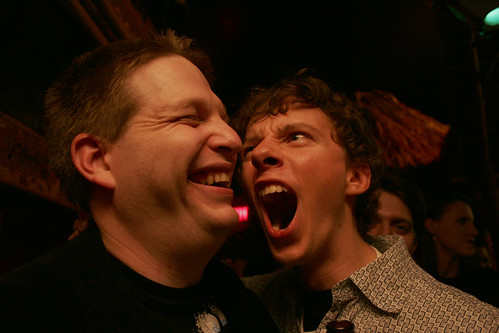
Image by Our Hero.

Labels: , , , , , ,

Tuesday, February 24, 2009

The Brogan Effect 2: Electric Boogaloo

Bad Chris Brogan - Gnomedex 2008

Last week, I mentioned that a retweet from Chris Brogan had resulted in 21 times my normal daily blog traffic. When I mentioned this, a commenter asked what effect my blog post about "The Brogan Effect" would have on my traffic that day.

As it turns out, a lot.

Once again, according to Lijit, my daily traffic (which normally hovers around 30 visits, or so Lijit tells me) jumped to 563 visits on the day I posted "The Brogan Effect." That's about 18x my normal traffic, or just a hair off from the previous instance. (And, yes, Chris Brogan retweeted *that* day's post too, so the same effect still applies.)

As I mentioned before, Chris isn't the only person who drives traffic to my blog, nor does that traffic always stick around after his initial "must-read" suggestion has been heeded. (In fact, last week, my traffic steadily declined each day after the initial Brogan bump.) But it's becoming clear to me that one way to generate a large amount of daily traffic is to either:

* write a post that the influencers (like Brogan, whose word is trusted among his readers) enjoy and recommend, or

* write about the influencers themselves, because their sheer association with a blog post is somehow magnetic.

This leads me to two larger observations about the future of blogs and media:

* In this new millennium, as Gary Vee implores, anyone can become a content creator, but that's still not enough to topple the existing media congolmerates. However, being a trusted thought leader of thousands *could* be enough, because that kind of clout leverages both the distribution AND marketing power of those corporations into smaller, individualized channels that prompt direct action. (Lucky for you, I've assembled 10 ways to become a thought leader.)

* If writing about the influencers is the best way to aggregate an audience -- at least for a day at a time -- does this mean we'll all be reading (and writing) a lot fewer posts about original concepts and a lot more posts about what other people are already doing? I know none of my posts that involve critical analysis of a subject generate anywhere near the amount of feedback as the sound bite-friendly, personality-driven ones do -- probably because the web isn't designed for analysis, but snapshots of distraction.

All of which means I should probably find a way to work the word "Brogan" into everything I write from now on, just to make sure my bills get paid on time... and so should you.

Image by Randy Stewart.

Labels: , , , , , , , , ,

Tuesday, February 17, 2009

The Brogan Effect

podcamp pittsburgh

Last week, I witnessed the direct impact of a referral from Chris Brogan on my blog traffic, and I thought it was significant enough to share.

After having not blogged since December, I finally got back in the blogging habit last week. One of those posts, about the reasons people don't talk to each other at social events, grabbed a lot of attention on Twitter -- and the bulk of that attention was driven by a single re-tweet from Brogan:

My friend @justinkownacki doesn't want to meet you - http://is.gd/jihd


True to the form of a verified thought leader, Brogan's acolytes ignored his warning and swarmed my blog in huge numbers. (Huge for me, anyway.)

By the Numbers

* According to Lijit, my normal weekday traffic (as measured by their service) hovers somewhere between 30 and 40 hits per day.

* On Thursday of last week -- the day of the blog post mentioned by Brogan -- my traffic jumped to 769 views. (That's 21 times my normal traffic.)

* I have over 2,000 followers on Twitter; Chris Brogan has over 40,000 followers. That means Chris has approximately 20 times the reach I have on Twitter.

* That one retweet by Chris of my initial blog post announcement was then retweeted at least 6 times by Chris Brogan's followers.

* My Friday traffic also jumped to 224 views, which is 7 times my normal traffic.

* I gained over 100 Twitters followers on the day that blog post hit; most of whom were already following Chris, but not me.

Admittedly, Some Other Things to Keep in Mind...

* The blog post itself was titled "I Don't Want to Meet You." It doesn't take Copyblogger to tell you that contentious blog titles often elicit clicks and rewteets.

* In point of fact, my own mentions of this post on Twitter were retweeted at least 7 times all by themselves.

* Influence is disparate. Fellow Twitterer Lily Hill also drove new traffic here, with her followers retweeting her mention of my post another 2 or 3 times.

* Despite the influx of new readers (and commenters), my RSS subscriptions only jumped by 6 people.

So What's It All Mean?

* It's currently impossible to track EXACTLY how much traffic was driven by any one of the mentions of my blog post on Twitter, so all traffic estimates are just that -- educated guesses.

* It's often hard to tell which retweets come from where, since people often paraphrase the original in order to fit within the 140 characters while also hopefully giving proper attribution to where they found it.

* Either most blog readers still aren't using RSS subscription tools, or the new readers who came here via Chris and Lily decided that the *rest* of my blog output wasn't worth subscribing to.

And, of course, the one undeniable truth:

* In the aftermath of a huge awareness spike, I now feel the need to be INCREDIBLY RELEVANT to anyone who stumbled across my blog and now expects pearls of Brogan-approved wisdom on a daily basis.

Or, as Randy (one of Brogan's followers) put it:

Glad @ChrisBrogan yelled it out, he's rarely wrong, if ever


So if I think *I* have pressure meeting people's expectations, something tells me Chris's followers' expectations for *him* are almost Neo-like. (Somehow, I doubt that makes either of us sleep any easier at night.)

Photo by m0xie.

Labels: , , , , , ,

Tuesday, September 09, 2008

10 Ways to Be a Social Media Asshole

You may have heard that social media is "all about the conversation." That may be true in some cases, but not all. In fact, for some people, social media is simply about finding new and interesting ways to be an asshole - it's Machiavelli's "The Prince," as applied to text boxes.

If you're finding it difficult to irritate people on a regular basis, here are ten tips you can follow to aggravate even more people - many of them strangers!

1. Insult people loudly and publicly. Bonus points if you don't know the person, but you do know enough to know that he / she / they must be horribly, horribly wrong. This will endear you to everyone else who shares your opinion, and will make you seem like a man / woman / composite persona that's not to be fucked with.

2. Leave scathing comments in public places. Nothing says "I've seriously considered your work / opinion and respectfully disagree" like personal attacks injected into one's thoughtstream.

3. Always be anonymous. Never say with public faces what's best typed hidden in private places.

4. Always ignore grammar / spelling / punctuation. Clear and legible disagreements are best left in the classroom. As a person with unbridled truth to share, you're free of the rules of class.

5. Steal other people's work. Creative Commons licenses never hold up in court, because Americans know that anything available to the public is fair game. If they didn't want you to take credit for their work, they wouldn't have made it public in the first place.

6. Talk endlessly about yourself. In a world of nearly 7 billion people, nothing is as interesting as you. Always find a way to turn topical conversations into conversations about you - especially when you don't know what people are talking about in the first place. (One great way to do this is to lead off with "Speaking of ___," and then immediately change the subject to that head cold you're not quite over.)

7. Namedrop like it's your job. Because it is. That's because people may not remember you, especially if what you're doing is redundant or unremarkable -- like, say, being a "social media expert" or "communications guru"-- but they'll damn sure remember who you had lunch with last week. (And by "had lunch," it's okay if you forget to add, "in the vicinity of," or "at the same conference as." Because even if you *didn't* technically "have lunch" with Seth Godin, he undoubtedly follows you on Twitter, so he might as well have been at your table when the server girl spilled all that water on Andrew Baron [at the next table].)

8. Pontificate loudly about why all new ideas will fail (or PHALE). And then, if they don't, take credit for their success by insisting that the creators of said idea must have taken your warnings seriously and changed their business plan.

9. Blame designers for your inability to understand their services. Because if it doesn't work exactly like Google, Flickr, MySpace or anything else you already know, it's new, and new design is bad and likely to fail (see above).

10. Make all private emails and messages public. Because if so-and-so had really meant it when they direct messaged you in confidence, or asked you to sign that non-disclosure agreement, they wouldn't have used the internet for such sensitive communications. As mentioned previously, if it's on the web -- even behind someone else's password-protected intranet firewall -- it's fair game. (The people have a right to know.)

Do you have a favorite approach that I've overlooked?

Labels: , , , , , , , , , ,

Wednesday, October 03, 2007

Has the Social Network Exodus Begun?

** UPDATES to this post at the bottom **

It's official: Michael Bailey is off MySpace and Facebook.

If you don't know Michael personally, you've probably never been to a social media function. I've known Michael to pop up at PodCamps from Boston to Pittsburgh, and at VON in San Jose and PME in SoCal -- all from his homebase in Missouri. For quite awhile, Michael has been one of the few active cross-coast socializers originating from the Midwest.

And he just admitted today that it's mostly bullshit.

Now, granted, Michael has been known to ruffle feathers. Michael is a pot-stirrer, like myself, and is often just as interested in seeing HOW people react as he is in WHAT they actually have to say.

But he brings up a great point, via Twitter:
When you lower the bar of what really matters and what is important, things like social networks crop up like weeds... You all know how to get ahold of me, you have my email address, my cell #, my address. If it matters, reach out, attach yourself.
Let's ignore, for the moment, the fact that not EVERY interaction requires a phone call or an email. (Michael himself would admit that.) The bigger question is:

What PURPOSE Do Social Networks Serve in our Daily Lives?

I myself never use MySpace for personal communication anymore. When I started blogging and Twittering, MySpace lost out in the time sink.

I've also not bothered to join Facebook. Surprisingly, I'm still alive, healthy and getting work.

LinkedIN? The most it's done for me is pepper my inbox with arbitrary questions from people I barely know, about job openings or tech issues. No real traction there.

Pownce? Never bothered.

Delicious? Haven't used it in years.

What Michael (and I) seems to be saying is: the signal-to-noise ratio (god, I love Web 2.0 buzzwords; perhaps they'll someday have a Smithsonian display all their own) is reaching the point of pointlessness.

I've heard many people, myself included, muse about the possibility of deleting their MySpace accounts, now that they've essentially become spam boxes. Perhaps there's a temptation to migrate to Facebook, or whatever else comes next.

But, for people like Michael, perhaps Seth Porges is right -- perhaps social networking is a trend that's about to end.

Do YOU still need YOUR MySpace account?

(Side note: In the earlier days of Twitter, when the system was even buggier [if that's possible], there was a massive one-day defection to Jaiku. It was led by Chris Brogan and Robert Scoble, two of the most influential social media voices. And, of course, when Twitter came back, so did everyone else.

Had they stayed gone, what would have happened to Twitter?

Michael Bailey isn't as much of an inciter as Scoble or Brogan, but his point is much more valid. I'm interested to see if there's a tipping point here, and how close Michael comes to it.)

** UPDATE (8:27 PM Oct 3rd): I just canceled my MySpace account as well. Odd, how a service I once spent so much time on is now something I avoid at all costs. Granted, when I started on MySpace (in 2004), I was single and the service was new -- two great hooks to occupy my time. But now, I have so many other ways to keep up with people, I just don't NEED MySpace.

I still have an STBD account there, though. Why? Because that's the only way some people watch our show, so as long as there's an STBD, there might as well be an STBD MySpace...

Labels: , , , , , , , , , , , , , , , ,