Cafe Witness

Tuesday, April 21, 2009

Where I'm Speaking Next: The Business Smart Tools Conference

On Tuesday, May 5, I'll be conducting a pair of workshops at the Business Smart Tools Conference in Stamford, CT. The subjects I'll be covering are the two I spend the most time with online: video and Twitter, both in terms of business use.

The BST Conference is aimed squarely at companies who are just starting to explore social media. Admittedly, as someone who's been creating social media for years, I often take it for granted that everyone already knows what I know. Then I meet someone new -- or I organize a PodCamp Pittsburgh -- and I remember that technophobia and learning curves tend to keep some people away from the web. This event is intended as a way to break down some of those barriers and get new businesses interested and up to speed on the potential of social media.

Other speakers include Tom Guarriello, John C Havens, Cindi Bigelow, Albert Maruggi and Scott Monty, who's been working wonders on the social media front at Ford.

Want to attend the BST Conference? Register with the discount code "twitter" (no quotes) and save 20%!

Want to hire me to speak at your event? Contact me on Twitter, or leave your email address in the comments below.

Labels: , , , , , , , ,

Friday, February 13, 2009

They'll Never Know Who You Are Unless You Break Into Their Homes

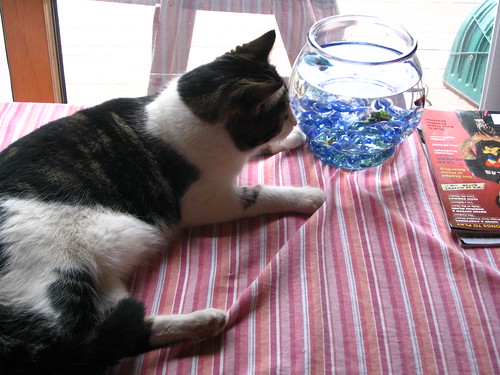
sonny and the fishbowl

After the conversational stir caused by yesterday's blog post, I'm happy to report that there was a healthy intermixing of complete strangers at last night's Pittsburgh Twestival. (Congratulations to Holly Maust and Mandy McFadden for organizing a great event, and special thanks to Derrick Brashear for manhandling the A/V duties like a man possessed [by his own techxpertise].)

And yet, at least one person mentioned that he hadn't even heard of the Twestival until yesterday morning. (In fact, he'd just heard of the worldwide event at 5 AM, and he said to himself, "There's no way Pittsburgh would be involved in this." And then he scrolled down the list of participating cities and was amazed to discover he was wrong.)

To me, the bigger question isn't "why would one automatically presume that Pittsburgh wouldn't be involved in such a thing," but, "why wouldn't someone have heard about a fairly major event until the morning of?"

I'm pretty sure the answer has to do with closed loops.

I Can't Hear You Because I Won't Stop Talking

Because Holly and Mandy travel in a slightly different social media crowd than I (and the rest of the PodCamp Pittsburgh organizers) do, each group doesn't always hear about the events that the other group is involved with. That's because all the chatter about these events tends to be confined to our existing Twitter / blog / podcast / social network loops -- which means we'll talk about them endlessly to ourselves, but the information will be lost to anyone who isn't already tracking those channels.

The long-standing knock on social media is that we're a giant fishbowl of geeks who talk endlessly about ourselves to each other. Based upon the disconnected subdivisions I'm discovering among the Pittsburgh social media crowd, I think it's likely that every city has its own disparate groups who are caught in their own feedback loops, which means we're actually all a bunch of even SMALLER fishbowls stacked inside the same dunk tank.

So how do we break out?

By breaking in.

You be Me for Awhile, and I'll Be You

Sure, we're all swimming in our own fishbowls, but SO IS EVERYONE ELSE. And for every person who knows what Twitter is, there are a thousand (at least) who don't, which means THOSE people are getting their information from other sources. And guess what: they don't think they're missing anything, because if something's important enough, they presume it's already found a way onto their radar.

So get on their radar.

To do this, you'll have to step outside your comfort zone and step into theirs. Everyone has a different information-gathering routine, and you need to figure out what everyone else is doing when they're NOT engaging you (because, right now, they aren't -- so spending more time getting the word out through your existing channels is just polishing the same fishbowl).

You may have to traffic your message in unfamiliar territory. You may have to explain things that you currently take for granted. You may even have to engage different TYPES of media, because not everyone is on Twitter, or Facebook, or even the internet. But they're all somewhere, and they're all reading something, or watching something, or listening to something else. And that something probably isn't you.

But it could be.

(Image by samatt.)

Labels: , , , , , , , , ,

Thursday, February 12, 2009

I Don't Want to Meet You

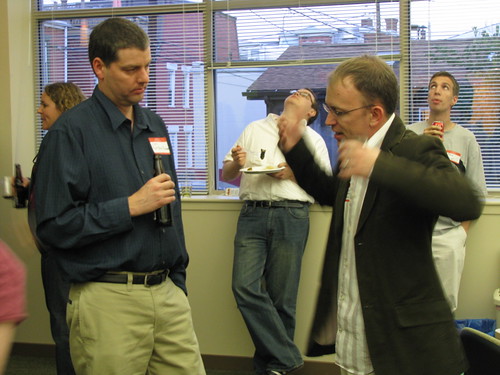
IMG_0257.JPG

I had a great time at yesterday's Open Coffee Club, where investors, entrepreneurs and wild cards (like myself) came together at AlphaLab for some quality face time. The catch? Although I met 3 or 4 new and interesting people, I spent most of the event talking to folks I already know.

Why do we do this?

Why do so many of us attend "face to face" events and then spend the bulk of the event talking to the same people we knew yesterday? Isn't the entire point of a social event to meet people you wouldn't otherwise have the opportunity to talk with?

And yet, when faced with the prospect of cold-contacting a complete stranger -- even at an event where everyone allegedly has multiple overlapping interests and is ostensibly there PRECISELY to make new contacts -- most of us who don't already have an elevator pitch burning up our tongues opt for the woobie of familiarity.

I think the reason why is 3-fold:

* The known payoff from talking with a friend is preferable to the unknown outcome of talking with a complete stranger. Especially at an event where you're not sure what everyone's area of expertise is, and you're afraid you won't be able to extricate yourself from a conversation with someone who offers no direct value (in your opinion).

* We have no idea what our true value is. So instead of trying to explain why we think we're valid to a complete stranger (who, we presume, is automatically judging us and comparing our net conversational worth against that of everyone else in the room), we'd rather talk with people whom we already know appreciate us in some capacity.

* We have no game plan. Sure, the concept of being surrounded by "interesting people" is alluring, but once we're in the situation, we immediately presume that everyone else who's there has a much more specific agenda. If WE don't, we wouldn't want to waste anyone's time (or our own), so we aim for the low-hanging fruit of familiarity instead.

All of this usually results in small clumps of conversations among people who obviously already know each other OR, in a variant, people of a similar age / gender / dress code, who gravitate together because they imagine that they must have something in common. And if you've come to such an event alone and aren't wearing a popularized "uniform," you're probably floating along the fringes, eating the free food and conspicuously pretending to check your text messages, so no one knows you're privately terrified of making contact.

If so, here are 5 tips for breaking up the monotony at your next "live" event:

* Pre-set one goal. Maybe you want to meet one prospective collaborator. Or bounce a vague idea off 5 people. Or collect 20 business cards. As long as you have a concrete goal, you can focus on accomplishing that first, and then any chatting among your friends won't feel so guilty.

* Talk to the loner. Immediately beeline for the nearest person who appears to be floating adrift and engage them directly. As you've probably noticed, small groups tend to be where the loners will eventually wash up anyway, so you might as well cut out the middleman and form your own small group right from the get-go.

* Bring people together. Chris Brogan is the master at this, usually because he's swamped with conversations and needs an elegant escape clause. Following his method, start by engaging someone you DON'T know. Find out their story, in a nutshell. Then rope in your nearest friend by asking the new person, "Have you met my friend [NAME] yet?" and physically deposit them in a conversation. This allows you to then step away without leaving the new person alone, which is probably how you found them.

* Make a scene. This is where talking with your friends actually comes in handy. Once a pack of you are talking about something, get contentious / absurd / offensive / funny, and raise your voices. Move around. Draw attention to yourselves. Because nothing attracts a crowd like a crowd -- especially one where a wallflower can expect to linger and observe without being drawn into the fray because the fray seems self-contained. But here's the catch: once you've attracted some spectators, then draw them directly into the spectacle. Ask them a question, use them as an accomplice in a recreation -- whatever it takes to incidentally break the ice and help them feel like they're now a part of the fray. (Because they are.)

* Refuse to leave until you're out of business cards. This means you're forcing yourself to meet new people until there are none left. It also means you probably want to arrive with fewer than 500 cards in your pocket, or you'll be making friends with the caterers and janitors, too. (Which, depending on your pre-set goals, may not be such a bad idea after all...)

NOTE: Dropping the cards in a stack near the coffee cups doesn't qualify as dispensing them. Man up, people.

This image of Woycheck trying unsuccessfully to frighten Jim Russell into fleeing was taken at a previous AlphaLab event by Michael Fulk.

Labels: , , , , , , , , , ,

Wednesday, February 11, 2009

10 Things I Learned at SocComm

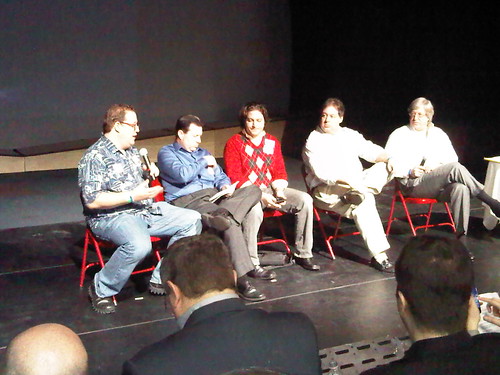
Privacy and policy panel at #SocComm

I spent yesterday driving to and from New York City to attend the first Social Communications Summit, a meeting of the new media minds organized by Jeff Pulver. Amid the flurry of driving, schmoozing and driving again, I gleaned a few bits of wisdom. Here, in no particular order, are ten of them:

* Social media has become a haven for people who like to talk loudly, and at length, about what they think they know.

* When it's barely 10 AM and the audience Q&A has already forced one speaker to restate the scientific definition of "reality," I become acutely aware that the buffet table is only offering decaf.

* We need new demonstrable criteria for what defines anyone as an "expert" in any field -- especially something as subjective as communications.

* I disagree with part of Gary Vee's assertion that "FOX is dead. The New York Times, CNN, all of them: dead." Most people seem to confuse the distribution mechanisms, the content and the companies. The physicality of the daily newspaper is in decline, but the New York Times is not dead; people still require information. The Times (and every other news / entertainment company) has the resources, reach and ability to place that information in the possession of those who desire it, for a price. The way it reaches them may change, but by no means does a shift in the distribution mechanism mean that a whole company or medium is "dead;" nor does it mean that the power has shifted to the content creators, who still -- like it or not -- require some variation of a trusted "gatekeeper" to ensure that their content is seen by the maximum number of people. (Although, I will concede that it's possible to now include "yourself" in that list of gatekeepers who are keeping your work from being seen.)

* Privacy and property law are going to be HUGE issues for these media in the coming years; Pulver's right to be training everyone's attention on the policy discussions surrounding what we can and can't do (yet / now / for a little while longer).

* Lots of rhetoric from 2005 (i.e., mass media is dead, each of us can become a mogul, etc.) still being tossed around, but the core issues (money, innovation, proliferation) still involve much grasping and posturing, and few verifiable answers.

* It's quite awkward to watch the people who hover around Chris Brogan, Jeff Pulver or Gary Vee, waiting for the opportunity to introduce themselves and slip immediately into "the pitch." These three get immense pleasure from having the power to connect people, bring disparate personalities together, and generally act as "hubs" for disruptive thinking. And yet, for a medium that's allegedly built around being social, too many people seem to be confusing "social" with "sales."

* That said, I've realized that I don't have it in me to "work the room." I'm more content to chat with a few people, and (ideally) have an enlightening conversation or two, than to make the casual acquaintance of an eventual stack of business cards. Either I haven't distilled my essence into the proper elevator pitch, or I just don't feel the driving need to impress people. (I'll let my razor-sharp wit and rampant douchebaggery do that for me...)

* Amber Naslund = thank god for real people.

* Lots of the top minds in these overlapping fields (mobile technology, content creation, marketing, law, etc.) are saying the same things privately and making the same predictions and proclamations, but using slightly different terminology. Methinks the next shift in fishbowl consciousness is upon us; look for it to trickle down into easily-quoted memes by the end of the year. (Keyword hint: "reputation", not "brand".)

* The staff at the 3LD Art & Technology Center were friendly, helpful and generally seemed to be on the ball about most of the event's logistical needs. However, they -- like most first-time "new media" hosts -- were woefully underprepared, wifi-wise, resulting in lots of people not being able to connect. Oddly enough, instead of forcing attendees to actually pay attention to the presentations, the absence of wifi somehow seemed to destroy everyone's ability to focus. This resulted in a day-long plethora of bite-sized hallway conversations, which may be proof that the social media crowd has now been programmed toward distraction, regardless of availability.

* Driving in New York for the first time? Not as hard as I thought it would be. But driving in New York for the first time and tangling with a duplicitous Google map, unmarked road construction, throngs of pedestrians militantly dedicated to walking slowly and a bladder so full to the point of rupture that I actually contemplated the physics of peeing upward into an empty water bottle while in motion? Slightly more difficult than it should be. (Indeed, you're welcome for my $10 "donation," Brooklyn-Battery Tunnel...)

Thanks to Jeff, 3LD and everyone else involved in organizing and executing the event. I suspect it'll be fuel for a number of conversations over the coming days, and hopefully some of these nagging questions about the future of social media will begin to find their answers -- preferably without the disapproving eye of The Law.

Image by Michael Lewkowitz.

Labels: , , , , , , , ,

Friday, November 14, 2008

How Bad Typography Can Help You Solve Problems

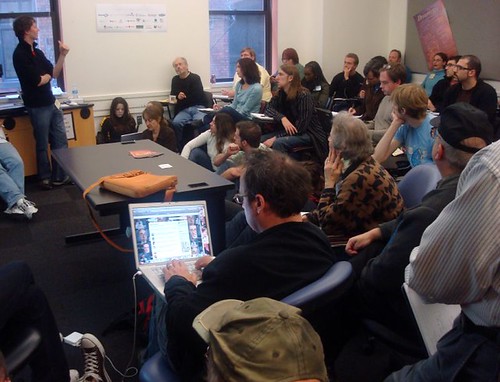
Typography Friday

Last night, I attended my first Refresh Pittsburgh meet-up, held at the local tech startup incubator, AlphaLab. Refresh Pittsburgh is an informal group of designers and programmers, looking both to network and to learn from one another (and their occasional guest speakers). Although I'm not a designer, per se, I *am* a creative type (or so I like to claim), so I enjoy hearing how other creative types solve their problems.

Yesterday's guest speaker was Samantha Warren of Viget, a design firm in Washington DC. (She also blogs here. She gave a kick-ass presentation on bad typography, and how (and why) it can kill your web experience. And then she showed how she would have redesigned one horrible site in particular, taking us step-by-step through both her technical AND her theoretical processes.

What I appreciated most was seeing her decision-making process, and learning HOW and WHY she arrived at the conclusions she did. Sometimes, she realized her initial presumptions or goals were incorrect midway through her process, so she backtracked to redesign her end product. Fellow speakers and presenters of the world, take note: knowing that a speaker can admit to being wrong, and then seeing the steps she took to fix things, made me trust her (and her process) even more.

In the end, the two lessons that stuck in my head most clearly were:

* (Samantha's intentional lesson): Don't let the details (like typography, design or even functionality) drive the project; let the PURPOSE drive the project, and the details will fall into place.

* (Samantha's unintentional lesson): When presenting, always make sure to include the URLs of any interesting sites / services you might mention. If you catch the audience's attention, they'll want to know how to learn more.

Other cool tips and tidbits you may know (but I didn't):

* Ms. Warren considers the 3 pillars of web typography to be: Legibility, Hierarchy and Expression.

* A gent named Jakob Nielsen developed a design concept called the F-Pattern, which (counter-intuitively, if you ask me) seems to make sense.

* Ms. Warren suggests designers evaluate all information on a webpage in terms of order of importance, and then allocate the proper typographical weight and direction of attention as required.

* Use phark or siffr for image replacement -- which, as a non-designer, I can barely even understand, but I suspect some of you know what she's talking about (and it seemed important).

* Texture, texture, texture.

If any of this sounds interesting to you -- or if you suspect you would have learned more by actually attending the meet-up (rather than reading my shoddy secondhand journalism), perhaps I'll see you at the next Refresh Pittsburgh event?

Image by ErokCom.

Labels: , , , , , , , , , , , ,

Monday, October 20, 2008

Post-PodCamp Pittsburgh 3: 5 Ways to Gauge an Event's Success

JustinAtPCPGH3

First off, thanks to everyone who attended PodCamp Pittsburgh 3 this past weekend. Although we haven't tallied the final check-in numbers yet, all practical indications (like perpetually running out of food) point to this being our largest and most well-attended event yet. (Either that, or everyone got a free tapeworm in their swag bags...)

Also, as one of the event's primary organizers, I can never thank my fellow organizers enough. I know how much work went into planning PCPGH3, and even though things never run 100% smoothly at any event -- much less one involving technology -- I'm exceedingly proud of how well things came together this year. Everyone did a great job and I'll be very happy to work with all of you again next year... after we all hibernate for a few months.

However...

After throwing a huge event, I think there's a temptation on the part of the organizers to pat themselves on the back and say, "well done." But when it comes to social media events like PCPGH3, we won't *really* know how well we did at organizing the event until several months from now, because the long-term impact of education-based events like this can't be measured immediately. We have to see what people DO with the information they learned here.

So, in the meantime, here are 5 Ways I'll Be Gauging the Success of PCPGH3:

1. Attendance -- Although we had our largest number ever of pre-registered attendees, we'll need to tally the final head count before we know if our active numbers are actually increasing or remaining stable. The good news is, I didn't recognize about half of this year's attendees, which means we're definitely bringing NEW people in. (Also, weather plays a factor in attendance, so don't judge a summer event straight-up against a winter event, etc.)

2. Press Coverage -- If your event is a success in the eyes of the attendees, they'll talk about it afterward -- in our case, via blogs, Flickr, Twitter, etc. The more we see, the more we'll know that the PCPGH3 experience was share-worthy, and that's always a good thing.

3. Who Follows Up? -- We're holding a smaller, informal gathering on Wednesday, November 19 @ 7 PM at the Firehouse Lounge in the Strip District. Our goal is to support the conversation (and the community) that coalesces every year at PCPGH, but then seems to recede as the months intervene between events. Knowing that people want to keep the discussion (and the activity) alive beyond an annual clip is a good indicator that the ideas they encountered at PCPGH3 have traction.

4. Who Takes Action? -- Since PCPGH is an event designed to help people learn more about creating web media, it follows that we like to see our attendees creating newer, better things all the time. The long-standing content creators here in town won't be fading out anytime soon, but for the dozens of attendees who don't yet blog or podcast, who among them will start experimenting and reaching out for help when they need it?

(One great way to stay involved is to join the newly-created OMGPittsburgh blog, launched for us by Bostonian weekend-expat Chris Brogan live at PCPGH3.)

5. Who (or What) Will Become Next Year's Success Story? -- A year ago, none of our attendees had been a finalist for major web awards like the Bloggies or the Yahoo Video Awards, but this year, that (twice) changed. So did the idea that you can't invent a new word and have the public take notice (bacn, anyone?).

So will someone else take the lessons they learned (and the relationships they built) at PodCamp Pittsburgh 3 and use them to build the next killer app, the next red-hot web series or blog, or even expand their business? If they do, then the concept of PodCamp Pittsburgh as a reliable incubator of game-changing ideas will live on.

How do YOU think we did at PodCamp Pittsburgh 3?

Photo by Locobone, who would have made this available under Creative Commons License if he'd thought about it... ;)

Labels: , , , , , , , , , , ,

Wednesday, October 15, 2008

PodCamp Pittsburgh 3: Meet Our VIPs

Although PodCamp Pittsburgh 3 is a free event, we decided to offer this year's attendees the opportunity to pre-register as VIPs. The perks of being a PCPGH VIP -- in addition to having a lot of abbreviations to throw around -- include some advance notoriety (i.e., a listing here), a swag bag and a free PCPGH3 t-shirt.

Following are the profiles of some of our PCPGH3 VIPs -- namely, the ones who wanted to take advantage of the opportunity to get some extra exposure for themselves and their work. (Those who didn't must only be coming for the free t-shirts...)

PCPGH 3 VIPs (Listed Alphabetically by Last Name)

Aaron Aiken (Twitter)

Aaron is a Web 2.0 junkie who will jump on any bandwagon offering private beta invites. He is passionate about personal finances and happens to write a blog on the subject with his wife, Lindsay. He writes to fulfill his passion and dreams of writing full-time one day. Aaron believes strongly that change can only come if one is willing to grow. His advice (to anyone who does not ask for it): “Track your spending for the next 30 days and get on a budget.”

* Areas of expertise: Writing, creativity, learning, and his Blackberry Curve 8310

* Areas he'd like to learn more about: Podcasting, getting more traffic to our site and developing repeat visits, growing a community, and using social media to raise awareness of our website.

********

Lindsay Aiken

Lindsay is a full-time nanny and part-time college student studying Massage Therapy. When she’s not working, she enjoys writing for her personal finance blog that she maintains with her husband, Aaron. She hopes that their blog will be useful to other people their age, helping to teach them the importance of properly managing their money so they will be prepared for the future.

* Areas of expertise: Writing, creative organization, and frugal living

********

Kathleen Danielson (Twitter)

"I am a college student just learning about social media. I'm eager to learn more about the way information spreads online and how people connect and develop relationships using different tools across the web. I'm studying International Affairs at George Washington University, concentrating in Global Public Health. Hopefully, I'll eventually be able to combine my passion for international affairs with my passion for social media."

* Areas of interest: viral marketing, social networking, human interaction, lolcats, video, blogging, building community, evangelizing web 2.0

********

Megan Engle (Twitter)

Megan is the Social Media Manager at the Michigan Nonprofit Association, and is currently working on revamping the MNA blog. She enjoys exploring new ways to cook vegetarian food, polishing her near-extinct Arabic skills, and figuring out what's going on in the world of social media.

Outside of work, Megan can generally be found walking her chocolate lab Mort, sporting a Kentucky Wildcats t-shirt, thinking about whether she passed the Michigan Bar Exam, and mourning the loss of The Wire, which she thinks may possibly be one of the greatest television shows, ever.

* Areas she'd like to learn more about: blogging, audio (podcasting), video, social networking, and ways for nonprofits to use social media.

********

Shawn Farner (Twitter)

Shawn Farner is a senior at IUP with an unhealthy passion for both social media and community service. After his December graduation, he hopes to work for a web startup or for a business trying to establish a social media presence.

********

Tim Grubb (Twitter)

Tim podcasts with Jen Sadler on Brain Gravy and insists, "We're not alcoholics with a drinking problem, we're Alcohol Enthusiasts with a podcasting problem."

********

Tim Hindes, Pittsburgh Tech Council (Twitter)

In his current position, Tim oversees all aspects of marketing and communications efforts for the Pittsburgh Technology Council -- one of the sponsors of PCPGH3. Tim's job focuses primarily on electronic media and strategic communications. In addition, he was responsible for project management of the Council’s new Web site, dedicated to highlighting membership benefits, member profiles, case studies, new products and added services. Strategic planning, brand development and marketing partnership relations were additional areas of Tim’s responsibility. While at the PTC, he developed other viral marketing media, including social marketing channels, blogs and interactive networking groups. His communication plan helped earn the Council the ASAE Gold Circle Award - Honorable Mention, in 2007, for electronic communications.

Based upon his marketing expertise, Tim also serves on two advisory boards including the Business Administration Advisory Committee for Pittsburgh Technical Institute and the Sales & Marketing Network Advisory Board of the Pittsburgh Technology Council. Tim is a 2000 cum laude graduate of Allegheny College in Meadville, PA, with a bachelor’s degree in Communication Arts and a minor in Society, Art and Science. He currently resides in the South Hills of Pittsburgh, PA.
 
* Areas of expertise: Marketing, Blogging, Lead Generation, Social Media Strategy

* Areas he'd like to learn more about: Networking, More Blogging, SEO, Podcasting, Business Usage

********

Blake Imeson (Twitter)

Blake is a junior at Grove City College, working on a degree in Entrepreneurship. Blake does part-time SEO and Social Media consulting. Connect with him on LinkedIn.

* Areas of expertise: SEO, Blogging and Social Media

* Areas he'd like to learn more about: He is a huge fan of Wordpress and Firefox.

********

Alan Jakub (Twitter)

Alan is a Web Designer with experience in WordPress, Podcasting -&- Graphic Design  He's also online at Dr-T.

********

Julie Morey, ElasticLab (Twitter)

Julie Morey is currently the Chief Creative Officer at ElasticLab -- one of the sponsors of PCPGH3. In 30 years as a designer, art director and brand strategist, Julie’s work for brands like Vehix, AT&T, Quiznos, Nextel, Herman Miller, American Express, Nordica and Public Television has resulted in both dramatic results and creative recognition. With a strong background in commercial production, a mid-career opportunity to lead creative efforts promoting a spirit of ethnic diversity for AT&T, MTV, HBO and TBS has fueled Julie’s love of the social medium. In 2007, she began developing Elastic Lab with a firm belief in the creative future of film and new media. Julie has earned more than 150 awards including the One Show, Communication Arts, Clios, and International Broadcasting Association (IBA).

* Areas of expertise: brand design, film production, advertising

* Areas she'd like to learn more about: music, new technologies, blogging


********

Melody Platz

* Areas of expertise: Travel writing, maintaining multiple blogs and creative writing

* Areas of interest: Humor, History, Eating, Science, Good Friends and Sleeping

********

Walt Ribeiro (Twitter)

Walt Ribeiro's "in your face" teaching style has created an entire community of those interested in music or not. "The Internet's Music Teacher" has consistently created a fleet of dedicated viewers, and shares his lessons, passion, and knowledge of music (and more) everyday. Ribeiro now teaches music lessons full-time online as "Your Daily Music Lesson with Walt" for sites like Revision 3, Ustream.TV, and more.

* Areas of expertise = The Internet's Music Teacher, Social Media marketing, Orchestration

* Areas he'd like to learn more about = Networking, production, distribution, marketing

********

Jen Sadler (Twitter)

Jen is a Podcaster/Freelance Social Media Consultant from Essex, Ontario, Canada. She podcasts at Brain Gravy.

********

Scott Tyler

A beer geek and snob extraordinaire...

********

Come meet these fine folks and hundreds more at PodCamp Pittsburgh 3 on October 18-19!

Labels: , , , , , , , , , ,

This Weekend: Pods, Puppets and Smarm


PodCamp Pittsburgh 3 happens this weekend at The Art Institute of Pittsburgh, and as a primary organizer of the event, I'm excited to meet, teach and learn from fellow social media creators -- as well as people who haven't created anything yet but who are very eager to learn how.

In that vein, PCPGH3 is helping to promote the 10th Annual Black Sheep Puppet Festival that's happening all week here in Pittsburgh. Part of the event involves a live 24-hour "puppet reality" experiment, in which teams of puppeteers are grouped together and given 24 hours to create a full performance -- including making the puppets from scratch. In addition to helping the BSPF set up a wireless connection for their live webcast of the experiment, we're also helping them use Twitter and other services to spread the word.

Plus, I'm launching the sixth (!) season of our web sitcom Something to Be Desired on Monday -- but if you're at PodCamp on Sunday morning, you'll be able to see the first episode of our new season in front of a live audience. Meanwhile, we'll be filming scenes for an upcoming episode of STBD during the Black Sheep Puppet Festival, so look for excerpts from the BSPF on STBD and see them both at PCPGH3.

(And now I'm out of acronyms for the week...)

Labels: , , , , , , , , , , , ,

Monday, September 15, 2008

Two Ways to Spend a Night in the Dark

IMG_2391_pso_encore.jpg

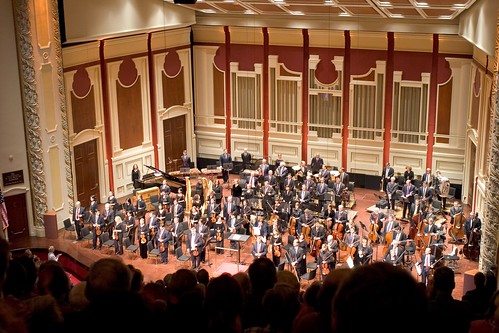
The Pittsburgh Symphony Orchestra recently issued a call for bloggers to cover this year's season of performances, so I threw my text-based hat in their web-based ring. They took me up on it, and now I'm one of nearly a dozen bloggers who'll be offering "outside perspectives" on various PSO performances over the next 8 months. If you're a fan of classical music (or incongruous and occasionally insightful commentary about it), you can follow the PSO group blog here.

Meanwhile, a case of celestial irony: Shortly after attending the PSO's "sneak preview" concert -- at which new maestro Manfred Honeck was not in attendance -- I posted my first PSO blog entry, entitled "A Night Without Honeck". Suitably amused, the gods then caused a wayward tree branch to collapse on some electrical lines in my Greenfield neighborhood, resulting in A Night Without Power for me and about 30 of my neighbors. (Since Duquesne Light is still swamped with reports of outages, we're not expecting ours to get fixed anytime soon.)

As a result, four of my neighbors gathered on their shared stoop last night and listened to the end of the Steelers-Browns game by candlelight, on a battery-powered radio. I couldn't quite hear the details from my open window, so I wandered down and listened to the closing moments with them. Funny that it takes an act of nature (and NFL scheduling) to force people who live less than ten feet apart to actually make the effort to introduce themselves.

Lastly, the Pittsburgh Post-Gazette has an interesting profile about the hard-fought rise of Maestro Honeck, who -- since he wasn't the apprentice to an established conductor -- decided to become one by starting his own orchestra. Talk about innovating your way to success...

Photo by Sriram

Labels: , , , , , , , , , , , , , ,

Wednesday, September 10, 2008

Liquid Sundays: How to Make YOUR Event More Social

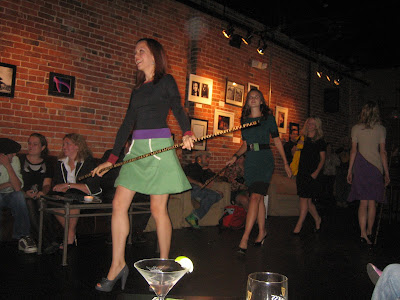
This past Sunday, the minds behind Liquid Sundays, Pittsburgh's bi-monthly fusion of music / art / fashion, invited several bloggers and podcasters to attend their latest event at Olive or Twist downtown. The night featured music from:

* Central Plains (a Pittsburgh semi-supergroup)

* TheeAdora (femme-fronted pop rock)

* The Lost Sea (country folk rock, and my personal favorite of the night)

These performances were interspersed with a DIY fashion show featuring designs from local boutiqes Sugar and Pavement. Plus, discounted drinks, which is always good.

The upside? Decent bands, fashionable people, trendy-yet-functional locale, and a collective of artists and promoters who truly care about Pittsburgh and are endeavoring to help build out its social scene by bringing people from numerous artistic backgrounds together.

The downside? A few lighting issues (the first runway interlude was barely lit, which seemed to defeat the purpose) which were quickly corrected, and a few audio issues (like the space being ill-designed for multiple sonorous amplifiers), which couldn't be.

But my primary observations of the night have less to do with what WAS there than what WASN'T there:

* Apart from the drunk guy who tried a little too hard to get to know me, I didn't meet any people at this event that I didn't already know, and

* Live art / music events are still notoriously averse to the actual idea of connecting people, but they could very easily become better at it - and so can YOUR event.

How?

Identifying the Problem(s)

Admittedly, the main reason I didn't meet anybody new at this event is because I didn't try. I already knew a dozen people in attendance, so I had more than enough conversation to go around. Plus, it was sonically impossible to hear anyone over the din of the speakers, so it didn't make sense to strike up a conversation with a complete stranger when I could barely hear myself.

On the other hand, this event -- like most concerts and performances -- wasn't designed to introduce people to one another. It was designed to showcase the work of the people organizing it, and in that context, it makes perfect sense to drive all of the focus toward the art on display.

But why invite bloggers and podcasters to an event that makes it a challenge to gather information about the people and personalities involved? If we can't divine your story, it's much harder to then explain your story to other people, and isn't that the whole point of putting yourself out there -- to generate a discussion?

Solutions: A Performance Isn't a Conversation - But It Could Be

The Lost Sea perform at Liquid Sundays

In no particular order, here's a laundry list of 10 ways all future art events / gallery openings / concerts / meet-ups / etc. can improve their social functionality.

1. Make nametags available, regardless of the type of event. Even if it's an ultra-hip shindig, give people the option to make their names or other info public. At all levels of conversation-dom, icebreakers are key.

2. Artists: post multiple contact streams. Email signup sheets are functional, but leave out full-contact postcards for visitors to take away: email, MySpace, Facebook, Twitter, LinkedIn, Flickr, etc. Give people the option to contact you in the way that's most convenient for them (and therefore the most effective for you).

3. Liveblog each event. Posting handbills before an event is a necessity. Liveblogging / Twittering / Brightkite-ing an event should become one. This not only gives the live attendees another avenue to meet each other, but it allows people at home to enjoy the event without being there -- and they'll be more inclined to show up next time.

4. Announce your tags. Create search tags for your event / art / music, or hashtags for Twitter, so people will be able to find evidence of the event more easily. Then let people know what those tags are, so they can properly tag all their photos / videos / blog posts that they're creating on the spot. List the tags in all promotions, or call them out from the stage if necessary, but don't let people's media go forth anonymously - or else you lose out on valuable (free) promotion.

5. Schedule "quiet time." Dial down the "between bands" music for a few moments, and give people a chance to meet each other without shouting.

6. Give something away for free, just for coming. Bands: make an MP3 available for download -- maybe even a live cut from the show. Artists: make a photo or image available as a downloadable wallpaper for laptops or cell phones. Let attendees take part of your show home with them, and then they'll have something to show others. (If content control is an issue, post this free media in a secure part of your site, and give attendees directions / passwords during your social network follow-up; see below.)

7. Collect media your attendees have created. If people have tagged their media properly, you should have no trouble finding photos and video from your event. Repost the samples you think are the best on your event's groups / blog, and give credit to the people who enjoyed your event enough to celebrate it afterward.

8. Use Twitter to centrally connect your attendees. Twitter is promotional, but it's also functional. Multi-location or multi-day events can use it to keep attendees posted on schedule changes, location switch-ups, upcoming showtimes, etc. That means fewer questions for your volunteers to answer, and fewer opportunities for your attendees to miss something important.

9. Overlap with similar events AND completely different events. You can use social networks to find people who share interests similar to those offered at your event - armchair photographers, foreign film fans, etc. - but why not reach out to people who have NOTHING in common with your event? Mash up your fashion show with a beerfest, or your gallery opening with a rap battle. It may sound crazy, but how many new ideas -- or buzz -- do you see generated by people speaking strictly within the same echo chamber? (Hint: Not as much as you get from mixing it up.)

10. After the event, add attendees to your network. Include the URL of your event's group on Facebook / MySpace / LinkedIn / NING, etc., on all signage and promotions before and during the event. Encourage people to join / follow your event on the social network of their choice. Reach out to the people who did attend, or who join your network after the event, and thank them personally -- don't let your interaction stop when the lights come up.

In short: give people handles and they'll carry your story onward to others.

Labels: , , , , , , , , , ,

Friday, July 20, 2007

Pittsburgh Photographers, Assemble!

If you're a Pittsburgh-based photographer, photo lover, or just looking for a place to unwind on July 28, Creative Treehouse is hosting an event called Capture Pittsburgh. It's a low-key gallery show of Pittsburgh-related photos, along with live music, food and drink (BYOB if 21+). The event runs from 6 PM - Midnight. Click the pic for a full-size explanation of the festivities.

Labels: , , , ,