Cafe Witness

Wednesday, March 11, 2009

Shepard Fairey: Hero or Hypocrite?

[NOTE: Update at bottom of the post.]

This week, the Pittsburgh City Paper reports that now-legendary street artist Shepard Fairey -- he of the Obama "HOPE" poster -- is suing local graphic designer Larkin Werner over the use of the word "OBEY" in association with Werner's own indie art project, Steelerbaby.

In a nutshell, one of many designs for Steelerbaby merchandise says, simply, "Obey Steelerbaby." Fairey's lawyers claim the use of the word "Obey" is trademark infringement, because Fairey himself first became famous for a series of street art featuring an image of Andre the Giant (remember him?) and the word "OBEY" -- which he then evidently trademarked at some point over the past 20 years.

The ironies, hypocrisies and questions raised by this story are numerous, including:

* Fairey was originally sued by the WWF (now WWE) for his copyright-infringing Andre the Giant images in the first place. But who really "owns" an image? And if that image is of a person, doesn't that person have the final say over where his or her image is allowed to be used?

* Fairey has been under fire from the Associated Press, who claim his Obama "HOPE" image is a blatant infringement on a photo they own the rights to. Fairey's response is that the "HOPE" poster is a derivative work, which means he has the right to use the original image as a basis for something new. If that's his defense against the AP, why wouldn't it also apply in Steelerbaby's case?

* Larkin has yet to be sued by the Pittsburgh Steelers (or the Kewpie doll company), either of which would probably have a much better reason for doing so than a corporation founded by a fellow "street artist."

* Can you realistically trademark a commonly used word?

* At what point does an artist cease to be "street" and transition to becoming "corporate"? (Is it when your work is installed in The National Portrait Gallery? Or is it when you countersue the AP?)

* Am I the only person who thinks now is a great time to push for wider adoption of Creative Commons licenses, as opposed to copyrights and trademarks?

What do YOU think? (Because we already know what Gawker and Steelerbaby think...)

UPDATE (March 23, 2009): It seems Shepard Fairey dropped the lawsuit against Steelerbaby.

Labels: , , , , , , , , , , , ,

Wednesday, October 15, 2008

This Weekend: Pods, Puppets and Smarm


PodCamp Pittsburgh 3 happens this weekend at The Art Institute of Pittsburgh, and as a primary organizer of the event, I'm excited to meet, teach and learn from fellow social media creators -- as well as people who haven't created anything yet but who are very eager to learn how.

In that vein, PCPGH3 is helping to promote the 10th Annual Black Sheep Puppet Festival that's happening all week here in Pittsburgh. Part of the event involves a live 24-hour "puppet reality" experiment, in which teams of puppeteers are grouped together and given 24 hours to create a full performance -- including making the puppets from scratch. In addition to helping the BSPF set up a wireless connection for their live webcast of the experiment, we're also helping them use Twitter and other services to spread the word.

Plus, I'm launching the sixth (!) season of our web sitcom Something to Be Desired on Monday -- but if you're at PodCamp on Sunday morning, you'll be able to see the first episode of our new season in front of a live audience. Meanwhile, we'll be filming scenes for an upcoming episode of STBD during the Black Sheep Puppet Festival, so look for excerpts from the BSPF on STBD and see them both at PCPGH3.

(And now I'm out of acronyms for the week...)

Labels: , , , , , , , , , , , ,

Wednesday, October 08, 2008

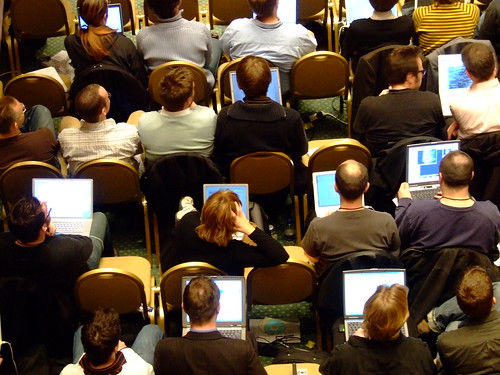
An Audience Without A Reason to Care Is Just a Bunch of People That You Have to Clean Up After

Carson Summit - Audience


Every three months, downtown Pittsburgh's art galleries unite for a free Friday Night gallery crawl. All the spaces are open to the public, the arts organizations mount new works and performances, and there's free food and drink for everyone who attends.

As you might imagine, people usually show up in droves for these events. And then, afterward, almost none of them come back. (At least, not until the next free event.)

Why?

Because just getting an audience in the door once isn't enough to make them want to come back on their own. You have to make the effort to get their attention, yes, but you also have to dazzle them while they're in your space AND give them a means to stay involved even after they've left.

And all of that requires a lot more effort than just handing them a mailing list.

The Fallacy of Eyeballs

At concerts, all bands love to leave mailing list sign-up sheets around the merch table. Mailing lists are useful, but getting people to admit that they want to hear more about you is only one step toward RETAINING that audience; it has nothing to do with GROWING an audience in the first place.

If all a band did was play four shows a year and then hound their mailing list to buy a CD every week, they'd have the support of very few people. So why would an arts organization -- or YOUR company -- be any different?

Give People Handles

The takeaway is the key. A band sells (or gives away) copies of its CD. Their fans play that CD for other people, and their interest in the band spreads. People start talking about that band and developing an emotional or intellectual alliance with the band's style, content and point of view.

Being a fan of the band becomes an active part of each fan's daily culture, and it becomes a natural act to share their passion for that band with others.

The organizations involved in Pittsburgh's quarterly Gallery Crawls can hand out postcards, fliers and mailing lists all they want, but they're not handing out anything people can actually take away and share. Nobody gives their friend a flier, but they will give them a CD.

So what can artists or organizations provide that would be a "CD equivalent"?

What could someone take away from your business / site that would enable them to tell another person about you, and illustrate WHY they think you're so interesting and worth getting excited about?

You Don't Know a Thing About Me

The other major stumbling block most of the Gallery Crawl organizers face is that, for many attendees, this will be the first (and only) time they'll ever walk through a gallery's or theater's doors. If they don't understand what that space is about, what kind of work it normally produces, and why its work actually matters (not to the world at large but to them, the individual visitor), they won't have a reason to come back because they won't even know why they should.

How many websites do you visit where you can't immediately figure out WHY it exists? Did the site designers provide you with sufficient answers on the About page? (Did the site designers provide an About page at all?) If not, was the site still sufficiently interesting that you cared enough to explore it on your own, or did you press the "back" button and try to find something else more obviously rewarding?

Artists face this challenge every day, and yet so few of them bother to make themselves interesting AND easily explainable. The same conundrum applies to social media. If I visit your site or download your podcast and I can't immediately understand who you are and why you're doing what you do, do you really expect me to spend my own valuable time figuring out why you matter?

If you or your organization / site / company is able to generate occasional bursts of traffic, but you never seem to actually RETAIN it, ask yourself what it is that you're NOT doing to dazzle / engage / explain yourself to them before they leave. Then, make every effort to solve that problem. Because if you don't, all you end up with are some half-eaten cheese plates and a few scribbled names on a mailing list, and neither of those are going to pay your bills.

Photo by Pete Lambert

Labels: , , , , , , , , , , ,

Monday, September 15, 2008

Two Ways to Spend a Night in the Dark

IMG_2391_pso_encore.jpg

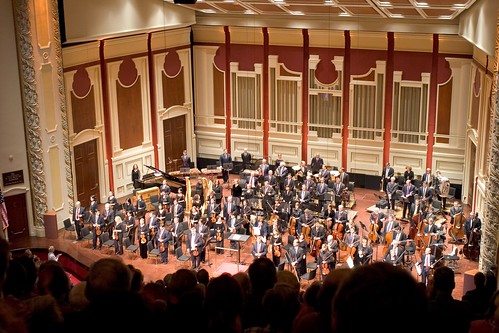
The Pittsburgh Symphony Orchestra recently issued a call for bloggers to cover this year's season of performances, so I threw my text-based hat in their web-based ring. They took me up on it, and now I'm one of nearly a dozen bloggers who'll be offering "outside perspectives" on various PSO performances over the next 8 months. If you're a fan of classical music (or incongruous and occasionally insightful commentary about it), you can follow the PSO group blog here.

Meanwhile, a case of celestial irony: Shortly after attending the PSO's "sneak preview" concert -- at which new maestro Manfred Honeck was not in attendance -- I posted my first PSO blog entry, entitled "A Night Without Honeck". Suitably amused, the gods then caused a wayward tree branch to collapse on some electrical lines in my Greenfield neighborhood, resulting in A Night Without Power for me and about 30 of my neighbors. (Since Duquesne Light is still swamped with reports of outages, we're not expecting ours to get fixed anytime soon.)

As a result, four of my neighbors gathered on their shared stoop last night and listened to the end of the Steelers-Browns game by candlelight, on a battery-powered radio. I couldn't quite hear the details from my open window, so I wandered down and listened to the closing moments with them. Funny that it takes an act of nature (and NFL scheduling) to force people who live less than ten feet apart to actually make the effort to introduce themselves.

Lastly, the Pittsburgh Post-Gazette has an interesting profile about the hard-fought rise of Maestro Honeck, who -- since he wasn't the apprentice to an established conductor -- decided to become one by starting his own orchestra. Talk about innovating your way to success...

Photo by Sriram

Labels: , , , , , , , , , , , , , ,

Wednesday, September 10, 2008

Liquid Sundays: How to Make YOUR Event More Social

This past Sunday, the minds behind Liquid Sundays, Pittsburgh's bi-monthly fusion of music / art / fashion, invited several bloggers and podcasters to attend their latest event at Olive or Twist downtown. The night featured music from:

* Central Plains (a Pittsburgh semi-supergroup)

* TheeAdora (femme-fronted pop rock)

* The Lost Sea (country folk rock, and my personal favorite of the night)

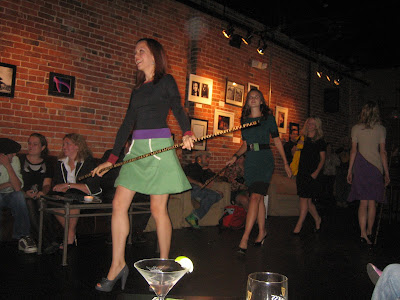
These performances were interspersed with a DIY fashion show featuring designs from local boutiqes Sugar and Pavement. Plus, discounted drinks, which is always good.

The upside? Decent bands, fashionable people, trendy-yet-functional locale, and a collective of artists and promoters who truly care about Pittsburgh and are endeavoring to help build out its social scene by bringing people from numerous artistic backgrounds together.

The downside? A few lighting issues (the first runway interlude was barely lit, which seemed to defeat the purpose) which were quickly corrected, and a few audio issues (like the space being ill-designed for multiple sonorous amplifiers), which couldn't be.

But my primary observations of the night have less to do with what WAS there than what WASN'T there:

* Apart from the drunk guy who tried a little too hard to get to know me, I didn't meet any people at this event that I didn't already know, and

* Live art / music events are still notoriously averse to the actual idea of connecting people, but they could very easily become better at it - and so can YOUR event.

How?

Identifying the Problem(s)

Admittedly, the main reason I didn't meet anybody new at this event is because I didn't try. I already knew a dozen people in attendance, so I had more than enough conversation to go around. Plus, it was sonically impossible to hear anyone over the din of the speakers, so it didn't make sense to strike up a conversation with a complete stranger when I could barely hear myself.

On the other hand, this event -- like most concerts and performances -- wasn't designed to introduce people to one another. It was designed to showcase the work of the people organizing it, and in that context, it makes perfect sense to drive all of the focus toward the art on display.

But why invite bloggers and podcasters to an event that makes it a challenge to gather information about the people and personalities involved? If we can't divine your story, it's much harder to then explain your story to other people, and isn't that the whole point of putting yourself out there -- to generate a discussion?

Solutions: A Performance Isn't a Conversation - But It Could Be

The Lost Sea perform at Liquid Sundays

In no particular order, here's a laundry list of 10 ways all future art events / gallery openings / concerts / meet-ups / etc. can improve their social functionality.

1. Make nametags available, regardless of the type of event. Even if it's an ultra-hip shindig, give people the option to make their names or other info public. At all levels of conversation-dom, icebreakers are key.

2. Artists: post multiple contact streams. Email signup sheets are functional, but leave out full-contact postcards for visitors to take away: email, MySpace, Facebook, Twitter, LinkedIn, Flickr, etc. Give people the option to contact you in the way that's most convenient for them (and therefore the most effective for you).

3. Liveblog each event. Posting handbills before an event is a necessity. Liveblogging / Twittering / Brightkite-ing an event should become one. This not only gives the live attendees another avenue to meet each other, but it allows people at home to enjoy the event without being there -- and they'll be more inclined to show up next time.

4. Announce your tags. Create search tags for your event / art / music, or hashtags for Twitter, so people will be able to find evidence of the event more easily. Then let people know what those tags are, so they can properly tag all their photos / videos / blog posts that they're creating on the spot. List the tags in all promotions, or call them out from the stage if necessary, but don't let people's media go forth anonymously - or else you lose out on valuable (free) promotion.

5. Schedule "quiet time." Dial down the "between bands" music for a few moments, and give people a chance to meet each other without shouting.

6. Give something away for free, just for coming. Bands: make an MP3 available for download -- maybe even a live cut from the show. Artists: make a photo or image available as a downloadable wallpaper for laptops or cell phones. Let attendees take part of your show home with them, and then they'll have something to show others. (If content control is an issue, post this free media in a secure part of your site, and give attendees directions / passwords during your social network follow-up; see below.)

7. Collect media your attendees have created. If people have tagged their media properly, you should have no trouble finding photos and video from your event. Repost the samples you think are the best on your event's groups / blog, and give credit to the people who enjoyed your event enough to celebrate it afterward.

8. Use Twitter to centrally connect your attendees. Twitter is promotional, but it's also functional. Multi-location or multi-day events can use it to keep attendees posted on schedule changes, location switch-ups, upcoming showtimes, etc. That means fewer questions for your volunteers to answer, and fewer opportunities for your attendees to miss something important.

9. Overlap with similar events AND completely different events. You can use social networks to find people who share interests similar to those offered at your event - armchair photographers, foreign film fans, etc. - but why not reach out to people who have NOTHING in common with your event? Mash up your fashion show with a beerfest, or your gallery opening with a rap battle. It may sound crazy, but how many new ideas -- or buzz -- do you see generated by people speaking strictly within the same echo chamber? (Hint: Not as much as you get from mixing it up.)

10. After the event, add attendees to your network. Include the URL of your event's group on Facebook / MySpace / LinkedIn / NING, etc., on all signage and promotions before and during the event. Encourage people to join / follow your event on the social network of their choice. Reach out to the people who did attend, or who join your network after the event, and thank them personally -- don't let your interaction stop when the lights come up.

In short: give people handles and they'll carry your story onward to others.

Labels: , , , , , , , , , ,

Tuesday, August 26, 2008

Who Determines the Shelf Life of "Modern" Art?

I saw a very cool play last night at the Bricolage summer reading series: Neighborhood 3: Requisition of Doom, by Jennifer Haley. It's an ultra-modern parable about communication, expectation and the nature of reality, cloaked in the guise of a horror film spoof.

The story centers around a fictional MMORPG (the titular "Neighborhood 3"), in which disaffected teens lose themselves -- literally -- for days on end. The game is a complex quest to eradicate the zombies who threaten to overrun a picture-perfect suburb -- which, the players notice, is a mirror image of their own suburban housing plan...

I'll let you draw your own conclusions about the play's themes and politics (or you can read this review of a prior performance in Louisville, which unfortunately seems to have missed out on so much of the play's dark humor). As I consider my own feelings about the play -- which I very much liked but am still processing -- a few thoughts enter my mind, such as:

* How well will hypermodern works of art age in an era of ever-increasing nostalgia, when the millennium bug already seems like it happened a generation ago?

* Can a work of art be judged a success or failure by a critic whose frame of reference doesn't encompass the ability to appreciate / process / understand the work of art?

* What's the cutoff age for understanding irony? (In my experience, irony seems to have a self-contained 30 year "generation," give or take, which suggests that the basis of humor / irony 'shifts' every quarter century or so.)

* What are the artistic reasons to create something "in the now," vs. something of an indeterminate time? How does that choice affect the audience's experience today, or in 100 years?

* How do you assign merit for a collaborative work in which the author or creator is separated from the audience by a wall of actors, interpreters or players? In these cases, who determines where the success or failure of the idea's execution lies?

* What is an artist's proper recourse when an audience or a critic misses the point?

* Which of our current cultural touchstones will still be memorable -- or even recognizable -- in 20 or 50 years?

Thoughts?

Labels: , , , , , , ,

Wednesday, May 28, 2008

The Culture Gap

Last week, I saw a play that was written by an African-American playwright. It dealt with issues of gender, race and identity. It tackled sensitive subjects like sexual abuse and racism. And it was framed around an iconic myth of nature, hope and redemption.

And I hated it.

Not because the play was heavy-handed, unsurprising or obvious (which it was), but because it was being lauded despite these shortcomings. Lauded, I felt, *because* it was a play about a different cultural experience than what the theatregoers in Pittsburgh are used to. In this particular case, I felt quality (or its absence) was being ignored in favor of political correctness -- of the NEED to champion a work of art that presented a less-omnipresent POV than that of the Straight White Male that governs so much of American society.

My continued evaluation of that play, and of my experience with it, have prompted numerous questions over the past week, including:

* Am I unable to connect with art created by artists from different cultural backgrounds because we lack the same shared experiences?

* Does our cultural background directly impact our ability to emotionally or intellectually evaluate art?

* Is mediocre art from underexposed cultures given a "pass" by the cultural gatekeepers simply because they feel obligated to promote any voice from within those cultures that are willing to step forward?

* Does allowing mediocre art to flourish do a disservice to the potential artists from within a specific culture by lowering the bar of expectations?

* Is it fair to compare art from various cultural backgrounds? Is it racist NOT to?

* How profoundly does a difference in gender impact one's ability to understand another?

* What larger cultural or social implications arise when art created for "shock value" ceases to provoke a "shocked" experience in its audience? Does that mean we've diverged too far from a "norm" of behavior, or does it mean we've simply assimilated that previously "extreme" behavior into our larger frame of reference and nullified its impact?

I don't have answers to any of these questions, but I'd be interested in hearing your thoughts.

Labels: , , , , , , , ,

Saturday, October 13, 2007

What Good Is Criticism?

I have a larger point to make, but first, a specific window into the situation:

This is the closing weekend for In Service, a powerful multimedia production that presents the stories of actual Pittsburgh soldiers who've returned from service in Iraq. The show is purposely absent of any slanted political context because it's meant to provide a rare glimpse of the soldiers themselves, not the ideologies behind the war they've fought (and continue to fight).

Ted Hoover, the stage critic for Pittsburgh's City Paper, issued a lukewarm review of the piece. Instead of basing his judgment on what the piece was, he bemoaned what it wasn't -- specifically taking the creators to task for NOT speaking out against the war itself.

To raise that complaint misses the point of the piece entirely, but it also betrays a complicated paradox in the world of art criticism (and critical thinking in general):

What IS the Role of the Critic?

Before you think this question doesn't apply to you, consider this: when was the last time you recommended an album/ movie / TV show / book to someone else?

Did you recommend it because you thought it was legitimately good and worth their time, or because the creation in question was closely aligned with what YOU, personally, enjoy?

Now consider the last time you told someone a book / movie / TV show / song was horrible.

WHY was it horrible?

Was it because the execution was terrible? Because the artist was a fraud? Because the communication was unclear, or the artistic choices were false?

Or, did you simply not like it? (Or, worse, did you not understand it, and therefore you presumed no one else would either?)

The Thin Line Between Criticism and Control

Critics are cynical enough to realize they can't support something their readers won't like. Stray too far from your audience's tastes and they'll forsake you. Thus, to remain relevant, a critic must review all art AS THOUGH HE ALREADY KNOWS WHAT HIS AUDIENCE WILL ACCEPT.

For example, in the case of Pittsburgh theatre, the target audience tends to be adults over the age of 50. Therefore, any play that doesn't speak directly to that demographic is likely to be panned, or commended with caution.

As you can imagine, this creates a stifling atmosphere for artists attempting to create new work, because they have two uphill battles to fight: the one to get an audience to take them seriously, and the one to convince the powers-that-be (who shape the choices of the populace) to convince the masses to take them seriously.

Personal Anecdote Time

Before I ventured into social media, I spent 2+ years as a music critic for the nearly-major music website Splendid (now defunct), out of Chicago. In that time, I reviewed hundreds of CDs, averaging a minimum of 3 per week.

Considering this was an unpaid, "free time" gig, it was in my best interests to plow through the CDs as quickly as possible. Most reviews were written after one or two listens, with only the ones that caught my attention garnering additional quality time.

I know from artist feedback that my reviews validated the burgeoning musical careers of several underground indie artists, who drew strength from my support of their work. I also know (from scathingly-worded emails) that my negative reviews cut the musicians deeply. If I helped keep some artists active, I don't think it's unreasonable to presume I may have also driven others out of their musical dreams altogether.

Looking back, it's ironic that a review written in haste might have caused a potentially talented musician -- who happened to not yet be "up to par" with others of his / her ilk -- to throw in the towel prematurely.

And yet, that's the power (fair or not) that every critic has with each word he commits to paper and page.

So, the Real Question Is...

... should a critic support the work of an artist who has the potential to become great, even if that work isn't yet fully commendable, because the risk of smiting that dream too early might mean the absence of new work that could someday change the world?

Or, should a critic be exceedingly harsh and unrelenting, fostering an environment where only the strongest survive?

Is a critic's primary function to be a guide for the audience or the artist?

How each critic answers those questions determines the role he seeks to fill: cheerleader or executioner?

Then again, EVERYONE'S a critic -- so what do YOU think?

Labels: , , , , , , , , ,

Friday, October 05, 2007

Pittsburghers: Three Cool Art Events!

For everyone who laments that Pittsburgh is a city with no artistic culture, I offer you three (3!) reasons that your statement is a filthy lie. Ready?

(By the way: I make no commission off these recommendations; I just like to see the arts in Pittsburgh succeed.)

UnBlurred

Did you know that Lawrenceville comes alive every First Friday with new art shows in every gallery, live music, free food and drink, and an all-night party?

Don't worry - few people do.

Tonight is the first Friday in October, which means UnBlurred kicks off after work. Go check it out -- unless you'd rather see one of the following shows (which are both incredible).

Key to the Field (Final Weekend)

I wrote previously about what an amazingly cool play Key to the Field is. This reality-skewing tale about family, suburbia and a dicey episode involving a garbage disposal is its last weekend, and if you have 90 minutes and $15, I strongly, strongly suggest you go see it. The play has received great reviews, but that still hasn't helped it draw the kind of audience we'd like to see for energetic, envelope-pushing new work in Pittsburgh.

Or, put another way: wouldn't you like to be able to say you saw the world premiere of a potentially major new work, in Pittsburgh, before it goes on to become a national classic that you pay $50 to see when it returns to town in 30 years?

For information and tickets, click here.

In Service

Bear with me for a second, because the initial explanation doesn't do this experience justice:

Pittsburgh Filmmakers and the Bricolage Theatre group co-present this vital multimedia piece that gives voice to the veterans of the Iraq war.

Why does this matter? Why is this different than your daily news coverage of the war(or, if you're cynical, the lack thereof)? Because In Service presents documentary AND live testimonials from local veterans who've returned from Iraq. Instead of hearing the story the corporate-controlled mainstream media sell us, you have a rare opportunity to see life from the soldiers' point of view.

I saw the show's opening last night, and it was compelling. The servicemen and women featured are diverse, representing no specific political ideology. Some are obviously anti-war, and some wouldn't hesitate to return to Iraq if called. Some have experienced horrific effects of life in the theater of war, and some will never be the same.

But, as the show makes very clear, all of them deserve our support, as Americans, because -- regardless of their own ideals -- they went to Iraq to serve our country. The least we can do is hear their side of the story.

For more information and tickets, click here.

Labels: , , , , ,

Saturday, September 22, 2007

Finally: A New Pittsburgh Play Worth Supporting!

Since my girlfriend is a theatre person, I see a lot more stage plays than I might otherwise. That's difficult, because Pittsburgh's theatre scene is regularly horrible.

Specifically, Pittsburgh fails to support new, envelope-pushing work. That's because 90% of its theatre-going audience are senior citizens, who prefer reimagined classics over anything that generates actual discussion or controversy. Thus, there's no audience for new works, so no one performs them, and therefore most under-40s in Pittsburgh believe that theatre is a medium that can't possibly speak to them.

Here's a play that will hopefully break that mold: David Turkel's "Key to the Field," being produced and performed by the Bricolage theatre group at 937 Liberty Ave. (Tickets $15 here -- don't worry, I make no commission.)

I saw it last night. It was wonderful, gripping, compelling and satisfying -- easily the best play I've seen in Pittsburgh in the past 2 years. Hopefully you'll agree.

I won't attempt to explain what the play is "about," because that's kind of the point -- this is a piece of art from which everyone will be able to draw their own conclusions. Double-casting, a non-linear narrative and a heavy dose of surreality create a story that's part modern allegory and part road trip nightmare. However, it's not so open-ended as to be aggravating for the more traditional theatregoers who require logic and closure.

Interesting side note: I originally saw "Key" during last year's Bricolage summer reading series, an annual (FREE) event in which 6 plays are read for an audience, one per month, to generate feedback for the authors. At the end of the reading series, the audience is asked to vote for the play they most enjoyed. The winner is staged by Bricolage the following year.

"Key" was last year's winner. It's almost entirely the same in most respects as it was during the reading, with a few structural changes that have tightened the plot and made the underlying themes more prevalent. IMHO, this is a great example of what can happen when a talented writer receives valuable feedback and applies his own common sense to the existing flaws in his story. With "Key to the Field," Turkel has produced a play he -- and Pittsburgh - can be proud of.

So, do yourself (and the city) a favor: go see "Key to the Field." Bricolage deserves our support, so they can be encouraged to continue creating new, relevant and engaging theatre. (And, if it works for them, maybe someone else will do it, too...)

Labels: , , , , ,

Thursday, September 20, 2007

Season Five of Web Sitcom STBD Has Launched!

I know most readers of my personal blog (aka this one) are well aware, but just in case you aren't: Season Five of Something to Be Desired (or STBD), the web sitcom I created and have been producing since 2003, launched last week.

STBD is a comedy about life after college. We produce a new 10-minute episode every Monday, here in Pittsburgh, Pennsylvania, with a local cast and crew (usually just me). And, while we're not always "worksafe," we're usually worth plugging in your headphones for.

If you visit our site, you'll see we're already up to our 2nd episode of the season, but the nifty new Blip TV player allows you to watch ALL our episodes within the same player. (Just click "Guide" and then the "Episodes" tab along the bottom.)

Hope to see you there!

Labels: , , , , , ,

Thursday, August 02, 2007

Does Your Job Matter?

A friend of mine works for a non-profit arts organization. She laments, continually, that she cannot accomplish anything at work because her coworkers don't DO anything. She's walked into their offices dozens of times to ask IF they've done something -- or, more accurately, why they HAVEN'T done what they were SUPPOSED to do -- and is repeatedly met with excuses and shrugs.

Thus, she's come to the conclusion that, no matter how much effort SHE exerts, IT WON'T MATTER. That's a very debilitating POV to take to work every day, every week, every month...

(One apparent problem? IT DOESN'T MATTER if they do anything or not, because they're funded primarily by government grants. As long as those grants are stable, they have absolutely zero need to DO anything because they'll receive funding whether they're active or not.)

But this isn't an indictment of the non-profit arts system, because it works quite well for companies that DO something with those funds. Instead, this is a snapshot of a company with an even LARGER problem:

It doesn't matter of they do anything or not because THERE ARE NO CONSEQUENCES FOR BAD PERFORMANCE.

Heads Will (Not) Roll

Motivation starts from the top down.

As anyone who's ever attempted to work for himself knows, the number one hurdle to clear is motivation. With no one MAKING you work every day, it's easy to backslide into the illusion of "having it easy," and of things "not mattering."

Ironically, that same hurdle exists in every company I've ever witnessed. If an owner / president / manager / CEO isn't responsible and doesn't impose penalties for failing to achieve goals, a company has no clear-cut reason to take a specific action.

(Or, in this case, ANY action.)

Thus, employees realize they can remain at this company until they retire or die -- that they can accomplish absolutely nothing every day and still be employed -- because THE DECISION MAKERS DON'T IMPOSE CONSEQUENCES.

Few are the organizations who are motivated enough to accomplish their goals (much less achieve actual change). I believe this is because so few individuals are properly motivated in the first place -- and that includes a clear understanding of the goals AND reasonable cconsequences related to accomplishment or failure.

At the top, every company -- whether a sole proprietorship or a Fortune 500 corporation -- is led by individuals. How properly those individuals are motivated -- and how reliable, reasonable and consistent their imposed consequences are -- determines how successful they'll become.

What are the consequences if YOU fail? What are the rewards if you succeed?

Does your job matter?

Do you want it to?

Labels: , , , , , , , ,

Friday, July 20, 2007

Pittsburgh Photographers, Assemble!

If you're a Pittsburgh-based photographer, photo lover, or just looking for a place to unwind on July 28, Creative Treehouse is hosting an event called Capture Pittsburgh. It's a low-key gallery show of Pittsburgh-related photos, along with live music, food and drink (BYOB if 21+). The event runs from 6 PM - Midnight. Click the pic for a full-size explanation of the festivities.

Labels: , , , ,

Wednesday, June 27, 2007

Constructive Criticism?

My mom is writing a book. It might be a novel, or a novella, or a short story -- she's not sure. Neither am I. But she's done with the first draft, and she gave it to me to read -- with one request: be honest.

So I read it. Or, to be more precise, I read the first 43 pages. And then I stopped.

I called her and I gave her the news I'm sure she didn't want to hear: I think she needs a rewrite.

I think the characters are more "types" than individuals. I think the plot feels contrived, rather than organic. I think the way the narrator imparts information on the audience is confusing -- sometimes too much, sometimes too little, and sometimes completely unnecessary, given the thrust of the plot.

In summary, I think she has a bunch of raw elements that COULD become a compelling story, but they haven't coalesced yet. I think she's a few rewrites away.

In reviewing her, I started reviewing my own work, especially on Something to Be Desired. Ironically, we're in the story development stage for Season Five, which is the perfect time to apply this same level of scrutiny to my own work.

So what have I realized?

I've realized I have dozens of questions that I, as the writer and creator, can't answer. I also see structure and character holes that are screaming for attention. And there's a debilitating lack of plot that can only be due to my own lack of understanding of the characters (and their goals).

It's disheartening, in some ways, to realize I'm so far from where I'd like to be in the creation of the story. On the other hand, it's gratifying to know that I'm identifying the problem areas and taking positive steps to improve them, getting ever-closer to where I want to be. It helps me realize that a few minor setbacks aren't the end of the world -- they're actually a sign that I'm on the right track toward something I can really be proud of.

I hope my mom realizes that.

Labels: , , , , , , ,