Cafe Witness

Monday, September 15, 2008

Two Ways to Spend a Night in the Dark

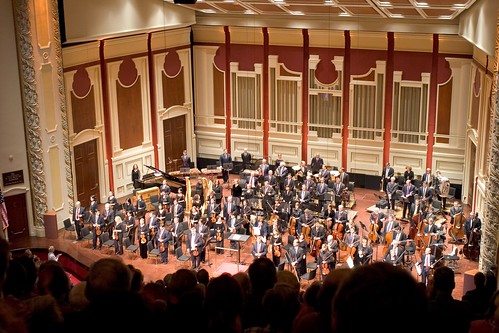
IMG_2391_pso_encore.jpg

The Pittsburgh Symphony Orchestra recently issued a call for bloggers to cover this year's season of performances, so I threw my text-based hat in their web-based ring. They took me up on it, and now I'm one of nearly a dozen bloggers who'll be offering "outside perspectives" on various PSO performances over the next 8 months. If you're a fan of classical music (or incongruous and occasionally insightful commentary about it), you can follow the PSO group blog here.

Meanwhile, a case of celestial irony: Shortly after attending the PSO's "sneak preview" concert -- at which new maestro Manfred Honeck was not in attendance -- I posted my first PSO blog entry, entitled "A Night Without Honeck". Suitably amused, the gods then caused a wayward tree branch to collapse on some electrical lines in my Greenfield neighborhood, resulting in A Night Without Power for me and about 30 of my neighbors. (Since Duquesne Light is still swamped with reports of outages, we're not expecting ours to get fixed anytime soon.)

As a result, four of my neighbors gathered on their shared stoop last night and listened to the end of the Steelers-Browns game by candlelight, on a battery-powered radio. I couldn't quite hear the details from my open window, so I wandered down and listened to the closing moments with them. Funny that it takes an act of nature (and NFL scheduling) to force people who live less than ten feet apart to actually make the effort to introduce themselves.

Lastly, the Pittsburgh Post-Gazette has an interesting profile about the hard-fought rise of Maestro Honeck, who -- since he wasn't the apprentice to an established conductor -- decided to become one by starting his own orchestra. Talk about innovating your way to success...

Photo by Sriram

Labels: , , , , , , , , , , , , , ,

Wednesday, September 10, 2008

Liquid Sundays: How to Make YOUR Event More Social

This past Sunday, the minds behind Liquid Sundays, Pittsburgh's bi-monthly fusion of music / art / fashion, invited several bloggers and podcasters to attend their latest event at Olive or Twist downtown. The night featured music from:

* Central Plains (a Pittsburgh semi-supergroup)

* TheeAdora (femme-fronted pop rock)

* The Lost Sea (country folk rock, and my personal favorite of the night)

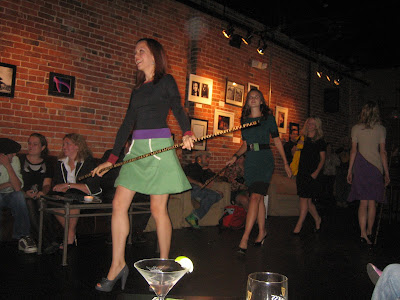
These performances were interspersed with a DIY fashion show featuring designs from local boutiqes Sugar and Pavement. Plus, discounted drinks, which is always good.

The upside? Decent bands, fashionable people, trendy-yet-functional locale, and a collective of artists and promoters who truly care about Pittsburgh and are endeavoring to help build out its social scene by bringing people from numerous artistic backgrounds together.

The downside? A few lighting issues (the first runway interlude was barely lit, which seemed to defeat the purpose) which were quickly corrected, and a few audio issues (like the space being ill-designed for multiple sonorous amplifiers), which couldn't be.

But my primary observations of the night have less to do with what WAS there than what WASN'T there:

* Apart from the drunk guy who tried a little too hard to get to know me, I didn't meet any people at this event that I didn't already know, and

* Live art / music events are still notoriously averse to the actual idea of connecting people, but they could very easily become better at it - and so can YOUR event.

How?

Identifying the Problem(s)

Admittedly, the main reason I didn't meet anybody new at this event is because I didn't try. I already knew a dozen people in attendance, so I had more than enough conversation to go around. Plus, it was sonically impossible to hear anyone over the din of the speakers, so it didn't make sense to strike up a conversation with a complete stranger when I could barely hear myself.

On the other hand, this event -- like most concerts and performances -- wasn't designed to introduce people to one another. It was designed to showcase the work of the people organizing it, and in that context, it makes perfect sense to drive all of the focus toward the art on display.

But why invite bloggers and podcasters to an event that makes it a challenge to gather information about the people and personalities involved? If we can't divine your story, it's much harder to then explain your story to other people, and isn't that the whole point of putting yourself out there -- to generate a discussion?

Solutions: A Performance Isn't a Conversation - But It Could Be

The Lost Sea perform at Liquid Sundays

In no particular order, here's a laundry list of 10 ways all future art events / gallery openings / concerts / meet-ups / etc. can improve their social functionality.

1. Make nametags available, regardless of the type of event. Even if it's an ultra-hip shindig, give people the option to make their names or other info public. At all levels of conversation-dom, icebreakers are key.

2. Artists: post multiple contact streams. Email signup sheets are functional, but leave out full-contact postcards for visitors to take away: email, MySpace, Facebook, Twitter, LinkedIn, Flickr, etc. Give people the option to contact you in the way that's most convenient for them (and therefore the most effective for you).

3. Liveblog each event. Posting handbills before an event is a necessity. Liveblogging / Twittering / Brightkite-ing an event should become one. This not only gives the live attendees another avenue to meet each other, but it allows people at home to enjoy the event without being there -- and they'll be more inclined to show up next time.

4. Announce your tags. Create search tags for your event / art / music, or hashtags for Twitter, so people will be able to find evidence of the event more easily. Then let people know what those tags are, so they can properly tag all their photos / videos / blog posts that they're creating on the spot. List the tags in all promotions, or call them out from the stage if necessary, but don't let people's media go forth anonymously - or else you lose out on valuable (free) promotion.

5. Schedule "quiet time." Dial down the "between bands" music for a few moments, and give people a chance to meet each other without shouting.

6. Give something away for free, just for coming. Bands: make an MP3 available for download -- maybe even a live cut from the show. Artists: make a photo or image available as a downloadable wallpaper for laptops or cell phones. Let attendees take part of your show home with them, and then they'll have something to show others. (If content control is an issue, post this free media in a secure part of your site, and give attendees directions / passwords during your social network follow-up; see below.)

7. Collect media your attendees have created. If people have tagged their media properly, you should have no trouble finding photos and video from your event. Repost the samples you think are the best on your event's groups / blog, and give credit to the people who enjoyed your event enough to celebrate it afterward.

8. Use Twitter to centrally connect your attendees. Twitter is promotional, but it's also functional. Multi-location or multi-day events can use it to keep attendees posted on schedule changes, location switch-ups, upcoming showtimes, etc. That means fewer questions for your volunteers to answer, and fewer opportunities for your attendees to miss something important.

9. Overlap with similar events AND completely different events. You can use social networks to find people who share interests similar to those offered at your event - armchair photographers, foreign film fans, etc. - but why not reach out to people who have NOTHING in common with your event? Mash up your fashion show with a beerfest, or your gallery opening with a rap battle. It may sound crazy, but how many new ideas -- or buzz -- do you see generated by people speaking strictly within the same echo chamber? (Hint: Not as much as you get from mixing it up.)

10. After the event, add attendees to your network. Include the URL of your event's group on Facebook / MySpace / LinkedIn / NING, etc., on all signage and promotions before and during the event. Encourage people to join / follow your event on the social network of their choice. Reach out to the people who did attend, or who join your network after the event, and thank them personally -- don't let your interaction stop when the lights come up.

In short: give people handles and they'll carry your story onward to others.

Labels: , , , , , , , , , ,

Friday, November 09, 2007

Why Punk Rock *IS* the Blueprint for Social Media

I saw the documentary Punk's Not Dead at the Three Rivers Film Festival this week and it got me thinking about why punk is the model we social media creators SHOULD be following.

Major Similarities Between Punk and Social Media

Punk was a medium created by the disenfranchised youth who sought to rebel against the corruption and groupthought inherent in "the system."

Punk had a low barrier of entry -- most "musicians" had zero training or experience (or, often, talent), but their passion and presence is what made them noteworthy.

The punk scene relied on word-of-mouth, grassroots marketing and DIY production values.

Punks regularly refer to themselves as a family, bonded by a philosophy and shared experiences.

Punk, like social media, is primarily the playground of white men.

Major Differences Between Punk and Social Media

Social media requires more expensive equipment to create than punk rock does.

Social media relies upon digital distribution.

Social media can reach anyone, anywhere, at any time -- if they have a computer.

Social media is looking down the barrel of the "money vs. passion" argument much earlier, and much more publicly, than punk ever did.

About the Film

Punk's Not Dead is an insider's look at how and why punk has survived for 30 years. Director Susan Dynner grew up in DC during the birth of the punk scene and has been involved with it ever since. The interviews she conducted for the film mirror the kind of "passionate desperation" found in today's social media movement, and offer a LOT of correlations for our potential success.

Among them:

* Henry Rollins makes several great points about the hand-to-mouth lifestyle led by even the "top" bands. Everyone looked up to Black Flag as the epitome of punk success, but in reality, they were sleeping on fans' couches and floors and living out of their tour bus -- which, he insists, could never stop moving.

"We were like sharks," Rollins says. "If we stopped moving, we wouldn't eat."

* Ian MacKaye built the Dischord label from the ground up, based primarily on the reality that the mainstream recording industry saw no value (or marketability) in the punk scene. But instead of scheming to find ways to make the MSM notice them, the punks said "fuck it" and created their own labels to sustain their momentum.

(Dynner was on-hand at the 3RFF showing and, during the post-film Q&A, told stories about hanging out at Dischord in the early years, where she - and everyone else on-hand - taught themselves how to hand-package the records and ship them out, one by one.)

* To the people *in* the punk scene, the musicians were both larger-than-life and completely accessible. Casual fans could wander backstage and have a beer with Bad Religion or Sham 69 almost by accident. That kind of "peer" mentality involved the fans of the music in ways that MSM could never hope to achieve.

* Throughout the whole punk lifeline, the scene has consistently resembled a "family" or artists who distrust MSM intervention or any attempts to control or repackage their original intentions.

On the other hand, the nature of speaking truth to power, as punks often did, was seen as the most *mainstream* concept in the world -- far moreso than the antiseptic POV of the MSM.

* The seminal punk bands were (and still are) happy to play a room of 5 fans or 50. Numbers weren't the driving force; the need to be heard, and to meet new people who shared their POV, was.

* Again, from Rollins: "We were (metaphorically) standing outside, screaming [pantomimes a loud voice], but to the record labels, it was like [pantomimes tiny, muted voice]."

Until, of course, the "cool kids" noticed, and suddenly punk mutated into something marketable... but *ONLY* after the punk pioneers carved out their own (relative) success.

* To this day, bands like Subhuman, The Adicts and The U. K. Subs tour incessantly, sleeping in fans' houses and selling their own merch from tables and vans -- 30 years after they first took the stage.

Despite the fact that bands who have come along well after the forefathers started the scene are now enjoying exponential success, while the legends who lit the fire in the first place are still living hand-to-mouth, they carry on because they still derive so much pleasure from the endeavor that they couldn't imagine NOT doing it.

All of Which Makes Me Wonder...

Will social media have this kind of longevity?

Why are some of us so eager to model our work after MSM -- or to garner their attention in the first place -- rather than refining our specific brand or shade of originality?

Are modern media creators so passionate to have their voices heard that they're willing to push through all obstacles, sleep on floors and "tour" endlessly, just to ensure they're heard by the audience that's seeking them out?

What think you?

Labels: , , , , , , ,

Friday, May 11, 2007

The Problem with Redundancy

I'm sitting in the Crazy Mocha in the South Side Works. The barista this evening (whose name escapes me) is playing her collection of Beatles music on the PA system.

This barista ALWAYS plays the Beatles on the PA system.

Other baristas have their favorite musicians too. One plays Stevie Nicks and the Black-Eyed Peas often. Another used to play the most recent Fiona Apple every shift, without fail.

My question: what's the benefit in listening to the same music SO OFTEN?

I understand having a comfort zone. I also understand wanting to share your personal choices with the public.

But where's the value in logging, literally, HUNDREDS of hours listening to the same -- and, frequently, decades-old -- music?

This is the same question I ask of people who have classic rock stations bookmarked on their radio dials. Have you NOT heard Dark Side of the Moon enough in your lifetime? Do you have any idea how much new information you're NOT taking in as a result?

I also find certain music (like all art) elicits a specific response in me, which can help with brainstorming, motivation and mood control -- but only for so long. The more I listen to the same music, the less of an impact it has on me.

If we overplay it, the magic is gone. And what are we doing then but listening to familiar noises?

Labels: , , , ,

Saturday, March 24, 2007

7 Songs I Like

I awoke to find I'd been tagged by Chris Brogan re: a new meme, started by 7 year-old Aidan Hatch (!), called 7 Songs I Like. The concept is pretty self explanatory:

7 Songs I Like (in absolutely no order):

"Idiot Kings" by Soul Coughing
"El Dorado" by The Tragically Hip
"New Millennium Homes" by Rage Against the Machine
"Some Party" by The Constantines
"The Morning Story" by Running from Dharma
"Time Running" by Tegan and Sara
"Luck Be a Lady" by Frank Sinatra

And now, I tag: Steve Garfield, Sarah Atwood, Jim Kirks, Vergel Evans and iJustine.

Labels: , , , ,