Cafe Witness

Wednesday, November 12, 2008

10 Ways to Become a Thought Leader

When I was a kid, I wanted to grow up and become an artist, a chef or (in one bout of misplaced humanism) a farmer. Today, kids grow up wanting to be social media rockstars and thought leaders. (And by "kids," I mean "thirty-five year-old desk jockeys," but I digress...)

Why the newfound passion for "thought leadership"? Because in uncertain economies, one thing still counts: influence. You may not have two dimes to rub together, but if you can convince the guy next to you that You Have Ideas, he'll probably buy you a cup of coffee just to hear you out. And that's how people without real jobs can stay alive when the depression comes.

So, without further ado, here are 10 Ways YOU Can Become a Thought Leader:

1. Get It Out There. History is littered with the corpses of people who put off sharing their big ideas because they "weren't ready yet." Do you have an idea? Share it. If it sucks, people will tell you. If it's good, people will steal it. And if it's great, people will tell you it sucks and THEN steal it. (Watch for this; it means you're on to something...)

2. Be Controversial. No one quotes the moderate, and even when they do, no one remembers what he said. If you want to be remembered, be extreme. If you want to be influential, be extreme AND easy to read. No one likes long-winded crackpots.

3. Make It All About You. Human beings have a natural tendency to cast the spotlight off themselves and onto other people, especially when they ask things like "How are you?" and "What do you think?" Be resilient. That spotlight was made for you, and the longer it's cast across your luminescent talents, the longer an opportunity the world will have to bask in the shadow of your genius. Thus, never miss an opportunity to turn any conversation into a time-worn anecdote about A Lesson You Learned (Preferably In Three Acts).

4. Start a Religion. Hey, it worked for L. Ron Hubbard and Jesus.

5. Influence the Influencers. Remember Basquiat? He was forever surrounded by low-level starmakers, but it wasn't until he literally threw himself at Andy Warhol that he got "discovered." Who's the Andy Warhol of your field? Get on that person's radar, and then don't leave -- at least not until you're bigger then he is. (Then run, because he'll probably want something.)

6. Repeat Things. This is a fast-paced world. People often completely ignore the best advice, even when it's right in front of them, because they're distracted. Or skimming. Or both. Don't let them miss out on your gems of wisdom.

7. Be Vague. If you give people a 10-step plan to upright the economy, you're a policy wank. If you tell people that "Savers Are Losers", you're a thought leader. Go with that.

8. Repeat Things. This is a fast-paced world. People often completely ignore the best advice, even when it's right in front of them, because they're distracted. Or skimming. Or both. Don't let them miss out on your gems of wisdom.

9. Be Prolific. It's not enough to have one good idea. Have dozens. Because if you're capable of being a genius once, people will expect you to be a genius in all cases. DO NOT DISAPPOINT THEM.

10. Preach Common Sense. Because life isn't all that hard, when you stop and think about it. In fact, it can be summed up pretty easily: say, think and do the things that make your life, and the lives of those around you, as fulfilling and rewarding as possible. But these days, no one actually has the time to stop and think; they need YOU to do that for them.

And they'll pay you for it.

(Photo by farlyj)

Labels: , , , , , , , ,

Wednesday, October 08, 2008

An Audience Without A Reason to Care Is Just a Bunch of People That You Have to Clean Up After

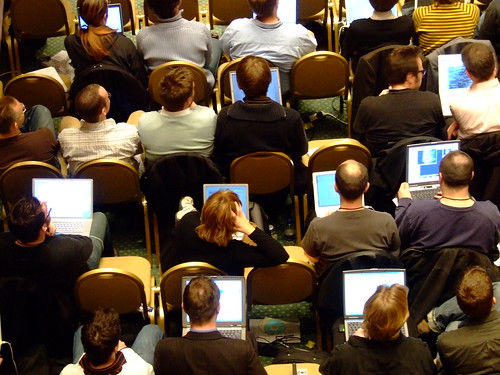
Carson Summit - Audience


Every three months, downtown Pittsburgh's art galleries unite for a free Friday Night gallery crawl. All the spaces are open to the public, the arts organizations mount new works and performances, and there's free food and drink for everyone who attends.

As you might imagine, people usually show up in droves for these events. And then, afterward, almost none of them come back. (At least, not until the next free event.)

Why?

Because just getting an audience in the door once isn't enough to make them want to come back on their own. You have to make the effort to get their attention, yes, but you also have to dazzle them while they're in your space AND give them a means to stay involved even after they've left.

And all of that requires a lot more effort than just handing them a mailing list.

The Fallacy of Eyeballs

At concerts, all bands love to leave mailing list sign-up sheets around the merch table. Mailing lists are useful, but getting people to admit that they want to hear more about you is only one step toward RETAINING that audience; it has nothing to do with GROWING an audience in the first place.

If all a band did was play four shows a year and then hound their mailing list to buy a CD every week, they'd have the support of very few people. So why would an arts organization -- or YOUR company -- be any different?

Give People Handles

The takeaway is the key. A band sells (or gives away) copies of its CD. Their fans play that CD for other people, and their interest in the band spreads. People start talking about that band and developing an emotional or intellectual alliance with the band's style, content and point of view.

Being a fan of the band becomes an active part of each fan's daily culture, and it becomes a natural act to share their passion for that band with others.

The organizations involved in Pittsburgh's quarterly Gallery Crawls can hand out postcards, fliers and mailing lists all they want, but they're not handing out anything people can actually take away and share. Nobody gives their friend a flier, but they will give them a CD.

So what can artists or organizations provide that would be a "CD equivalent"?

What could someone take away from your business / site that would enable them to tell another person about you, and illustrate WHY they think you're so interesting and worth getting excited about?

You Don't Know a Thing About Me

The other major stumbling block most of the Gallery Crawl organizers face is that, for many attendees, this will be the first (and only) time they'll ever walk through a gallery's or theater's doors. If they don't understand what that space is about, what kind of work it normally produces, and why its work actually matters (not to the world at large but to them, the individual visitor), they won't have a reason to come back because they won't even know why they should.

How many websites do you visit where you can't immediately figure out WHY it exists? Did the site designers provide you with sufficient answers on the About page? (Did the site designers provide an About page at all?) If not, was the site still sufficiently interesting that you cared enough to explore it on your own, or did you press the "back" button and try to find something else more obviously rewarding?

Artists face this challenge every day, and yet so few of them bother to make themselves interesting AND easily explainable. The same conundrum applies to social media. If I visit your site or download your podcast and I can't immediately understand who you are and why you're doing what you do, do you really expect me to spend my own valuable time figuring out why you matter?

If you or your organization / site / company is able to generate occasional bursts of traffic, but you never seem to actually RETAIN it, ask yourself what it is that you're NOT doing to dazzle / engage / explain yourself to them before they leave. Then, make every effort to solve that problem. Because if you don't, all you end up with are some half-eaten cheese plates and a few scribbled names on a mailing list, and neither of those are going to pay your bills.

Photo by Pete Lambert

Labels: , , , , , , , , , , ,

Friday, July 27, 2007

Fishbowls and Treehouses

Quick: who's your audience?

Most of us know who our TARGET audience is. We know who we're EXPECTING to interact with our product / service / message ("PSM"). We may even have demographics that PROVE whom our audience actually IS...

What we're forgetting is everyone ELSE who may stumble across our PSM by accident... or through the back door... or on referral... or any of a million ways we didn't plan for.

Does your PSM "work" for the people OUTSIDE the fishbowl?

Even The Pros Get It Wrong

To wit, the photo above. How many of you noticed that "Vanilla" is misspelled on the Glade packaging? Apparently, no one at Glade did, either...*

Odds are, no one at Glade lost their job over that gaffe. The people who already buy Glade vanilla spray know what the canister looks like. They don't even stop to read the label.

But what about potential new users? Will they be dubious of a product from an industry leader who can't even spell the product's name right?

Industrial Shorthand

At my old job, I edited industrial safety videos. Due to time constraints, these videos are pumped out quickly, which means it's vital to get the information across as CLEARLY and QUICKLY (in regard to production time) as possible.

While on a recent visit to the old office, I realized just how UNCLEAR some of the information in these videos would be to anyone without a working foreknowledge of the subject covered.

With a few extra graphics, more explanatory video clips and some clarification of the actual script -- all very small investments in actual production time -- that video would be FAR more valuable as a learning tool.

But why make those changes? After all, their target audience is already paying for them as-is.

A Ladder to the Treehouse

Very often, we as creators of social media -- whether we're writing text, making graphics, shooting video or communicating in general -- make presumptions about our audience.

If we're proactive, we assume they know at least as much about our subject as we do.

If we're cynical, we presume the general public doesn't CARE about our subject as much as we do.

And if we're ignorant, we presume our audience will stick with us even when we sell them short, take them for granted or deliver less than our best.

In all cases, we don't take the trouble to make our conversations accessible beyond the immediate, expected audience -- our personal fishbowl.

We might therefore blame the audience when they can't follow our line of thinking. We might accuse them of being lazy, or having short attention spans, or simply bad taste.

What we're losing sight of is that our audience, by and large, WANTS to like what we do. People who stumble across us WANT to be entertained, WANT to be informed, WANT to be pleasantly surprised. If all we do is reinforce THEIR presumption -- that we're of a treehouse mentality, uninterested in admitting them because they're "not as cool" -- then we certainly can't complain when they don't take an interest in what we do... or tell their friends... or subscribe to our RSS feeds... or pay our bills.

Granted, your existing audience may love what you do despite -- or even BECAUSE OF -- the fishbowl you've created. But for everyone who blindly follows your lead because they've become complacent in your fishbowl, there's another person who actually knows how to spell "vanilla" -- and they'll do business with someone else who bothers to do the same.

* UPDATE: As has been mentioned to me off-blog, "vainilla" is a Spanish spelling of "vanilla," and "spray" translates bilingually as well. Fair enough. But, by that rationale, if "spray" translates bilingually, why doesn't "vanilla"?... Someone find me a bilingual French canister that says "chocolat spray," please...

Labels: , , , , , , , , ,

Thursday, April 05, 2007

Cafe Witness Moment

Returning to the roots of this blog for a moment -- back when it was a glimpse into the coffee culture of Pittsburgh, rather than a treatise on new media...

I walked to the Tazza D'Oro cafe tonight, only to realize it was the meeting place for the latest of their (seemingly irregularly-) scheduled "women's nights," for which the place is closed to non-club members (like me).

So, instead of working from home, I hopped in my car and zipped down to Crazy Mocha in the South Side Works. The trip took half an hour. Along the way, I passed a Starbucks (no free wireless), a Coffee Tree Roasters (no free wireless), a Kiva Han (janky free wireless that doesn't always work) and ANOTHER Crazy Mocha (which allows smoking), all to come here.

My point is not to prove my loyalty to Crazy Mocha (though I do like this joint).

My point is: is it so hard to give away a free wireless signal? Think of the business these cafes are missing out on from 100 other people like me, who would rather drive out of their way for the free wireless (and the good coffee, and the comfortable scenery, and the pleasant community, and the friendly baristas) than pay to login.

John Moore touched on this in his "What Must Starbucks Do?" ChangeThis manifesto, which tackles the larger problem of what Starbucks must do to become relevant again. The lessons there are fairly specific to the Starbucks challenge, but the need to reinvent yourself applies to all of us sooner or later.

And why do most of us need to reinvent ourselves? Because we're out of touch with what our customers / clients / audiences want.

In this day of instant uber-communication, isn't that inexcusable?

Labels: , , , , , , , , ,