Cafe Witness

Wednesday, February 18, 2009

Even Prostitutes Get Paid

Last week, Gary Vaynerchuk told the audience at SocComm that FOX, CNN, The New York Times, etc., were all "dead" because any one of us can use the internet to become a media mogul tomorrow, without anyone's help.

I disagree.

Not because I think FOX, etc., are thriving right now, but because I don't believe the problem is a matter of content control. It's a matter of distribution and awareness, and those are two areas where the multinational corporations have such a head start over the little guy that it isn't funny. (And I won't even get into the trust gap between well-funded, well-researched news sources and a guy with a blog in the middle of nowhere.)

So what's an independent media creator to do?

For starters, here's one way social media can start to level the playing field between "us" and "them":

Stop Putting Your Videos Everywhere That Videos Can Possibly Go

Quick - where's the best place to find web video? YouTube? Veoh? Blip? Vimeo? Viddler? No matter your answer, you're still right, and here's why: because they all show the exact same thing.

Imagine if traditional TV were to suddenly adopt that model, in which you could watch CSI: Miami on any channel, at any time of the day, in multiple formats and resolutions. Well, that's great... but why would we need 500+ channels?

We wouldn't. And we don't need 50+ video distribution channels, which continually pollute the already-impossible-to-navigate web video world with ever-more duplicated content.

Divided, We Stand

TV stays alive because each channel has a stable of shows that can't be seen anywhere else (until they hit syndication). Web TV hasn't made that connection yet because it doesn't believe in its own quality or validity. It's so desperate to be seen, it's willing to give itself away for free across dozens of websites, and then it complains privately that it isn't making any money or being taken seriously.

Here's a hint: if people can get you for free anytime, any place, they'll never consider paying for you at your own convenience.

Someday in the very near future, Blip TV (or one of their competitors) will step up and tell their top 20 shows, "Hey, here's some money. Keep producing one new show a week for the next year -- and DON'T cross-post anyplace else (besides your own homepage) -- and we'll take care of the rest." Then we'll finally see Web TV reach a valid adolescence, where audiences will pay for ease of reliable access to quality content, and show creators will begin to earn what they're worth.

Until then, if you want to see quality web video, just spin the Google bottle because the kisses are all the same -- free, wet and desperate.

Image by slowburn.

Labels: , , , , , , ,

Wednesday, February 11, 2009

10 Things I Learned at SocComm

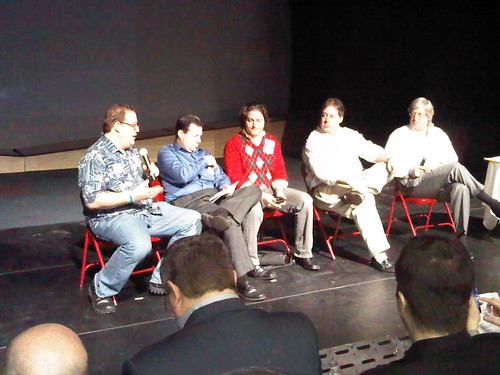
Privacy and policy panel at #SocComm

I spent yesterday driving to and from New York City to attend the first Social Communications Summit, a meeting of the new media minds organized by Jeff Pulver. Amid the flurry of driving, schmoozing and driving again, I gleaned a few bits of wisdom. Here, in no particular order, are ten of them:

* Social media has become a haven for people who like to talk loudly, and at length, about what they think they know.

* When it's barely 10 AM and the audience Q&A has already forced one speaker to restate the scientific definition of "reality," I become acutely aware that the buffet table is only offering decaf.

* We need new demonstrable criteria for what defines anyone as an "expert" in any field -- especially something as subjective as communications.

* I disagree with part of Gary Vee's assertion that "FOX is dead. The New York Times, CNN, all of them: dead." Most people seem to confuse the distribution mechanisms, the content and the companies. The physicality of the daily newspaper is in decline, but the New York Times is not dead; people still require information. The Times (and every other news / entertainment company) has the resources, reach and ability to place that information in the possession of those who desire it, for a price. The way it reaches them may change, but by no means does a shift in the distribution mechanism mean that a whole company or medium is "dead;" nor does it mean that the power has shifted to the content creators, who still -- like it or not -- require some variation of a trusted "gatekeeper" to ensure that their content is seen by the maximum number of people. (Although, I will concede that it's possible to now include "yourself" in that list of gatekeepers who are keeping your work from being seen.)

* Privacy and property law are going to be HUGE issues for these media in the coming years; Pulver's right to be training everyone's attention on the policy discussions surrounding what we can and can't do (yet / now / for a little while longer).

* Lots of rhetoric from 2005 (i.e., mass media is dead, each of us can become a mogul, etc.) still being tossed around, but the core issues (money, innovation, proliferation) still involve much grasping and posturing, and few verifiable answers.

* It's quite awkward to watch the people who hover around Chris Brogan, Jeff Pulver or Gary Vee, waiting for the opportunity to introduce themselves and slip immediately into "the pitch." These three get immense pleasure from having the power to connect people, bring disparate personalities together, and generally act as "hubs" for disruptive thinking. And yet, for a medium that's allegedly built around being social, too many people seem to be confusing "social" with "sales."

* That said, I've realized that I don't have it in me to "work the room." I'm more content to chat with a few people, and (ideally) have an enlightening conversation or two, than to make the casual acquaintance of an eventual stack of business cards. Either I haven't distilled my essence into the proper elevator pitch, or I just don't feel the driving need to impress people. (I'll let my razor-sharp wit and rampant douchebaggery do that for me...)

* Amber Naslund = thank god for real people.

* Lots of the top minds in these overlapping fields (mobile technology, content creation, marketing, law, etc.) are saying the same things privately and making the same predictions and proclamations, but using slightly different terminology. Methinks the next shift in fishbowl consciousness is upon us; look for it to trickle down into easily-quoted memes by the end of the year. (Keyword hint: "reputation", not "brand".)

* The staff at the 3LD Art & Technology Center were friendly, helpful and generally seemed to be on the ball about most of the event's logistical needs. However, they -- like most first-time "new media" hosts -- were woefully underprepared, wifi-wise, resulting in lots of people not being able to connect. Oddly enough, instead of forcing attendees to actually pay attention to the presentations, the absence of wifi somehow seemed to destroy everyone's ability to focus. This resulted in a day-long plethora of bite-sized hallway conversations, which may be proof that the social media crowd has now been programmed toward distraction, regardless of availability.

* Driving in New York for the first time? Not as hard as I thought it would be. But driving in New York for the first time and tangling with a duplicitous Google map, unmarked road construction, throngs of pedestrians militantly dedicated to walking slowly and a bladder so full to the point of rupture that I actually contemplated the physics of peeing upward into an empty water bottle while in motion? Slightly more difficult than it should be. (Indeed, you're welcome for my $10 "donation," Brooklyn-Battery Tunnel...)

Thanks to Jeff, 3LD and everyone else involved in organizing and executing the event. I suspect it'll be fuel for a number of conversations over the coming days, and hopefully some of these nagging questions about the future of social media will begin to find their answers -- preferably without the disapproving eye of The Law.

Image by Michael Lewkowitz.

Labels: , , , , , , , ,