Cafe Witness

Wednesday, February 11, 2009

10 Things I Learned at SocComm
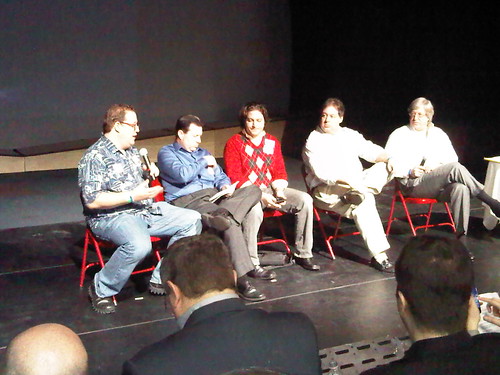
Privacy and policy panel at #SocComm

I spent yesterday driving to and from New York City to attend the first Social Communications Summit, a meeting of the new media minds organized by Jeff Pulver. Amid the flurry of driving, schmoozing and driving again, I gleaned a few bits of wisdom. Here, in no particular order, are ten of them:

* Social media has become a haven for people who like to talk loudly, and at length, about what they think they know.

* When it's barely 10 AM and the audience Q&A has already forced one speaker to restate the scientific definition of "reality," I become acutely aware that the buffet table is only offering decaf.

* We need new demonstrable criteria for what defines anyone as an "expert" in any field -- especially something as subjective as communications.

* I disagree with part of Gary Vee's assertion that "FOX is dead. The New York Times, CNN, all of them: dead." Most people seem to confuse the distribution mechanisms, the content and the companies. The physicality of the daily newspaper is in decline, but the New York Times is not dead; people still require information. The Times (and every other news / entertainment company) has the resources, reach and ability to place that information in the possession of those who desire it, for a price. The way it reaches them may change, but by no means does a shift in the distribution mechanism mean that a whole company or medium is "dead;" nor does it mean that the power has shifted to the content creators, who still -- like it or not -- require some variation of a trusted "gatekeeper" to ensure that their content is seen by the maximum number of people. (Although, I will concede that it's possible to now include "yourself" in that list of gatekeepers who are keeping your work from being seen.)

* Privacy and property law are going to be HUGE issues for these media in the coming years; Pulver's right to be training everyone's attention on the policy discussions surrounding what we can and can't do (yet / now / for a little while longer).

* Lots of rhetoric from 2005 (i.e., mass media is dead, each of us can become a mogul, etc.) still being tossed around, but the core issues (money, innovation, proliferation) still involve much grasping and posturing, and few verifiable answers.

* It's quite awkward to watch the people who hover around Chris Brogan, Jeff Pulver or Gary Vee, waiting for the opportunity to introduce themselves and slip immediately into "the pitch." These three get immense pleasure from having the power to connect people, bring disparate personalities together, and generally act as "hubs" for disruptive thinking. And yet, for a medium that's allegedly built around being social, too many people seem to be confusing "social" with "sales."

* That said, I've realized that I don't have it in me to "work the room." I'm more content to chat with a few people, and (ideally) have an enlightening conversation or two, than to make the casual acquaintance of an eventual stack of business cards. Either I haven't distilled my essence into the proper elevator pitch, or I just don't feel the driving need to impress people. (I'll let my razor-sharp wit and rampant douchebaggery do that for me...)

* Amber Naslund = thank god for real people.

* Lots of the top minds in these overlapping fields (mobile technology, content creation, marketing, law, etc.) are saying the same things privately and making the same predictions and proclamations, but using slightly different terminology. Methinks the next shift in fishbowl consciousness is upon us; look for it to trickle down into easily-quoted memes by the end of the year. (Keyword hint: "reputation", not "brand".)

* The staff at the 3LD Art & Technology Center were friendly, helpful and generally seemed to be on the ball about most of the event's logistical needs. However, they -- like most first-time "new media" hosts -- were woefully underprepared, wifi-wise, resulting in lots of people not being able to connect. Oddly enough, instead of forcing attendees to actually pay attention to the presentations, the absence of wifi somehow seemed to destroy everyone's ability to focus. This resulted in a day-long plethora of bite-sized hallway conversations, which may be proof that the social media crowd has now been programmed toward distraction, regardless of availability.

* Driving in New York for the first time? Not as hard as I thought it would be. But driving in New York for the first time and tangling with a duplicitous Google map, unmarked road construction, throngs of pedestrians militantly dedicated to walking slowly and a bladder so full to the point of rupture that I actually contemplated the physics of peeing upward into an empty water bottle while in motion? Slightly more difficult than it should be. (Indeed, you're welcome for my $10 "donation," Brooklyn-Battery Tunnel...)

Thanks to Jeff, 3LD and everyone else involved in organizing and executing the event. I suspect it'll be fuel for a number of conversations over the coming days, and hopefully some of these nagging questions about the future of social media will begin to find their answers -- preferably without the disapproving eye of The Law.

Image by Michael Lewkowitz.

Labels: , , , , , , , ,

Friday, March 30, 2007

Video on the Net: The Personal Recap

As with all things web media, it seems like the residual energy from a major event like VON is yet another "snack-based" item, something that dissipates quicker than it should.

It's logical, considering there are another 20 items vying for my attention the day I step off the plane and return to my "normal" life. But, fortunately, that residual energy doesn't fade away completely; it just wanes, ever so slowly, while my attentions are diverted.

So, before the memories fade completely, let me regale you with my personal recollection of the event. Will this be instructive? Doubtful. Will it make you wish you were there? Quite possibly.

I Love People

I'm a social guy. Drop me in a room full of interesting people and I'll find a million ways to amuse myself.

I'm not always the chattiest guy, nor am I someone who feels compelled to meet everyone within eyesight, but I do enjoy finding out what makes people tick.

At VON, I was fortunate to spend most of my time with people I either already knew and valued, or people I met and grew to appreciate in a very short amount of time.

Old Faces

- Chris Brogan, who made the world go 'round

- Jeff Pulver, who provided the gravity (and the raison d'etre)

- Steve Garfield, who continues to pioneer strange and wonderful new ways to use new media

- Brian Conley of Alive in Baghdad, who continues to strike fear in the hearts of insincere videobloggers everywhere

- Jim Kirks of The Clip Show, who remains one of the web's best "undiscovered" personalities

- Michael Bailey of MobaSoft, who has become nearly ubiquitous on the new media social scene. If there's a podcasting event, chances are Michael is on the guest list.

New Faces

- Clintus McGintus, who went from complete stranger to "my roommate" in the span of five minutes. One of the nicest human beings I've ever met, and without an ounce of pretense to muddy the picture. Great guy.

- Sarah Atwood, one half of Nontourage and co-star of the short-lived (but perhaps resuscitatable?) Vloggy-winning podcast Almost There. The female foil for many male egos in San Jose, Sarah proved her worth to the firm time and again.

- Grace Piper, whose Fearless Cooking podcast is truly the work of a woman to be reckoned with. Especially if you're a squid. (AKA Winner of $200 in a hit-and-run poker game at the after-party...)

- Jim Long, whose 17 years of experience as an NBC cameraman have prepared him well for this world of on-the-fly information gathering. Smart, friendly and self-deprecating to a fault.

- Casey McKinnon, the female half of Galacticast. (We'd actually met at PodCamp Boston, but I wasn't in the business of being memorable at that time.)

- French Maid TV's Tim Street, whom I'd also met at the Yahoo Halloween party in October. (Again, I tend to blend in quietly unless provoked.)

- Roxanne Darling, star of Beach Walks with Rox, who is every bit as calming and visibly wise in person as she is when following nature's paths in Hawaii.

- Schlomo Rabinowitz, "enabler to the podcasting stars of tomorrow." Also knows the right time for shots of Jameson. (Answer: always.)

- Toronto podcaster Vergel Evans, who was easily the silver medalist behind Clintus in the "nicest guy / happiest to be here" 100 metre dash.

- YouTube juggernaut Mark Day, who's nowhere near as blood-curdlingly intimidating as I expected him to be when left alone with him for the better part of an hour. Turns out all he needs is a good chaperone through the technological landscape and he's content.

- Nick Douglas, vlogstar of Look Shiny. We thought for quite awhile that we knew each other. Nope. Just turns out I'd seen Look Shiny recently and thought I knew him. You get that a lot in web video...

- Scott Simpson of iTunes, who -- in addition to being generally hilarious in a completely deadpan manner -- told what shall go down in history as, easily, the most paralyzingly funny story at the VON "after-party" circuit. I've tried replicating the moment with several audiences myself and failed; Scott sets a new bar for "dry delivery."

There were dozens of other folks I had a great time with, and whose brains I picked endlessly for some truly fascinating conversations. But many of them are executives or lawyers or other "behind-the-scenes" people, so I'll spare them the association with a blog post that's shaping up to be more "Entertainment Tonight" than "Inside the Actor's Studio."

If I've failed to mention any of the other wonderful people I met and enjoyed the company of at VON, by all means, consider yourselves lucky to remain anonymous.

The Inside Stuff

So, wondering what exactly goes on among a group of half-drunk pseudo-celebrities such as ourselves at an event like this? Here are, in no particular order -- and in no way guaranteed to make complete sense -- what I recall as some of the highlights of my week in San Jose:

- Arrive in San Jose. Make my way to the hotel. Bump into Steve Garfield, Blip TV's Dina Kaplan and others in the hallway outside the "beta party" suite. Dina talks to me for a few sentences before we both realize she doesn't recognize me. Last time we hung out, my hair was about 6 inches shorter. It takes Garfield, who'd lost his voice after SXSW, to explain who I was in pantomime.

- Pulver party suite: booze, piano, poker. Lots of food. Lots more liquor, mostly in people. People who are playing Dance Dance Revolution and Guitar Hero...

- I'm supposed to share a speaking slot with Garfield and Conley. We ask each other what we intend to speak about.

Garfield? The ease and impact of videoblogging with consumer-level equipment.

Kownacki? How to create engaging, sustainable episodic content.

Conley? "I'm just gonna walk up there, kick over the podium and let them all know they're full of shit."

Sounds like a well-rounded presentation...

- At VON, looking for a plug for my laptop. The only one I can find is being occupied by BuzzMachine's Jeff Jarvis. I momentarily consider asking if I can share his outlet, but some obscure form of "don't talk to the A-listers" stigma prevents me from doing so -- which is odd, considering Jarvis is quite a normal guy. Instead, I blog from the presentation room floor until my battery dies, while Jarvis makes small talk with VON honcho (and raconteur) Andrew Lipson -- not even using the computer that's plugged in.

- Wednesday morning. 11 AM. Garfield, Conley and I are due to speak in 15 minutes. My cell phone rings. It's Conley.

"Where are you?" I ask.

"Walking over from the hotel. I never set the alarm. Where is everybody?"

"Waiting for you to speak."

"Oh... Is there any juice?"

- Walking to a nearby Mexican restaurant on a beautiful spring evening with Kirks and Atwood. Says Kirks, apropos of nothing and with complete contentment, "We're gonna die tonight." This strikes all three of us as being perfectly agreeable.

- Never one to look a gift premonition in the mouth, we later find ourselves (and several of the others mentioned above) standing in a Jack-in-the-Box at 2 AM in the part of town that, it can charitably be said, "is where you get shot."

Never before has Michael Bailey taken SO LONG to open a straw wrapper. Seriously. The entire time, all that's going through my mind is the donut shop scene from Boogie Nights. Fortunately, we escape unscathed...

- A cheerful homeless guy asked us if we had "$100,000." As Jim Kirks noted, that's a bum with aspirations.

- Discussing (and toasting to) agnosticism with Conley and McKinnon as the "little people" at VON -- the actual service workers at the convention center, who REALLY make the event happen -- worked their tails off around us.

- Clintus's shrewd manner of ordering rounds of tequila shots when no one's looking. (Somewhere, never to be Flickr'd, there's a photograph of Atwood doing the tango with a parking meter...)

- Upon cashing out from the Mexican place (Chacho's, I now recall), we eyeballed the check. $1,400? $1,200 of which was for alcohol? Our stomachs dropped.

"How many tequila shots did you ORDER?"

"Who's got Pulver's number?"

Fortunately, the error was soon spotted: the cashier had accidentally cashed out the ENTIRE OPEN BAR to our party. Whoops. Situation amended, no bail money needed.

- Observation from Scott Simpson: "If a plane is allowed to fly lower than 500 feet above your downtown, you don't actually live in a city."

- When I die, I want to come back as Jim Kirks's hair. It's uncanny. That sh*t could survive a wind tunnel unscathed.

- And, of course, my now semi-legendary "drunken fan moment" involving the Pitt men's basketball team.

In Closing

Perhaps the signature moment of the entire week came at the end, when the roll call was down to me, Sarah Atwood and Grace Piper as the only three entities left behind after the masses had flown home.

My flight wasn't until 10:45 PM, so I crashed in Atwood's hotel room and watched some NCAA basketball while she labeled Flickr photos. We'd agreed to grab Grace for one final drink before I hit the road to the airport.

At halftime of the Pitt / UCLA game, we headed down to the bar. I texted Grace on the way:

"Drinks @ Fairmont."

Within seconds, she texted back:

"Already in bath with martini. Good luck!"

Rock stars. We may not yet be them, but for a few weeks every year, we can certainly live like them...

Labels: , , , , , , , , , , , , , , ,

Thursday, March 29, 2007

Big Noise, White Noise

Two interesting news bits made their way across my sphere of awareness today.

Blip'd

On twitter, Schlomo Rabinowitz asked Charles Hope from Blip TV what the website "Blipd" was. I noticed the message and went clicking around myself.

Turns out that Blipd is the brainchild of Ty Graham. An easy Google search pulled up this blog post from Startup Booster, in which the specifics of the Blipd concept are discussed.

In a nutshell, Blipd appears to be a patented way to monetize social networks. Graham's ultimate goal is to sell the idea, which he's been sitting on since 2005, to Google for use in YouTube.

Despite the bravado in his claim -- phrases like "It’s stunning how no one has thought of this yet" and "I hold the ultimate key for more tremendous Youtube success" do nothing for the cause of humility -- it could be interesting to see how this all plays out...

... especially since I find it odd that someone would coin a phrase ("blipp'd") to describe something so startlingly similar to the existing Blip TV that he even used the same color scheme on his own site...

Pyro TV

Speaking of borrowing ideas...

Jeff Pulver received a phone call from the folks at Pyro TV today, asking him to promote their site. During the phone call, Pulver noticed that Pyro TV seems to have all the great shows on their homepage -- Ask a Ninja, Rocketboom, Diggnation, even the evening news from ABC and CBS!

When he asked if the gent on the other end of the line had a working relationship with these content creators, he was told that, no, because the RSS feeds are just "out there," he felt they were free for the taking.

I have a sneaking suspicion the Ask a Ninjas and CBSs of the world may beg to differ -- especially because the Pyro TV logo is all over their content...

Onward and upward...

Labels: , , , , , , ,

Wednesday, March 28, 2007

Network2 Takes Manhattan

Chris Brogan, Jeff Pulver and the Network2 crew went to Times Square yesterday to relive the glory days of MTV -- specifically, the "I Want My MTV!" battle cry.

The results can be seen here.

No better way to build a buzz than by getting attractive people to shout about your product in Times Square, no?

Labels: , , , ,

Tuesday, March 27, 2007

Crosspost: STBD / VON on Geek Riot

On Sunday night, Shawn and Justine at Geek Riot invited me to talk about the STBD relaunch and my experiences at VON.

Joining us for the first hour of the show is Jeff Pulver, VON creator, who also talks about his Video on the Net Alliance and its impending battle to preserve web video from the prying eyes of the FCC.

It's a good all-around show, and features a healthy mix of STBD and VON topics. The whole enchilada clocks in around 2 hours (!), but you can stream and skim if you so desire.

(And yes, I know I posted this at the STBD blog too. Sometimes, there's an overlap. Other times, there are cupcakes. We adapt.)

Labels: , , , , , , , ,

Wednesday, March 14, 2007

(Secret?) Identities

Christopher Penn has a pair of very valid blog posts about how the Web 2.0 is quickly becoming the Matrix 2.0, and on the value of protecting your brand name assets on Twitter.

This got me thinking about a number of related topics.

Self-Defense Real Estate

- Do you own the URL of your name (i.e. "YOU dot com")? If you don't, who does?
- Do you own all available comparison URLs of your name ("YOU dot net, YOU dot tv, etc.)?

If you don't, or if you believe you're "not important enough" to need to, let me ask you this: what happens when you ARE "important enough" to become a household name, even in a very small circle?

Chances are, you'll BECOME popular because other people are talking about you... and other people may realize the value of your name before you do.

The savvy people are out there right now, buying up every URL associated with their own names, "just in case."

The savvier people are out there buying up every URL associated with OTHER PEOPLE'S names...

HappyBaptism.com

- Do you own the URLs for your children's names?

Let's presume that the web, as we know it, is here to stay, and that URLs will still be a valid way around the information superhighway in another 20-30 years.

How many of us have children who -- like ourselves -- may someday grow up to "be someone"?

Imagine how grateful you'd be, as a kid, knowing that your online identity was safely registered by your parents before you could even clutch a mouse. It certainly beats the alternative: knowing that you'll someday need to buy that URL back from some black market identities dealer who's currently using it as an affiliate site.

All Websites Are Actually Real Estate Agencies

- Is your profile registered on MySpace? Facebook? Digg? Twitter? Technorati?...

I recently joined Virb, a new social networking site... or, rather, STBD did.

I initially saw Virb as a new networking / marketing tool -- a cleaner version of MySpace -- so I registered a profile for Something to Be Desired. As I'm writing this post, I realize I haven't yet signed up as myself yet... so I just did.

I could (and should) do the same for every other social networking site on the planet... and every other web app that could be used for marketing, communication and brand imaging. So should you.

EVERY WEBSITE is a potential link into your world -- or your brand / product / business -- for someone else.

Think I'm joking? Google me. What do you see?

As of today, the top search results are:

- Something to Be Desired (the web sitcom I produce)
- The STBD blog
- This blog
- My Technorati tag
- My Blogger profile (including my AIM handle)
- A Jeff Pulver blog post referencing me
- Bryan Person's audio interview with me from PodCamp Boston
- STBD's Network2 show page
- A Chris Brogan interview with me from April of last year
- My MyFeedz tag

Observations?

- The easiest way for people to find me is through my work.
- Blogger and Network2 are ways to find me that I have AT LEAST SOME CONTROL OVER.
- Technorati and MyFeedz tags are ways to find me that I HAVE NO CONTROL OVER.
- Pulver, Person and Brogan's blog posts are also inbound links to my life that I HAVE NO CONTROL OVER.

Two other interesting notes:

- The Brogan interview was several pages down on my personal Google search results in April of last year. (Yes, I ego-surf.) Since then, Brogan and I have each seen our profiles rise, to the point that this same once-buried interview is now hot stuff.

- My MyFeedz tag actually produces no results. I've never even heard of MyFeedz until just now. But evidently other people have, and whatever is said about me there will have a much better chance of being heard by others than what I might say myself on, say, the PodCamp Pittsburgh Feedback page, which doesn't appear until the fourth page of Google search results.

What Does This Mean?

- You'll never have 100% control of how you're viewed by other people -- especially online.
- You DO have SOME control over how you're viewed -- and you should take those opportunities to stake your claim (and "defend your brand").
- You never know when your profile on an arbitrary website, a comment you've left on a blog or something you say in an interview will be stumbled upon by someone else, and THAT WILL BE SOMEONE'S FIRST IMPRESSION OF YOU.

Each of us needs to decide exactly how much of a "public persona" we're interested in cultivating online, and how much of a "private persona" we're willing to live without.

Think Michael Jackson had it bad walking down the street in the '80s without being recognized? That's nothing compared to what Britney Spears contends with from Perez Hilton on a daily basis -- or what you face thanks to Google, MySpace, WordPress, Twitter...

Labels: , , , , , , , , , ,

Wednesday, February 21, 2007

Who Do You Know?

Yesterday I mentioned that the new media landscape is filled with uncertainty. The main reason most people delve into it is not because of the promise of untold riches or eventual stability, but simply because it's an unexplored territory. With no rules, expect those which we make on our own and agree to follow, it feels more like the Old West than it does a modern media evolution.

In the Old West, the number one goal was survival. Prosperity is great if you can find it, but you can't build your empire unless you have food, water and shelter first. How did the early settlers make their mark on the new territories? They formed small, close-knit communities that provided for one another.

In short, they formed a lifeline.

Last Night's Lifeline

Yesterday evening, I attended the latest monthly PodCamp Pittsburgh Meet-Up. These gatherings of anywhere from a dozen to 40 people are the miniature versions of what we celebrated at PodCamp back in November: an opportunity to have a large conversation and share our individual bits of information with the larger audience.

It's a community-building effort that allows us to form a bond in this new media frontier, so we don't have to walk through the dark alone.

Among the attendees last night were some new faces. Some folks heard about the meet-ups and decided they wanted to take part, ask questions, make connections.

They wanted to shore up their lifeline.

Everyone at the meet-up has an area of expertise. Everyone there knows something -- maybe 2%, maybe 50% -- about what it takes to succeed in this new arena. And everyone there wants to know what everyone else knows, so they can add that experience to their own repertoire.

But, more importantly, they all want to know they have someone they can ask for help.

Cold-Blogging and the Accidental Creation of a Movement

Last year, I started cold-contacting any blog I could find that was talking, even remotely, about web video. As the creator of Something to Be Desired, a web series that's now in its fourth year of existence, I felt I knew something about the medium. What I didn't know was how to get that knowledge out to a larger audience.

The logical thing to do, it seemed, was to contact the people who were already talking about it and ask them if they'd be interested in talking about us.

Some of these cold-contacts worked out. Most didn't. There's no harm in trying, just like there's no harm in being told that someone's not interested in what you have to say -- all you lose is the stamp, or, in this case, the time it took to send the email.

But of the ones that DID work out, one turned into a much larger conversation.

I stumbled across a blog post from someone named Chris Brogan, who was working in the technology field somewhere in Massachusetts. He'd mentioned an idea or two he'd had while exploring YouTube, in a post I found while searching Technorati. I commented on his post and referred him back to STBD, which he then watched and enjoyed enough to write about on his blog.

Instead of one obligatory post, Chris decided to continue the conversation. He had other questions about new media, and some ideas of his own, and he wanted to know what I thought about them. Over time, what started out as a request for media coverage turned into an actual friendship, with each of us bouncing creative ideas off one another and wondering where this all would lead.

During that time, I observed Chris grow from interested outsider to someone who wanted to take action and learn as much about new media as he could. Why? So he could do... something. He didn't know what it would be, and neither did I, but we each new it was different that what he'd been doing. For all we knew, what he wanted to do hadn't even been invented yet.

In order to find out what it was, he'd need to ask questions. He'd need to acquire information.

He'd need to meet people.

Flash forward to September of 2006. By this time, Chris had befriended a number of mediamakers in Boston and beyond, had begun his own podcasts to better understand the medium, and had taught himself as much of the existing infrastructure in this emerging field as he could. Inspired by the communal energy of the experience, and well aware that he needed more information to expand the conversation, he and his fellow Bostonians decided to launch an informal get-together known as PodCamp -- a grassroots meet-up for bloggers, podcasters and other new media creators to share ideas, opinions and connections.

In essence, one gigantic lifeline.

Now an Armada

Over 300 participants arrived in Boston last Septemer to take part in PodCamp. People came from as far away as Florida and California, Canada and England. All of them wanted one specific thing: to talk to other people who "got it."

When you work in any medium, whether you're a bricklayer or a computer programmer, you understand the kindred spirit and ease of dialogue you find when you discover another person who shares your passion. For new media folks, finding a way to talk, face-to-face, with a large group of like-minded individuals was tricky because everything was (and still is) so new. So when the opportunity to shore up their lifelines tenfold appeared in the form of PodCamp, the un-conference was literally flooded with people hungry for that connection.

Based upon the overwhelming success of the first PodCamp, a number of dominos began to fall. (Not least among them was Chris Brogan's newfound job as Community Developer for Network2, a new creation from Jeff Pulver's Pulvermedia group.) Suddenly, that original blog comment I'd made half a year earlier was starting to have major ramifications.

Since September, there have been two other PodCamps, one in Pittsburgh and one in San Francisco. There's another one scheduled this weekend in Toronto, and yet another in New York City in April, with even more to come later in the year (including the second go-rounds from Boston and Pittsburgh). And what happens at each of these events, regardless of the locale and the logistics, is this:

People meet people.

People make connections.

People establish lifelines.

PodCamp for Housewives

What works at PodCamp works in all walks of life, for one simple reason: it's all about communication.

Every one of us has lifelines. Each of us has a tiny mental Rolodex of friends we know we can call on when the going gets tough, or when we need help moving, or when the fuse in the basement blows at 2 AM and suddenly there's no heat.

Others have massive roll calls of people in their life whom they can call on for any question under the sun: doctors, lawyers, mechanics, repairmen, engineers, babysitters, chefs. There's not one pothole on the road of their lives that they can't negotiate with a little help from a friend.

These differences are merely cosmetic. Neither approach is demonstrably more useful than the other. That's because there are three ways to build your lifelines.

Have a LARGE lifeline

Know as many people as possible. Ask questions. Make friends. BE OF VALUE to as many people as possible. MAKE YOURSELF AVAILABLE to as many people as possible. Like the PodCampers, this will enable you to create a multilayered lifeline. And this way, whenever a problem pops up, you have a giant mental Rolodex to refer to. I call this BEING A HUB.

Have a LONG lifeline

If you don't have the time or the inclination to know everyone, GET TO KNOW PEOPLE WHO KNOW PEOPLE. Everyone knows someone. The more everyones you know, the more someones you have access to. It's a degrees-of-separation thing. You don't need to know everyone yourself, but the people you know may know other people you may someday need to know. MAINTAIN YOUR IMMEDIATE CONNECTIONS, and when a problem pops up, you'll be able to ask those immediate friends for referrals down their own lifelines. This is what makes sites like LinkedIn so useful, especially for the people who can't be (or don't want to be) hubs. I call these people THE CONDUITS.

Have a STRONG lifeline

Just as a lengthy lifeline can come in handy when something far outside your comfort zone becomes an issue, so too can a strong connection to your immediate support group. Sometimes it's not about knowing a guy who knows a guy, nor is it about knowing everybody. Sometimes it's just about knowing THE RIGHT PEOPLE. You may not be the center of attention or the person who makes things happen, but if you PROVIDE REAL VALUE in the lives of others, the bonds you form will enable you to weather more storms than the tenuous connections of a long lifeline, and will draw your central connections closer together. BECOME A SPOKE THAT CONNECTS TO A FEW VALUABLE HUBS OR CONDUITS.

Moving Past Survival

The Old West and the image of a lifeline seems apt when dealing with a new territory, whether it's the wild world of web media or the daunting prospect of college in another city. But eventually your needs change. Eventually the border towns are established, and the class schedules have been mastered, and you no longer need to worry about mere survival.

Eventually, you want to prosper.

This is when your lifeline becomes electric.

Now, you no longer need the bare basics. Now you no longer need the food and shelter and security, because those elements -- even if only crudely and impermanently -- have been established. Now you're ready to take action.

But it's impossible to take action alone.

Just like I never would have created something larger than my own portfolio in college without the connections I made to like-minded, motivated friends, and just like PodCamp never would have occurred without a few curious experimenters wondering what they DIDN'T know, the next steps in whatever venture you intend to embark upon -- whether it's repairing your garage or starting a new business -- won't be taken alone.

You need a team.

If your lifeline is large, you'll have dozens of potential teammates to call on from your hub.

If your lifeline is long, you'll have access to all the answers somewhere along the conduit.

If your lifeine is strong, you'll have a select group of dedicated friends to help you tackle the next task.

What you won't have is the worry that you're about to be overwhelmed, or that you're setting off unprepared, or that you won't be able to accomplish what you're intending. Because even if all of those fears turn out to be true, you know you'll be able to make the adjustments, change course or even retreat to dry land and try again later, with more experience and a different point of view.

That's why they call it a lifeline.

Labels: , , , , ,