Cafe Witness

Thursday, February 12, 2009

I Don't Want to Meet You
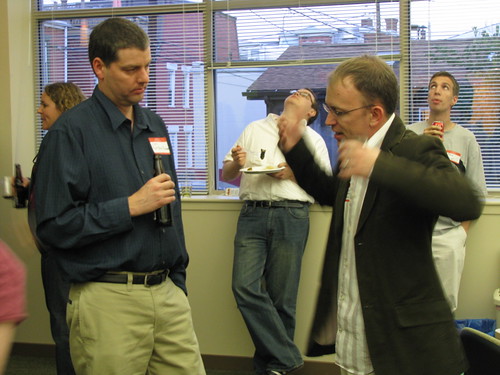
IMG_0257.JPG

I had a great time at yesterday's Open Coffee Club, where investors, entrepreneurs and wild cards (like myself) came together at AlphaLab for some quality face time. The catch? Although I met 3 or 4 new and interesting people, I spent most of the event talking to folks I already know.

Why do we do this?

Why do so many of us attend "face to face" events and then spend the bulk of the event talking to the same people we knew yesterday? Isn't the entire point of a social event to meet people you wouldn't otherwise have the opportunity to talk with?

And yet, when faced with the prospect of cold-contacting a complete stranger -- even at an event where everyone allegedly has multiple overlapping interests and is ostensibly there PRECISELY to make new contacts -- most of us who don't already have an elevator pitch burning up our tongues opt for the woobie of familiarity.

I think the reason why is 3-fold:

* The known payoff from talking with a friend is preferable to the unknown outcome of talking with a complete stranger. Especially at an event where you're not sure what everyone's area of expertise is, and you're afraid you won't be able to extricate yourself from a conversation with someone who offers no direct value (in your opinion).

* We have no idea what our true value is. So instead of trying to explain why we think we're valid to a complete stranger (who, we presume, is automatically judging us and comparing our net conversational worth against that of everyone else in the room), we'd rather talk with people whom we already know appreciate us in some capacity.

* We have no game plan. Sure, the concept of being surrounded by "interesting people" is alluring, but once we're in the situation, we immediately presume that everyone else who's there has a much more specific agenda. If WE don't, we wouldn't want to waste anyone's time (or our own), so we aim for the low-hanging fruit of familiarity instead.

All of this usually results in small clumps of conversations among people who obviously already know each other OR, in a variant, people of a similar age / gender / dress code, who gravitate together because they imagine that they must have something in common. And if you've come to such an event alone and aren't wearing a popularized "uniform," you're probably floating along the fringes, eating the free food and conspicuously pretending to check your text messages, so no one knows you're privately terrified of making contact.

If so, here are 5 tips for breaking up the monotony at your next "live" event:

* Pre-set one goal. Maybe you want to meet one prospective collaborator. Or bounce a vague idea off 5 people. Or collect 20 business cards. As long as you have a concrete goal, you can focus on accomplishing that first, and then any chatting among your friends won't feel so guilty.

* Talk to the loner. Immediately beeline for the nearest person who appears to be floating adrift and engage them directly. As you've probably noticed, small groups tend to be where the loners will eventually wash up anyway, so you might as well cut out the middleman and form your own small group right from the get-go.

* Bring people together. Chris Brogan is the master at this, usually because he's swamped with conversations and needs an elegant escape clause. Following his method, start by engaging someone you DON'T know. Find out their story, in a nutshell. Then rope in your nearest friend by asking the new person, "Have you met my friend [NAME] yet?" and physically deposit them in a conversation. This allows you to then step away without leaving the new person alone, which is probably how you found them.

* Make a scene. This is where talking with your friends actually comes in handy. Once a pack of you are talking about something, get contentious / absurd / offensive / funny, and raise your voices. Move around. Draw attention to yourselves. Because nothing attracts a crowd like a crowd -- especially one where a wallflower can expect to linger and observe without being drawn into the fray because the fray seems self-contained. But here's the catch: once you've attracted some spectators, then draw them directly into the spectacle. Ask them a question, use them as an accomplice in a recreation -- whatever it takes to incidentally break the ice and help them feel like they're now a part of the fray. (Because they are.)

* Refuse to leave until you're out of business cards. This means you're forcing yourself to meet new people until there are none left. It also means you probably want to arrive with fewer than 500 cards in your pocket, or you'll be making friends with the caterers and janitors, too. (Which, depending on your pre-set goals, may not be such a bad idea after all...)

NOTE: Dropping the cards in a stack near the coffee cups doesn't qualify as dispensing them. Man up, people.

This image of Woycheck trying unsuccessfully to frighten Jim Russell into fleeing was taken at a previous AlphaLab event by Michael Fulk.

Labels: , , , , , , , , , ,

Friday, November 14, 2008

How Bad Typography Can Help You Solve Problems

Typography Friday

Last night, I attended my first Refresh Pittsburgh meet-up, held at the local tech startup incubator, AlphaLab. Refresh Pittsburgh is an informal group of designers and programmers, looking both to network and to learn from one another (and their occasional guest speakers). Although I'm not a designer, per se, I *am* a creative type (or so I like to claim), so I enjoy hearing how other creative types solve their problems.

Yesterday's guest speaker was Samantha Warren of Viget, a design firm in Washington DC. (She also blogs here. She gave a kick-ass presentation on bad typography, and how (and why) it can kill your web experience. And then she showed how she would have redesigned one horrible site in particular, taking us step-by-step through both her technical AND her theoretical processes.

What I appreciated most was seeing her decision-making process, and learning HOW and WHY she arrived at the conclusions she did. Sometimes, she realized her initial presumptions or goals were incorrect midway through her process, so she backtracked to redesign her end product. Fellow speakers and presenters of the world, take note: knowing that a speaker can admit to being wrong, and then seeing the steps she took to fix things, made me trust her (and her process) even more.

In the end, the two lessons that stuck in my head most clearly were:

* (Samantha's intentional lesson): Don't let the details (like typography, design or even functionality) drive the project; let the PURPOSE drive the project, and the details will fall into place.

* (Samantha's unintentional lesson): When presenting, always make sure to include the URLs of any interesting sites / services you might mention. If you catch the audience's attention, they'll want to know how to learn more.

Other cool tips and tidbits you may know (but I didn't):

* Ms. Warren considers the 3 pillars of web typography to be: Legibility, Hierarchy and Expression.

* A gent named Jakob Nielsen developed a design concept called the F-Pattern, which (counter-intuitively, if you ask me) seems to make sense.

* Ms. Warren suggests designers evaluate all information on a webpage in terms of order of importance, and then allocate the proper typographical weight and direction of attention as required.

* Use phark or siffr for image replacement -- which, as a non-designer, I can barely even understand, but I suspect some of you know what she's talking about (and it seemed important).

* Texture, texture, texture.

If any of this sounds interesting to you -- or if you suspect you would have learned more by actually attending the meet-up (rather than reading my shoddy secondhand journalism), perhaps I'll see you at the next Refresh Pittsburgh event?

Image by ErokCom.

Labels: , , , , , , , , , , , ,

Wednesday, October 29, 2008

Who Starts a Company During Economic Collapse?

Yesterday, I attended Demo Day for AlphaLab, a local tech startup incubator here in Pittsburgh (and a sponsor of PodCamp Pittsburgh 3). The six companies they're currently working with will be nudged out the door at the end of the year, so yesterday was their chance to spread their wings (and make their pitch) in front of a roomful of potential investors, advisers and other interested parties.

But will any of their ideas fly?

Web-Wide Ripples of Discontent

Earlier this week, Steve Woolf of Epic FU (formerly JetSetShow) announced that they'll be ending their relationship with (formerly-considered-to-be) rising web video production company Revision 3. Due to international economic calamity, among other factors, Revision 3 is dropping numerous shows from their lineup, including Epic FU and Gary Vee's Wine Library TV -- which is odd, considering they're some of the web's most successful niche shows.

Perhaps their production costs outweigh their current revenue potential, but the long-term implications of this decision seem to be: Revision 3 can't afford to keep incubating emerging web video hits long enough for them to take flight on their own.

So if a company that's supposedly trafficking in The Next Big Thing (aka the web video revolution) can't keep their flagship shows afloat, what does that mean for companies like AlphaLab, who are incubating similarly-positioned, service-driven companies whose business plans hinge upon Web 2.0 metrics?

Building Houses During a Forest Fire

Every new company is fighting an uphill battle during this economic downturn, not to launch or to grow, but merely to validate their own right to exist. New ideas and properties that might have had a few years to experiment and develop an audience won't have that same luxury from investors who will increasingly be looking exclusively for "sure things" -- and if there's one field that's anything but "sure," it's the entire social media spectrum.

Admittedly, the AlphaLab-supported companies I consider to have the most potential -- Chogger and GameHuddle -- seem sexy to me because they're social media-based, and that's the arena I work in. But just because I can see their potential, that doesn't mean investors -- or customers -- will. In fact, I'd go so far as to say that these companies may be the exact right idea at the exact wrong time: concepts that COULD be sticky and even useful, if only their business plans didn't rely on large numbers of niche users having the time to find them, use them and spread the word.

In this economy, time is even less abundant than capital.

So: how can emerging companies -- social media-based or otherwise -- insulate themselves from an uncertain economy? Or, do new companies need to stretch beyond existing patterns of business thought and seize upon new opportunities before those uncharted waters seem too hazardous for anyone to fund?

Labels: , , , , , , , , , , ,